
Target reported third-quarter revenue of $25.27 billion, falling 1.5% year-over-year and missing analyst expectations as comparable sales declined for the third consecutive quarter. The retailer’s holiday guidance projects continued contraction during peak shopping season, contrasting sharply with Walmart’s strong performance in identical market conditions.
Senior retail analyst at Nexdi examines how Target’s struggles expose the growing divide between value-focused retailers and those dependent on discretionary spending categories.
The performance gap between Target and Walmart reached 7.2 percentage points in comparable sales growth, demonstrating execution differences rather than market conditions alone. Both face identical macro headwinds, including tariffs, government shutdowns, and consumer uncertainty, yet Walmart gains share while Target loses customers.
The Sales Decline That Won’t Stop
Target’s revenue of $25.27 billion fell short of analyst expectations of $25.32 billion, with comparable sales declining 2.7% marking the third consecutive quarter of same-store sales contraction. Traffic dropped 2.2% while average transaction amounts fell 0.5%, indicating customers visit less frequently and spend less per trip. The double deterioration suggests fundamental positioning problems rather than temporary headwinds affecting all retailers equally.
Adjusted earnings per share came in at $1.78, beating expectations of $1.72 but down from $1.85 a year ago. The earnings beat occurred entirely through cost-cutting rather than revenue growth, with Target eliminating 1,800 corporate positions in October, representing 8% of the corporate workforce. Incoming CEO Michael Fiddelke faces the unenviable task of returning Target to growth while operating a leaner organization.
The Holiday Guidance Disaster
Target maintained expectations for “a low-single digit decline in sales” during the critical fourth quarter, essentially forecasting another quarter of contraction during peak shopping season. The company lowered its full-year adjusted earnings per share guidance to $7-$8, down from the prior range of $7-$9. The midpoint of $7.50 sits 15.3% below last year’s $8.86, demonstrating accelerating profit erosion.
Target’s guidance assumes the best-case scenario. If holiday spending weakens further or promotional intensity increases, the company could miss even reduced targets.
41% of builders reported cutting home prices in November, a post-COVID record signaling broader consumer caution. When homebuilders slash prices to move inventory, it indicates widespread spending hesitation that will impact holiday discretionary categories where Target remains heavily exposed.
The Walmart Comparison Problem
Walmart reported 4.5% comparable sales growth in the same quarter Target declined 2.7%, a 7.2 percentage point performance gap between the two largest traditional retailers. Both companies serve value-seeking customers, but Walmart’s grocery dominance provides essential purchase frequency that Target lacks. Food and beverage delivered comparable sales growth for Target, but couldn’t offset continued weakness across the broader discretionary portfolio.
Walmart raised its full-year sales outlook while Target lowered earnings guidance, revealing execution differences rather than market conditions alone. Both face identical tariff pressures, government shutdown impacts, and consumer uncertainty, yet outcomes diverge dramatically. Walmart’s e-commerce grew 25% compared to Target’s 2.4% digital comparable sales increase, showing the gap extends beyond physical stores into online channels where Target once held advantages.
The DEI Boycott Nobody Quantifies
Target rolled back diversity, equity, and inclusion programs in late January, joining Walmart and numerous other brands in scaling back corporate DEI initiatives. The company blamed boycotts for weaker May sales results, acknowledging that consumer activism impacted traffic. Yet Target hasn’t quantified ongoing boycott effects or provided clear evidence that the controversy has ended.
The boycott narrative gives Target a convenient external explanation for poor performance, but also reveals brand vulnerability. Companies with stronger value propositions weather boycotts without sustained sales damage. Target’s prolonged weakness suggests either the boycott cut deeper than acknowledged or it exposed existing problems the controversy intensified rather than caused, making attribution difficult but outcomes undeniable.
The Leadership Transition Complication
Fiddelke will become CEO on February 1, the same day Walmart’s John Furner assumes leadership of that company. The simultaneous transitions ensure investor focus on comparing execution under new management. Fiddelke served as Target’s CFO before becoming COO, bringing financial discipline but limited merchandising experience to address problems rooted in product assortment and store experience.
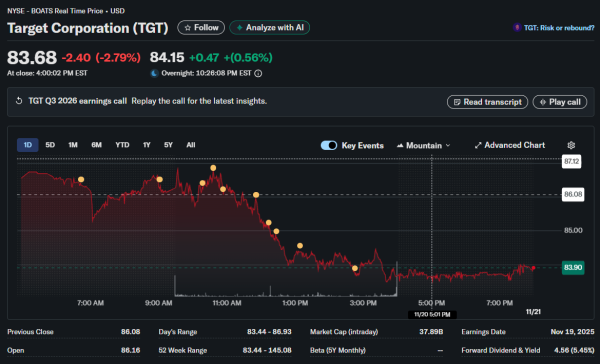
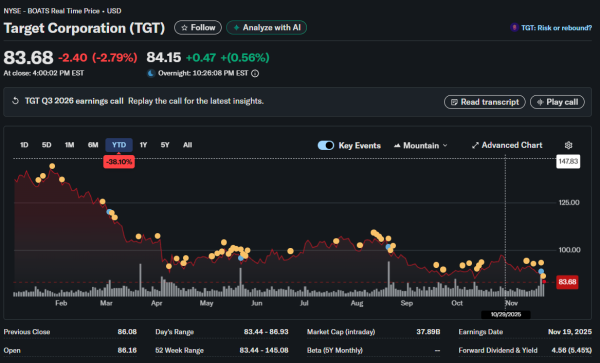
His three stated priorities are solidifying merchandise authority, elevating shopping experience, and harnessing technology for a faster pace. Those priorities implicitly acknowledge that Target lost its merchandise reputation, store experiences declined, and technology capabilities lag behind competitors. Target shares hit $268 in November 2021 and closed at $86.08 on Wednesday, a 67% decline reflecting lost confidence that new leadership must rebuild.
Facing the Turnaround Challenge
Target’s challenges extend beyond typical retail headwinds into fundamental brand positioning and customer perception. The company must simultaneously fix store conditions, improve merchandise appeal, accelerate digital capabilities, and restore pricing competitiveness, all while operating with fewer corporate resources following recent layoffs. Success requires flawless execution across multiple dimensions, where Target currently underperforms category leaders.
The contrast with Walmart’s strength suggests market share losses are permanent unless Target can differentiate on dimensions beyond price competition. The retailer built its reputation on style, design, and curated merchandise at accessible prices.
Reclaiming that positioning while competing on value against Walmart’s scale advantages represents the central strategic challenge Fiddelke inherits. Investors should watch comparable sales trends and market share data rather than earnings beats achieved through cost-cutting.