
Walmart and Target unveiled sharply contrasting third-quarter results, with Walmart beating expectations and raising guidance while Target missed revenue targets and lowered profit outlooks. The divergence between America’s two largest traditional retailers reveals more than execution differences; it exposes fundamental shifts in consumer behavior favoring value over discretionary categories.
Principal retail strategist at Nexdi examines how identical macro conditions produced opposite outcomes, with implications for understanding consumer spending patterns heading into 2026.
The performance gap between these retail giants reached historic proportions, with Walmart posting 4.5% comparable sales growth while Target suffered 2.7% declines, a 7.2 percentage point divergence that signals structural rather than cyclical factors.
Both companies face identical headwinds, including tariffs, government shutdowns, and economic uncertainty, yet Walmart gains market share while Target bleeds customers. The contrast provides the clearest evidence yet that retail success depends on positioning and execution rather than simply riding macro trends.
Walmart’s Winning Formula
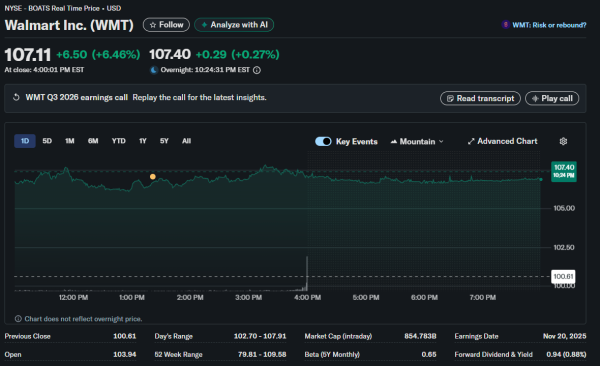
Walmart reported revenue of $179.5 billion, up 5.8% with adjusted earnings per share of $0.62, surpassing analyst estimates. The retail giant’s e-commerce business grew 25% in the U.S., driven by same-day delivery reaching 93% of households. Comparable store sales increased 4.5%, with strength across income levels as value-seeking behavior intensified among middle and upper-income shoppers trading down.
The company raised its full-year sales outlook to 4.8%-5.1% growth, up from prior expectations of 3.75%-4.75%, demonstrating confidence despite macro headwinds. Walmart’s third-party marketplace has become central to strategy, increasing profits faster than sales by collecting fees without inventory risk. The model mimics Amazon’s high-margin marketplace operations, supporting premium valuations as Walmart positions itself as a technology platform rather than a traditional retailer.
Target’s Troubling Trajectory
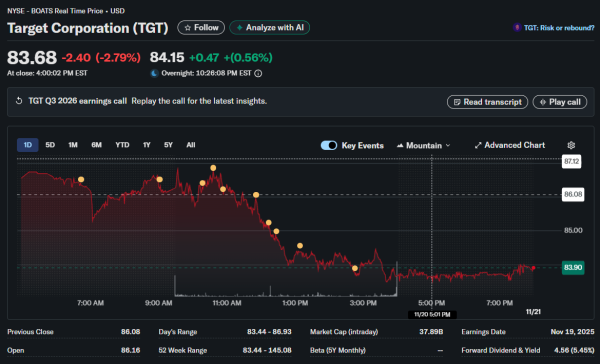
Target’s revenue of $25.27 billion fell 1.5% year-over-year, missing analyst expectations of $25.32 billion. Comparable sales declined 2.7%, marking the third consecutive quarter of contraction. Traffic dropped 2.2% while average transaction values fell 0.5%, indicating customers visit less frequently and spend less per trip, a double deterioration suggesting fundamental problems.
The company lowered full-year adjusted EPS guidance to $7-$8, down from $7-$9, with the midpoint sitting 15.3% below last year. Target maintained expectations for low-single-digit sales declines during the critical fourth quarter, forecasting continued contraction during peak shopping season. The holiday guidance particularly concerns investors, given traditional retail dependence on November-December performance for annual profitability.
The Consumer Spending Split
The diverging results reveal bifurcated consumer behavior, with spending concentrating in essential categories while discretionary purchases decline. Walmart’s grocery dominance provides essential purchase frequency, with food and beverage categories driving traffic even as shoppers cut back elsewhere. Target’s heavier exposure to discretionary categories like home goods and apparel creates vulnerability when consumers prioritize necessities.
Walmart noticed dips in same-day delivery during weeks when SNAP benefits were paused due to the government shutdown, revealing dependence on low-income households. Yet the company’s value proposition attracts customers across income levels, with middle and upper-income shoppers trading down during uncertain times. Target’s positioning as a slightly upscale alternative to Walmart becomes a liability when belt-tightening intensifies.
The Digital Divide Widens
Walmart’s 25% e-commerce growth dwarfed Target’s 2.4% digital comparable sales increase, demonstrating technology execution gaps. Walmart’s ChatGPT integration launching this week positions the retailer at the AI commerce intersection, while Target’s similar OpenAI announcement feels reactive rather than innovative. Amazon debuted its Rufus shopping assistant over a year ago, leaving both traditional retailers playing catch-up on conversational commerce.
The technology gap extends beyond AI into fundamental e-commerce capabilities. Walmart’s same-day delivery reaching 93% of U.S. households provides a competitive moat difficult for Target to overcome, given its smaller fulfillment network. Walmart’s marketplace business generates high-margin revenue streams, while Target’s marketplace remains underdeveloped compared to both Walmart and Amazon alternatives.
Leadership Transitions Add Complexity
Walmart’s Doug McMillon steps down on February 1, succeeded by U.S. business CEO John Furner, while Target’s Michael Fiddelke assumes the CEO role on the same day. The simultaneous transitions ensure investors focus on comparing new leadership execution.
Furner inherits momentum and strong positioning, needing primarily to maintain strategy. Fiddelke inherits turnaround requiring store experience fixes, merchandise authority restoration, and technology acceleration.
Target eliminated 1,800 corporate positions in October, representing 8% of the corporate workforce, forcing Fiddelke to execute a turnaround with fewer resources. His three priorities, solidifying merchandise authority, elevating shopping experience, and harnessing technology, implicitly acknowledge that Target lost competitive advantages that once differentiated it from Walmart on style, store experience, and product curation.
Looking Forward
The retail divergence will likely persist absent significant strategy shifts from struggling players. Consumer caution around discretionary spending favors essential categories where Walmart dominates.
Technology capabilities separate leaders from laggards as e-commerce, AI integration, and fulfillment speed become table stakes. Target’s turnaround requires flawless execution across multiple dimensions, store conditions, merchandise appeal, digital capabilities, and price competitiveness, while Walmart needs primarily to maintain momentum.
Target’s challenges reflect the broader retail reality that mid-market positioning without clear differentiation becomes vulnerable during economic uncertainty. Success requires either moving downmarket to compete on price or upmarket on experience and curation; the middle ground Target currently occupies offers the least defensible positioning.