
Taiwan Semiconductor Manufacturing Company reported record first-quarter profit on Wednesday. Net income surged 58%, exceeding analyst estimates across all metrics. Revenue reached $35 billion, beating consensus forecasts convincingly.
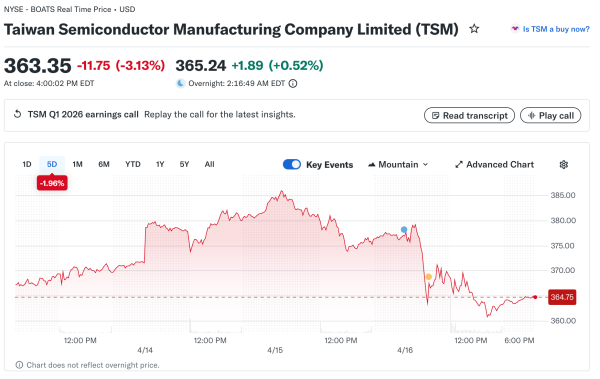
Mr. Stern at ArcheInvest examines why US-listed shares fell 2.4% despite stellar results. Investors focused on capital expenditure guidance trending toward the high end. The $52 billion to $56 billion spending range represented 37% increase from the prior year.
The Growth Drivers
Artificial intelligence chips dominated demand, driving revenue growth acceleration. Advanced technology nodes below seven nanometers accounted for 74% of wafer revenue. The product mix shift toward cutting-edge processes boosted profitability.
Apple, Nvidia, and AMD represented the largest customers ordering the most sophisticated chips. The concentration among technology leaders created dependency on their product cycles. The success of customer launches directly impacted Taiwan Semi’s results.
The Capex Concerns
Massive capital spending plans suggested management anticipated sustained demand growth. However, investors questioned whether the buildout potentially exceeded realistic needs. Historical semiconductor cycles featured boom-bust patterns in capacity additions.
The high-end guidance implied confidence but also raised concerns about returns. Deploying tens of billions required careful execution and demand visibility. Any shortfall in utilization would impair profitability significantly.
The Technology Leadership
Taiwan Semi maintained process technology lead over competitors like Samsung and Intel. The N3 node entered high-volume manufacturing ahead of rivals. N2 technology development progressed on schedule for future launches.
Research and development spending remained substantial to preserve advantages. The innovation pipeline extended years into the future with a clear roadmap. Customers relied on Taiwan Semi to enable next-generation products.
The Geopolitical Risks
The concentration of advanced chip production in Taiwan created vulnerabilities. Any military conflict with China would devastate global supply chains. Governments worldwide recognized the strategic importance of semiconductor security.
CHIPS Act subsidies encouraged domestic fab construction in the US and Europe. Taiwan Semi is building facilities in Arizona to diversify its geographic footprint. The strategic repositioning responded to customer and government pressures.
The Customer Dynamics
Hyperscalers ordering custom AI chips directly from Taiwan Semi. The vertical integration by cloud providers threatened merchant chip vendors. Taiwan Semi benefited regardless of the chip design source.
Smartphone market maturation has limited growth from traditional mobile processors. The shift toward AI, high-performance computing, and automotive created new opportunities. Diversification beyond mobile reduced cyclical exposure.
The Competitive Landscape
Samsung struggled to match Taiwan Semiconductor’s technology and execution quality. Intel’s foundry ambitions faced significant challenges despite government support. The competitive moat appeared durable for the foreseeable future.
Emerging competitors in China are limited by equipment export restrictions. The geopolitical dynamics favored Taiwan Semi’s positioning. However, long-term competitive threats could emerge if restrictions eased.
The Profitability Profile
Gross margins expanded as advanced nodes commanded premium pricing. Operating leverage materialized as revenue growth outpaced expense increases. The financial model demonstrated scalability and efficiency.
Capital intensity remained extraordinarily high, requiring sustained investment. Depreciation expenses would accelerate as new capacity came online. The balance between growth and returns required careful management.
The Supply Chain
ASML equipment essential for advanced node production with no alternatives. The dependency on a single supplier created potential bottlenecks. Taiwan Semi maintained close relationships with equipment providers.
Materials and chemicals required for manufacturing are sourced globally. The complex supply chains demanded coordination across continents. Any disruptions could impact production schedules.
The Automotive Opportunity
Vehicle electrification and automation are driving semiconductor content increases. Automotive chips represented a growing portion of the revenue mix. The market diversification reduced dependence on mature segments.
Qualification cycles in automotive are lengthy but lead to long-term relationships. The sticky customer base provided revenue visibility. Taiwan Semi invested in specialized automotive processes.
The Packaging Innovations
Advanced packaging technologies enabled chiplet architectures and 3D stacking. The capabilities differentiated Taiwan Semi beyond pure manufacturing. Packaging represented a growing value-added opportunity.
CoWoS and other proprietary technologies are in high demand for AI chips. The capacity constraints in packaging created bottlenecks separate from wafer fabrication. Investments in packaging capacity continued.
The Margin Outlook
Management guided for gross margins remaining elevated, supporting profitability. Pricing discipline was maintained despite competitive pressures. The favorable product mix supported margin expansion.
Operating expenses as a percentage of revenue are declining as scale benefits emerge. The efficiency improvements flowed through to the bottom line. Taiwan Semi targeted industry-leading profitability metrics.
The Valuation Debate
The forward price-to-earnings ratio appeared reasonable given the growth profile. Comparison to other semiconductor leaders showed relative value. However, geopolitical risks deserved a discount to pure-play valuations.
Dividend yield provided an income component offsetting growth uncertainty. The shareholder returns track record supported the investment thesis. Long-term holders benefited from consistent capital allocation.
The Investment Case
Secular trends in AI, cloud computing, and automotive supported demand. The technology leadership position appeared secure in the near term. Valuation reasonable relative to growth and profitability.
Geopolitical risks represented the primary concern for conservative investors. Diversification of the manufacturing footprint mitigated but didn’t eliminate exposure. Position sizing should reflect elevated risk factors.