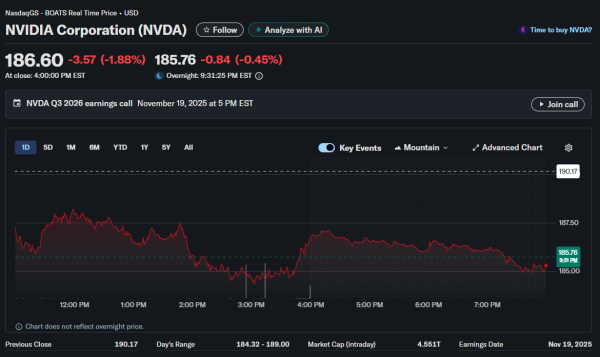
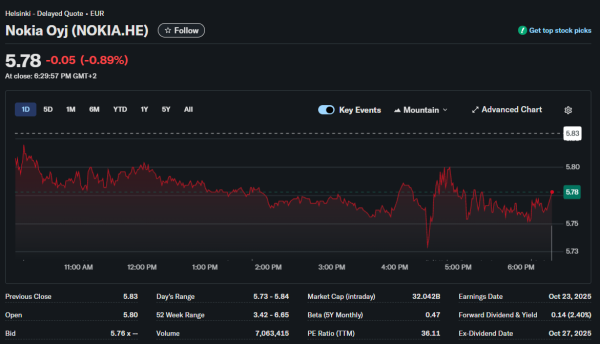
Nvidia revealed plans for a $1 billion equity stake in Nokia to speed up creation of AI-enhanced 5G and 6G mobile networks. The transaction delivers Nvidia a 2.9% ownership position in the Finnish telecom equipment manufacturer. Nokia stock jumped over 20% after the disclosure.
A financial analyst at LFTrade investigates what this strategic collaboration signals for wireless telecommunications’ future.
Collaborative Framework Emerges
Both enterprises will work closely on building AI-integrated wireless infrastructure for carriers worldwide. Nokia plans to embed Nvidia’s processors and computing systems into its radio access network equipment. This allows mobile operators to deploy AI-boosted 5G-Advanced and 6G networks using Nvidia’s technology foundation.
T-Mobile US entered the alliance and will launch AI radio technology trials beginning next year. The partnership targets the rapidly expanding AI-RAN sector, which research firm Omdia estimates could reach $200 billion total by 2030. This constitutes a major prospect within the larger radio access network industry.
Nvidia will simultaneously investigate utilizing Nokia’s data center innovations in its own AI infrastructure roadmap. The companies described this as launching the AI-native wireless age. It establishes groundwork for supporting AI-driven consumer applications and business services at network perimeters.
Transaction Details Explained
Nokia will create roughly 166 million fresh shares for Nvidia at a purchase price of $6.01 per share. The complete equity infusion to Nokia totals approximately $1 billion. Nokia intends to apply proceeds toward advancing its strategic objectives surrounding trusted connectivity for the AI growth cycle plus other standard business needs.
The investment requires meeting certain standard completion requirements typical for deals of this type. Nokia’s board voted to authorize the targeted share creation facilitating Nvidia’s stake. The agreement marks Nokia’s biggest strategic partnership reveal in recent years.
The purchase price sits above Nokia’s recent trading range before the announcement. This indicates Nvidia perceives substantial strategic merit in the collaboration beyond simply the financial component. The transaction framework aligns both firms’ motivations in the AI telecommunications sector long-term.
Technology Fusion Strategy
Nvidia will launch its Aerial RAN Computer Pro system, a 6G-capable accelerated computing platform merging connectivity, processing, and detection functions. This permits telecom carriers to advance from 5G-Advanced to 6G through software updates instead of demanding total hardware overhauls.
Nokia will broaden its worldwide product lineup with fresh AI-RAN offerings built on Nvidia platforms. The blueprint design is accessible for producers and network gear suppliers to construct commercial solutions. This facilitates both fresh network construction and enhancements to current cell sites.
Dell Technologies will supply PowerEdge servers to drive the novel AI-RAN system. The collaboration signifies what sector watchers term a pivotal moment for telecommunications. It advances AI-RAN from the experimental phase to worldwide commercial deployment.
Growth Potential Evaluated
The AI radio access network sector constitutes a tremendous expansion prospect for both organizations. Past the $200 billion forecast through 2030, the innovation unlocks completely novel services and uses. Mobile carriers can boost network capability and productivity while enriching customer interactions.
Upcoming generative AI and autonomous AI programs will necessitate this upgraded foundation. The systems will energize billions of fresh links for self-driving cars, robotics, aerial drones, and mixed reality gadgets. These uses require connectivity, processing, and detection at the perimeter concurrently.
Nvidia chief executive Jensen Huang characterized this as enabling America to reclaim worldwide supremacy in telecommunications infrastructure. The alliance tackles both the AI-RAN market prospect and strategic national priorities in next-generation wireless innovation.
Nokia’s Position Validated
Nokia’s fresh chief executive Justin Hotard, who formerly directed Intel’s data centers and AI division, has concentrated on growing the firm’s data center operations since arriving in April. The Nvidia collaboration confirms this strategic course and supplies capital to quicken implementation.
The organization has been preparing for the shift toward AI-native systems. Nokia currently employs chips from multiple vendors for its equipment. The Nvidia alliance delivers access to more potent AI-tuned processors despite potentially elevated expenses.
Nokia and competitor Ericsson both produce gear for linkages within data centers and across data centers. They’ve been gaining from increased AI adoption spurring data center growth. The Nvidia agreement fortifies Nokia’s competitive standing in this swiftly expanding sector.
Financial Effects
For Nvidia, the $1 billion commitment constitutes a fairly modest financial obligation given its $5 trillion market worth. Nevertheless, the strategic merit reaches well past the monetary figure. It stations Nvidia at the nucleus of the AI wireless networking shift.
For Nokia, the capital boost delivers financial adaptability to fund product creation and market growth. The endorsement from Nvidia also bolsters Nokia’s standing with clients and allies. Nokia’s stock rise contributed billions to its market worth, reflecting investor excitement for the collaboration.
The agreement framework guarantees both corporations maintain matched motivations for achievement. Nvidia’s equity holding means it immediately profits from Nokia’s expansion. Nokia obtains access to Nvidia’s technology and ecosystem links.
Extended Outlook
The collaboration signifies a meaningful advance toward AI-native telecommunications foundation globally. It confirms the merging of computing and networking at the infrastructure tier. The $200 billion market prospect by 2030 could prove cautious if embrace accelerates.
For investors, the agreement strengthens Nvidia’s standing as the indispensable AI infrastructure supplier across sectors. It also implies Nokia has successfully repositioned itself for the AI-propelled networking future. The collaboration’s triumph or setback will meaningfully affect both firms’ competitive standings in approaching years.