
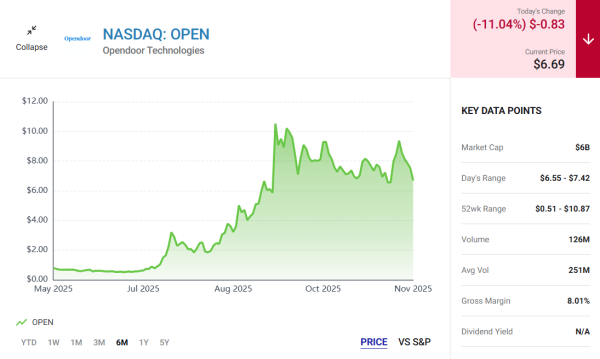
Opendoor Technologies (OPEN) has captured investor attention with a dramatic surge in stock price following the appointment of CEO Kaz Nejatian, who has promised to turn the company profitable using artificial intelligence (AI) and software-driven strategies.
Brokers from Aurudium analyze whether this high-risk, high-reward stock is worth considering for aggressive investors, or if it remains a speculative play with significant downside potential. With Opendoor attempting to scale house flipping at a national level, the company faces both exciting opportunities and formidable risks that make careful monitoring essential.
Opendoor’s Business Model
Opendoor operates in the residential real estate market, buying homes from sellers, renovating them, and reselling at a higher price, a model known as house flipping. While house flipping is a familiar practice for small-scale investors, scaling it to a national, publicly traded company has proven difficult. Since its SPAC merger, Opendoor has consistently reported losses, at times sinking its stock into penny stock territory.
The company’s financial struggles attracted activist investors and ultimately led to the installation of a new CEO. OpenDoor’s CEO, Kaz Nejatian’s AI-focused strategy has generated enthusiasm, pushing the stock higher even before operational improvements are evident. This speculative momentum has drawn comparisons to meme stocks, where investor optimism rather than fundamentals drives valuation.
Recent Stock Surge and Market Sentiment
Opendoor’s stock rocketed after the CEO change, fueled by excitement over a proposed transformation into a software and AI-driven company. While this has energized investors, brokers caution that the stock price already reflects expectations for improvements that have yet to materialize.
Historically, meme-like investor behavior can lead to volatility and sharp declines if the business fails to deliver on promises, highlighting the speculative nature of Opendoor as an investment.
The CEO’s Roadmap
In its third-quarter 2025 earnings, Opendoor outlined a strategic plan to become profitable by the end of 2026, marking a significant pivot from a purely transactional real estate business to a software and AI-focused model. The plan emphasizes three main initiatives:
- Scaling acquisitions – Monitoring the number of homes Opendoor purchases will indicate how effectively the company is expanding its market presence.
- Improving unit economics and velocity – Tracking the number of homes that remain on the market for over 120 days can provide insights into efficiency and turnaround speed.
- Enhancing operational leverage – Examining operating expenses as a percentage of revenue helps investors assess whether the company can manage growth cost-effectively.
These benchmarks give investors concrete data points to track the company’s progress, but each comes with inherent risk. Expanding acquisitions too quickly could backfire if homes fail to sell promptly, potentially amplifying financial losses..
Risk Considerations
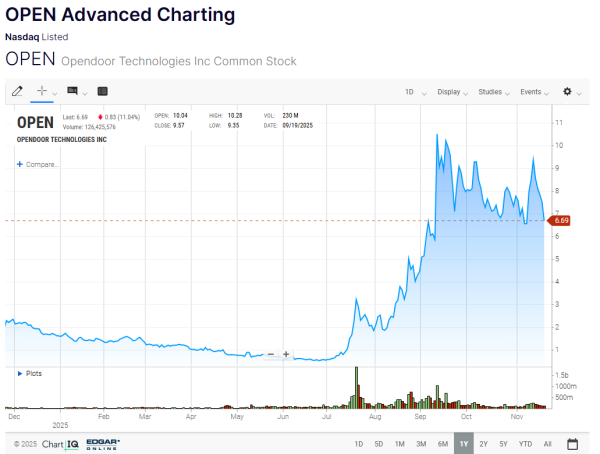
Investing in Opendoor carries significant risk. First, the recent stock surge prices in anticipated improvements that have not yet occurred.
Second, the operational risk of scaling house flipping nationwide remains high, as delays or missteps in the property market could significantly affect financial results. The company’s reliance on AI for profitability is still untested at scale, adding another layer of uncertainty.
Market sentiment also plays a critical role. Much of Opendoor’s current valuation is influenced by investor optimism and speculative enthusiasm, particularly from retail investors following headlines and CEO announcements. This makes the stock vulnerable to sudden swings, similar to other highly speculative or meme-driven stocks.
Who Should Consider Opendoor
Opendoor is not suitable for most investors, particularly those with low risk tolerance or a preference for stable, dividend-paying companies. However, for aggressive investors willing to closely monitor performance metrics and market conditions, the stock offers a high-risk, high-reward opportunity. If the company successfully executes its AI and software-driven strategy, there could be substantial upside potential, offering investors the possibility of significant gains.
Investors should focus on the benchmarks set by management, including acquisition volume, turnover velocity, and operational leverage, to gauge progress. Waiting for measurable results before committing large amounts of capital can help mitigate the inherent risk in a speculative stock like Opendoor.
Conclusion
Opendoor represents a high-risk investment with potential for outsized returns, contingent on the company successfully executing a complex business transformation. While the stock’s recent surge has captured headlines, many experts remind investors that the future success of the company is far from guaranteed, and that much of the upside is already priced in. Monitoring the company’s operational performance and progress toward profitability through 2026 is critical for anyone considering an investment.
In summary, Opendoor could be a transformative opportunity for risk-tolerant investors, but it remains speculative, with significant financial and operational risks. Those intrigued by the stock should track its strategic benchmarks closely, while others may prefer to wait for tangible evidence of sustainable growth before entering the market.