
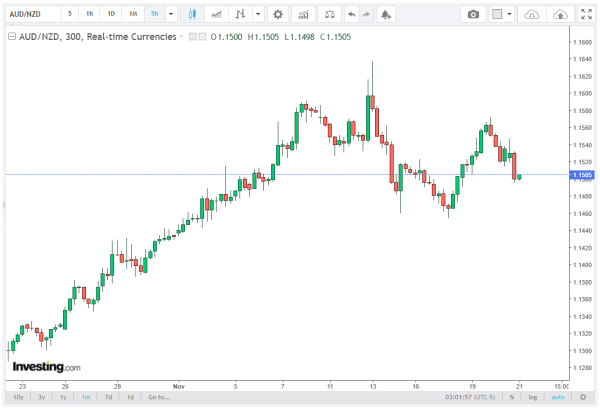
The AUD/NZD currency pair has seen a moderate depreciation, trading around 1.1520 during Asian hours on Friday, marking its second consecutive session of losses. This movement comes amid mixed economic signals from Australia and New Zealand, reflecting shifting central bank expectations, trade data, and underlying market sentiment. This article by Arbitics offers expert commentary and a full explanation of the subject.
The pair’s near-term dynamics are being influenced by a combination of resilient Australian economic indicators, a narrowing New Zealand trade deficit, and the growing expectation of a Reserve Bank of New Zealand (RBNZ) rate cut, all of which are shaping trader positioning and FX volatility.
New Zealand Trade Deficit Narrows in October
New Zealand’s Trade Balance for October indicated a narrowing of the trade deficit, falling to NZD 2.28 billion YoY from NZD 2.39 billion in the previous year. This improvement reflects a stronger export performance, which increased 16% to NZD 6.5 billion, while imports rose 11% to NZD 8.0 billion.
The data suggests that New Zealand’s external sector is showing signs of resilience, supported by robust commodity prices and steady demand from key trading partners, particularly Australia, China, and the US. Despite this positive development, the New Zealand Dollar (NZD) may struggle to sustain gains, as market participants focus on the central bank’s monetary policy outlook.
After a surprise 50 bps cut last month, the RBNZ is widely expected to reduce the Official Cash Rate (OCR) by 25 bps to 2.25% during its November monetary policy meeting. This anticipated easing is already reflected in forward rate markets, putting downward pressure on the NZD and limiting the upside potential of AUD/NZD in the short term.
Australian PMI Data Provides Support for AUD
In contrast, the Australian Dollar (AUD) is benefiting from solid domestic economic indicators, particularly in the manufacturing and services sectors. Preliminary S&P Global Australia Manufacturing PMI rose to 51.6 in November, up from 49.7, signaling expansion in manufacturing activity.
Meanwhile, Services PMI increased to 52.7 in November, up from 52.5, and the Composite PMI, which combines manufacturing and services activity, climbed to 52.6, up from 52.1. These strong PMI readings suggest resilient economic growth in Australia, highlighting steady demand, business activity, and optimism among firms.
The data provides a bullish backdrop for the AUD, reinforcing positive sentiment in the FX market, particularly against the NZD, which faces headwinds from monetary easing expectations. Traders are increasingly factoring in the potential divergence in central bank policies, which could drive short-term AUD/NZD fluctuations.
Central Bank Outlooks: RBNZ Rate Cut vs RBA Stability
A key driver of AUD/NZD movements is the diverging monetary policy outlooks of the RBNZ and the Reserve Bank of Australia (RBA).
The RBNZ appears inclined toward a more accommodative policy, following its recent 50 bps OCR cut and ongoing concerns over inflation and economic growth. Analysts widely expect a further 25 bps cut next week, which could weigh on NZD sentiment. Such expectations are already contributing to short-term volatility in the AUD/NZD cross, as traders reassess risk positioning and hedging strategies.
Conversely, the RBA maintains a cautious and data-dependent approach. Minutes from the RBA’s November meeting suggest that the central bank may maintain rates at current levels if economic conditions continue to outperform expectations. This stable policy outlook, combined with strong manufacturing and services PMIs, provides a supportive environment for the AUD, enhancing its appeal in the cross against NZD.
Technical Analysis of AUD/NZD
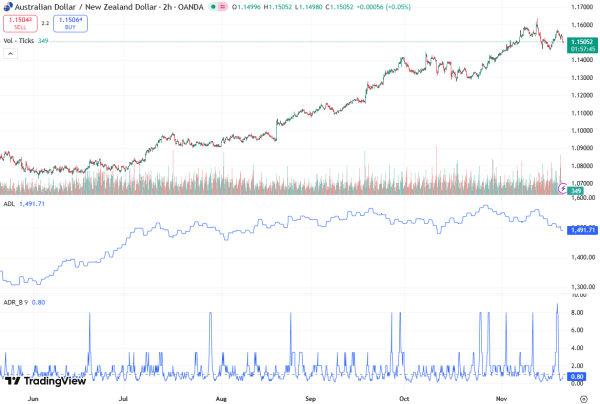
From a technical perspective, AUD/NZD has fallen below the 1.1550 level, testing near-term support around 1.1500. The pair’s recent depreciation is a reflection of a market balancing act between robust Australian economic data and improving New Zealand trade figures.
Short-term bearish momentum could continue if RBNZ rate cut expectations strengthen, yet any signs of moderation from the RBNZ or stronger-than-expected Australian data may provide supportive buying opportunities for the AUD.
Market participants should pay close attention to breakouts or rejections at these levels, as they may indicate the next directional bias for the pair.
Conclusion
In conclusion, the AUD/NZD pair is operating in a complex macroeconomic environment influenced by central bank expectations, trade dynamics, and domestic economic performance. While the narrowing New Zealand trade deficit offers temporary support for NZD, the expected RBNZ rate cut may limit gains, contributing to near-term depreciation.
Meanwhile, the AUD benefits from strong PMI data and the potential stability of the RBA, providing a supportive momentum for the currency against the NZD. Traders should closely monitor the RBNZ OCR decision, Australian PMI revisions, and commodity trends, as these factors will likely define AUD/NZD movements in the weeks ahead.