
Alderstone-Holdings consumer technology specialist Dr. Dan Wood analyzes how Apple’s reported foldable iPhone setbacks compounded broader market anxiety on a day when geopolitical fears dominated headlines.
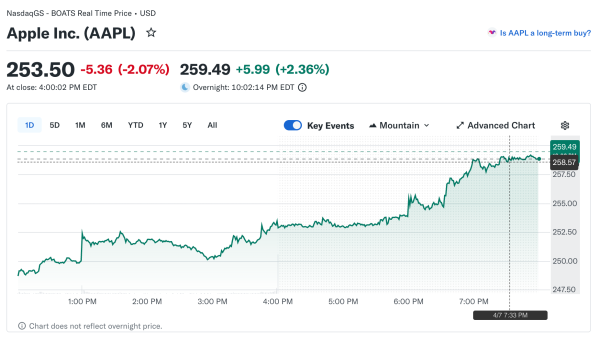
Apple shares tumbled on April 7 as reports emerged that the company faces significant engineering challenges with its first foldable iPhone, threatening the planned September 2026 launch. The timing could not have been worse, with markets already reeling from the 8 PM ET deadline for Iran to reopen the Strait of Hormuz.
The Nikkei broke the story, citing sources familiar with the testing phase who described “setbacks” severe enough to potentially delay the device indefinitely. Apple fell 3.67% in early trading, making it the Dow Jones Industrial Average’s worst performer and contributing to the blue-chip index’s 266-point intraday decline.
The Seven-Year Gap
Samsung and other Android manufacturers have sold foldable smartphones since 2019, giving them a seven-year head start on Apple. That represents an eternity in consumer electronics, where product cycles typically span 12 to 18 months.
Apple’s delayed entry stems from a perfectionist design philosophy. The company refuses to launch products until they meet Apple-standard user experience requirements. But perfectionism becomes a liability when competitors establish market positions and customer expectations.
The foldable segment remains relatively small, comprising roughly 5% of premium smartphone sales. But it represents the primary innovation vector in a market otherwise dominated by incremental camera and processor improvements. Missing this cycle could cost Apple credibility as an innovation leader.
The Revenue Implications
iPhones generate over half of Apple’s $143.8 billion quarterly revenue. Any threat to the launch cycle creates significant headwinds for a company trading at premium valuation multiples based on growth expectations.
The September 2026 timing matters enormously because it coincides with Apple’s traditional flagship iPhone launch window. Delaying the foldable model doesn’t just postpone that product’s revenue. It risks cannibalizing standard iPhone 18 sales if customers wait to see whether the foldable eventually ships.
Analysts had projected the foldable iPhone capturing 10% to 15% of total iPhone unit sales in its first year, assuming successful execution. Those estimates now face downward revision if the device misses its window or launches with compromised specifications.
The Design Challenges
Foldable smartphones require solving multiple engineering problems simultaneously. The hinge mechanism must withstand hundreds of thousands of open-close cycles without degradation. The display technology needs to fold without creasing or breaking. The battery placement becomes constrained by the folding form factor.
Samsung addressed these issues through multiple product generations. The company’s first foldable devices suffered screen durability problems and hinge failures. Subsequent versions refined the technology, but even current models show visible creases after extended use.
Apple engineers apparently remain unsatisfied with current solutions. The company’s reputation depends on products working flawlessly from day one rather than improving through iteration, as Android manufacturers tolerate.
The Memory Shortage Connection
Beyond foldable-specific issues, Apple faces the broader global memory chip shortage affecting the entire smartphone industry. DRAM and NAND supply constraints drive component costs higher, forcing manufacturers to either accept compressed margins or raise prices.
Price increases risk demand destruction in an already weak global smartphone market. Worldwide unit sales declined 8% in the first quarter of 2026 as consumers delayed upgrades amid economic uncertainty and rising prices.
Apple historically maintains pricing power better than Android rivals due to brand strength and ecosystem lock-in. But even Apple faces limits on how much premium customers will pay, especially for experimental form factors like foldables.
The Geopolitical Timing
Apple’s engineering troubles emerged on the worst possible day from a market psychology perspective. Traders already faced the Iran deadline, creating oil price spikes to $115 per barrel and recession fears.
Adding Apple-specific concerns to geopolitical uncertainty created selling pressure that overwhelmed any fundamental analysis. The stock became a vehicle for expressing general risk-off sentiment rather than trading on company-specific fundamentals.
The $3.67% decline exceeded moves in most other mega-cap technology names. Microsoft, Alphabet, and Amazon posted smaller losses, suggesting Apple bore disproportionate selling despite the entire sector facing similar macro headwinds.
The Bloomberg Correction
Later in the session, Bloomberg reported that the launch remains on track for September despite the engineering challenges. That report contradicted the earlier Nikkei story, creating confusion about the actual status.
Apple declined to comment officially, following its standard practice of not discussing unreleased products. The information vacuum allowed speculation to fill the void, with analysts offering conflicting assessments based on incomplete information.
 The Innovation Imperative
 The Innovation Imperative
Apple’s challenges with foldables highlight broader questions about the company’s innovation pipeline. The Vision Pro launched to a mixed reception. Apple Car development reportedly stalled. Now foldable iPhones face setbacks.
Investors question whether Apple can maintain its premium valuation without breakthrough products. Services revenue growth provides stability but lacks the excitement that drives multiple expansion.
The stock’s premium valuation assumes Apple continues delivering products that redefine categories. Execution problems undermine that narrative and force reassessment of what premium the market should pay.