

As investors increasingly seek resilience in a shifting economic landscape, attention turns toward companies that don’t just weather volatility but evolve through it. With technology reshaping entire industries and fiscal policies redefining market direction, some stocks stand out for their consistent performance and forward-looking strategies.
One such contender is T-Mobile US, Inc. (NASDAQ: TMUS)–a company quietly building a reputation for long-term growth potential. In an era where data rules and connectivity are king, T-Mobile is finding its footing not only in consumer markets but also in investment circles.
QuilCapital‘s financial strategist, Don Adler, dives deep into the evolving market landscape and examines whether T-Mobile could be a long-term winner for the next 15 years.
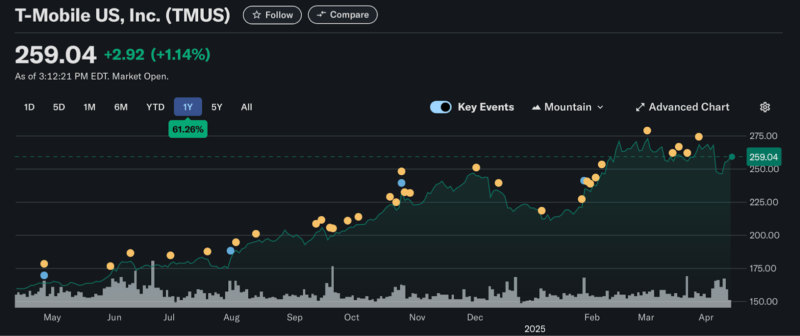
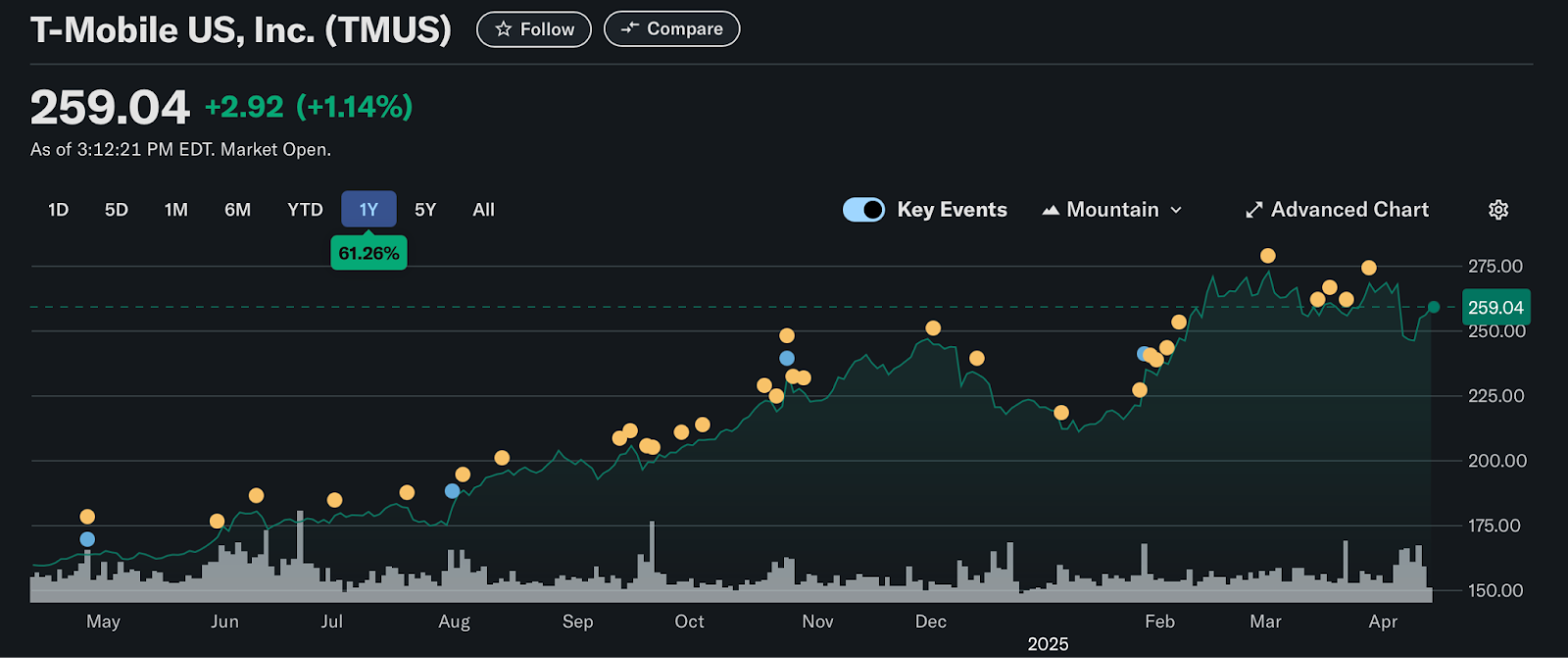 image from finance.yahoo.com
Market Landscape: What’s Shaping the Long Game?
According to insights from Russell Investments, the market outlook for 2025 and beyond hinges on three key dynamics:
- An elevated S&P 500 forward P/E ratio, suggests high valuations in certain areas.
- Continued strength in the U.S. dollar, can have implications on global competitiveness and export-driven revenues.
- The movement of the U.S. 10-year Treasury yield influences everything from borrowing costs to investor appetite for risk.
This macro backdrop, coupled with a severe market concentration in mega-cap stocks, has posed challenges for active managers. However, shifts in investor sentiment or fiscal policy could dilute the dominance of a few tech giants, opening up room for other growth companies–like T-Mobile–to rise in relevance.
AI and Sectoral Shifts: Where Opportunity Lies
Russell Investments sees strong investment prospects in sectors rapidly adopting artificial intelligence, particularly industrials, healthcare, and consumer goods. AI, when implemented strategically, offers the potential for productivity gains and operational efficiency, creating lasting competitive advantages.
This trend isn’t confined to Silicon Valley. Increasingly, under-the-radar companies that embed AI into real-world operations are catching the attention of seasoned investors. Savvy portfolio managers are now hunting for growth in less-covered corners of the market, where innovation is quietly compounding value.
 image from finance.yahoo.com
Real Assets and Infrastructure: Resilience in Concrete
Beyond stocks, there’s a growing appetite for real assets–notably in real estate and infrastructure. Russell Investments believes these sectors will benefit from:
- Stabilizing long-term interest rates, making financing more predictable.
- Valuations that appear more attractive than certain overstretched equity segments.
- The rising utility of AI in real estate, such as data centers and smart healthcare facilities.
Infrastructure, especially related to energy utilities and LNG (liquified natural gas) pipelines, is also on the radar. These areas are being buoyed by the U.S. administration’s focus on energy expansion, including increasing LNG exports–a trend that T-Mobile’s fiber and connectivity infrastructure might indirectly benefit from through digital infrastructure synergies.
T-Mobile’s Trajectory: Consistent Growth and Smart Moves
At the company level, T-Mobile US, Inc. has delivered an impressive ~10.6% revenue growth over the past decade–a figure that puts it in rare company when assessing long-term equity potential. More notably, the stock is currently held by 70 elite hedge funds, highlighting its appeal among institutional investors.
T-Mobile has continued to impress with its aggressive investment in 5G infrastructure, positioning itself ahead of the competition. Its early lead in 5G coverage and performance has translated into subscriber growth, especially in the high-value postpaid phone market.
This network advantage is now being translated into further growth avenues. Most recently, T-Mobile partnered with EQT in a joint venture to acquire Lumos, a fiber-to-the-home internet provider. With a 7,500-mile fiber network and existing access to 475,000 homes, Lumos represents a powerful platform to scale T-Mobile’s home internet services.
Through this JV, T-Mobile aims to expand its network to 3.5 million homes by the end of 2028. To support this, it has committed an initial $950 million investment, with an additional $500 million planned between 2027 and 2028.
This move complements T-Mobile’s wireless strengths, allowing it to integrate mobile and home connectivity–a synergy increasingly vital in an interconnected digital economy.
Strategic Alignment with Future Policies
The current economic climate favors companies that can adapt to policy moderation and regulatory shifts. Russell Investments notes that markets could respond positively to early initiatives around deregulation and tax adjustments, particularly if such moves stimulate corporate activity and consumer spending.
A projected U.S. “soft landing”–a gradual slowdown without triggering recession–could offer further support for equities. In such a setting, well-positioned firms like T-Mobile, with a stable growth history and bold infrastructure bets, may be set to benefit disproportionately.
Conclusion
In a market increasingly characterized by sharp cycles and concentrated bets, T-Mobile offers something refreshingly different: quiet consistency and strategic foresight. Its investment in 5G and fiber networks isn’t just about connectivity–it’s about owning the future of infrastructure-driven growth.
Coupled with favorable policy tailwinds, a growing presence in underserved internet markets, and continued trust from hedge funds, the case for T-Mobile as a long-haul investment becomes hard to ignore. While the spotlight often falls on the biggest names in tech, it may be the quietly performing companies like T-Mobile that deliver the most value over the next 15 years.

COMTEX_465097982/2922/2025-05-01T03:12:39
This press release was originally published on this site