
Alderstone-Holdings semiconductor industry analyst John Baker examines how Intel’s inclusion in an ambitious AI chip complex provided a rare bright spot during a trading session dominated by geopolitical crisis.
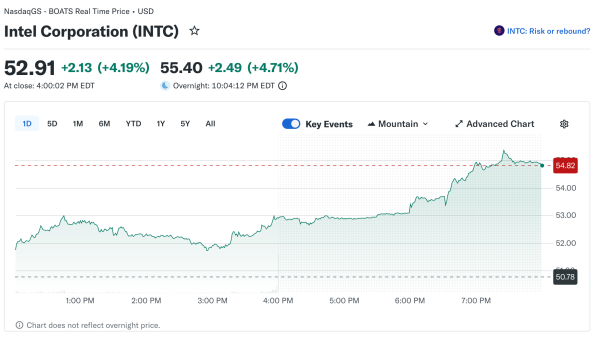
Intel rallied 4.19% to $52.91 on April 7, defying broader market weakness as news emerged that the chipmaker will participate in the Terafab AI chip complex. The collaboration represents strategic validation for a company that spent years losing market share to rivals and watching its stock languish while competitors soared.
Trading volume reached 124.8 million shares, coming in nearly 16% above its three-month average of 107.5 million shares. The surge indicated genuine institutional interest rather than retail speculation, suggesting investors view the partnership as potentially transformative.
The Terafab Vision
The xAI announced plans to build what it calls the world’s largest AI training facility, requiring massive quantities of specialized chips. The Terafab complex aims to house computing power exceeding current hyperscaler data centers by orders of magnitude.
Intel’s inclusion alongside other chip manufacturers signals that the project’s scale exceeds any single supplier’s capacity. But it also validates Intel’s manufacturing capabilities after years of questions about whether the company could execute on advanced process nodes.
The partnership likely involves custom chip designs optimized for xAI’s specific training workloads. This follows Intel’s strategy shift toward foundry services, manufacturing chips designed by customers rather than only selling Intel-designed processors.
The $14.2 Billion Fab Buyback
Intel also announced plans to repurchase a 49% stake in its Irish Fab 34 plant from Apollo Global Management for $14.2 billion. The move consolidates ownership of critical manufacturing assets as the company positions for AI chip production.
Fab 34 produces advanced processors using Intel’s latest manufacturing technology. Regaining full control provides flexibility to allocate capacity toward the highest-margin products without coordinating with outside investors.
The $14.2 billion price tag reflects confidence in manufacturing as a strategic asset. Many semiconductor companies outsource production to TSMC or other foundries. Intel doubles down on in-house capabilities even as that strategy costs billions in capital expenditures.
The Competitive Context
Intel’s 4.19% rally contrasted sharply with minimal gains for Nvidia at 0.26% and AMD at 0.61%. The divergence suggests investors view Intel’s partnership as a differentiating catalyst rather than benefiting all chip makers equally.
NVIDIA maintains overwhelming dominance in AI training chips with 80%+ market share. But xAI reportedly seeks supply diversification to avoid dependence on any single vendor. Intel benefits from this strategic shift even if its chips don’t match Nvidia’s raw performance.
AMD also competes for the AI chip business through its Instinct line of accelerators. The company makes progress but lacks Intel’s manufacturing scale and its relationship that could tip large volume orders in Intel’s favor.
The 16,154% Since IPO
Intel IPO’d in 1971, making it one of the original Silicon Valley success stories. The stock has gained 16,154% since going public, though most of those returns occurred in earlier decades before recent competitive struggles.
The company’s 52-week range from approximately $40 to $68 demonstrates significant volatility. The $52.91 closing price sits roughly mid-range, suggesting room for upside if execution improves but also reflecting skepticism about turnaround prospects.
Market capitalization of around $220 billion makes Intel smaller than AMD at roughly $350 billion despite Intel’s larger revenue base. This valuation gap reflects growth expectations favoring AMD’s trajectory over Intel’s restructuring efforts.
The Geopolitical Shield
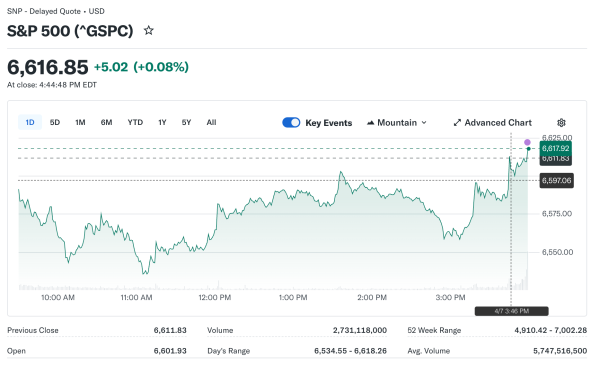
Intel’s strength on April 7 demonstrated how specific company catalysts can override macro fears. While the S&P 500 struggled with the Iran deadline, Intel traders focused on the partnership and Fab 34 buyback.
Oil prices near $115 per barrel typically pressure semiconductor stocks due to recession concerns and manufacturing cost increases. Intel’s rally through that headwind indicates genuine enthusiasm about business developments.
The xAI Relationship
The xAI brings both opportunity and risk to any partnership. His companies often make bold technical bets that either revolutionize industries or fail spectacularly. Intel’s participation in Terafab represents a calculated gamble on the vision.
If xAI successfully builds the world’s largest AI training facility and Intel chips power significant portions, the revenue potential stretches into tens of billions over the project’s lifetime. That scale would meaningfully impact Intel’s financial trajectory.
But the track record includes missed timelines and overpromised specifications. The Terafab project could face delays, budget overruns, or technical obstacles that reduce Intel’s ultimate participation.
The Path Forward
Intel’s 4.19% rally demonstrates how concrete business wins can drive stock performance even during macro chaos. The Terafab partnership and Fab 34 buyback provide tangible evidence of strategy execution.
Sustaining momentum requires following through on manufacturing commitments and winning additional foundry customers beyond xAI. The relationship opens doors, but Intel must deliver competitive chips on time and within budget.
The Iran crisis will eventually be resolved one way or another. Intel’s competitive positioning in AI manufacturing and government-supported domestic production remains relevant regardless of geopolitical outcomes.