
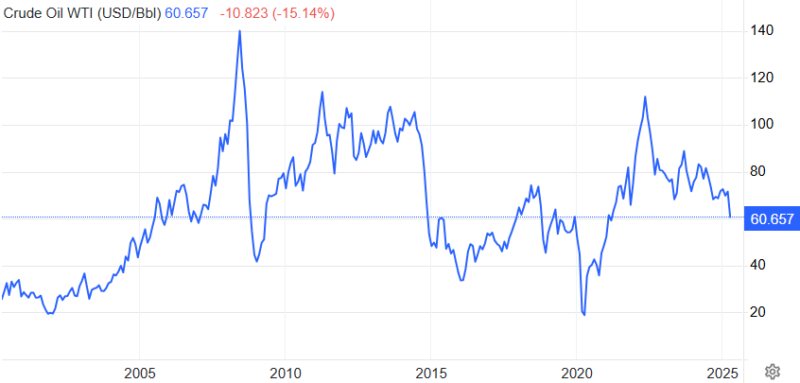

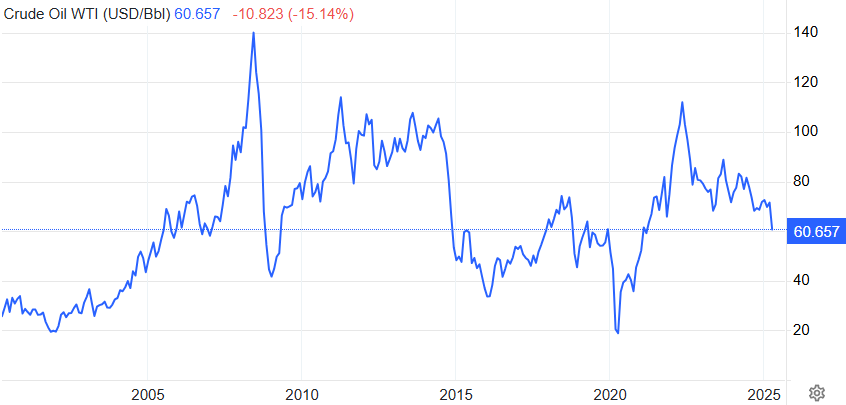
West Texas Intermediate (WTI) crude oil extended its losing streak on Friday, dipping below $59.50 and settling near $59.30 per barrel during Asian trading hours. This marks the second consecutive session of declines, driven by the resurgence of US-China trade tensions and a looming OPEC+ supply increase that has investors on edge over a possible market glut. Raliplen brings forward a detailed examination of this matter in the article.
Tariff Escalation Clouds Global Demand Outlook
The primary catalyst for the decline came from Washington’s aggressive tariff policy aimed at China. On Thursday, the United States hiked tariffs on Chinese imports to an effective rate of 145%, introducing an additional 125% levy on top of the existing 20% duty.
While the US President simultaneously announced a 90-day suspension of tariff hikes for most other trading partners, the disproportionate targeting of China, the world’s largest oil importer, has significantly rattled demand expectations.
A prolonged US-China trade dispute threatens to undercut global trade volumes, fragment international supply chains, and stifle economic growth in both countries. Since the US and China are the top two energy consumers globally, any sustained disruption in their economic activity could considerably curb crude oil consumption.
Markets are already pricing in the potential for reduced industrial output and transportation activity, both key contributors to oil demand. The Energy Information Administration (EIA) echoed these concerns in its latest forecast, cutting global oil demand projections and warning that trade policy uncertainty could exert prolonged downward pressure on energy markets.
EIA Downgrades Oil Demand and Price Outlook
In response to the deteriorating macroeconomic outlook, the EIA slashed its global oil demand growth forecast for the year to 900,000 barrels per day (bpd), down from 1.2 million bpd previously. The agency now anticipates global oil demand to reach 103.6 million bpd by year-end, reflecting slower-than-expected consumption across key markets, particularly in Asia.
Looking further ahead, the 2026 forecast has also been trimmed, with projected demand growth now sitting at 1 million bpd, below earlier estimates. This downgrade comes amid growing apprehension that aggressive trade policies, coupled with weaker-than-expected economic recovery in emerging markets, could suppress oil use for a longer duration than initially expected.
Simultaneously, the EIA revised its oil price forecast downward for both 2025 and 2026, citing not only weakening demand but also growing supply-side risks that could tilt the market toward surplus.
OPEC+ Production Boost Intensifies Oversupply Fears
Adding to the bearish sentiment, the OPEC+ coalition, which includes key producers like Russia and Saudi Arabia, confirmed plans to increase output by 411,000 bpd in May. This decision, while intended to support recovering global economies, has instead raised alarms over a potential oversupply scenario, especially in the context of subdued demand forecasts.
The proposed increase comes as OPEC+ faces internal pressure from several member states seeking to capitalize on short-term price stability. However, the move appears to be poorly timed, given current market conditions. Traders and analysts fear that this additional supply could overwhelm a fragile demand landscape, sending prices even lower in the coming weeks.
The market reaction was swift, with WTI futures seeing accelerated selling following the OPEC+ announcement. Market participants are increasingly skeptical that demand can absorb this influx without triggering inventory buildups.
Geopolitical and Supply Risks Add to Volatility
Further complicating the picture, the US administration announced new sanctions targeting Iranian oil infrastructure, including a China-based storage facility. These sanctions, aimed at curbing Tehran’s oil revenues ahead of upcoming US-Iran negotiations, have added another layer of geopolitical risk to an already volatile market.
Meanwhile, in North America, the Keystone pipeline remains offline following a significant spill in North Dakota. The pipeline, a crucial artery for crude oil transport from Canada to the US Midwest and Gulf Coast, has no set timeline for reopening.
While the shutdown temporarily tightens regional supply, it has failed to offer sustained upward momentum to WTI prices given broader macro concerns.

Conclusion: A Fragile Market Under Pressure
The fall in WTI below $59.50 reflects a confluence of bearish forces weighing on global oil markets. Escalating US-China trade tensions have renewed fears of a prolonged slowdown in global economic activity, directly undermining oil demand forecasts.
Meanwhile, the OPEC+ decision to ramp up production has exacerbated concerns about an emerging supply glut, especially with demand growth being revised downward by authoritative agencies like the EIA.
Short-term price action may continue to reflect high volatility as markets digest the dual impact of geopolitical developments and shifting production policies. Unless there is a marked improvement in trade relations or a pause in OPEC+ supply hikes, WTI could remain under pressure, testing new lows as sentiment deteriorates.

COMTEX_465096849/2922/2025-05-01T02:19:01
This press release was originally published on this site