


For years, businesses pursued media coverage primarily for exposure. A feature in a respected publication generated referral traffic, introduced a company to new audiences, and added credibility to marketing materials. Public relations and search engine optimization often operate as separate disciplines with different objectives.
That separation is becoming increasingly difficult to maintain.
As AI-powered search continues to evolve, the internet is shifting from a collection of individual webpages to a connected network of information. Modern AI systems don’t simply evaluate what a company publishes on its own website. They can also draw upon publicly available information from news organizations, industry publications, interviews, research, and other independent sources to gain a deeper understanding of a business and the expertise it demonstrates.
This doesn’t mean every media mention directly influences AI recommendations. No public documentation from Google, OpenAI, Anthropic, or Microsoft makes that claim. However, it does highlight an important reality: businesses that are consistently recognized across reputable publications tend to create a broader digital footprint than those that exist almost exclusively on their own websites.
That broader footprint contributes to something increasingly valuable in AI-powered search—context.
Your Website Tells One Story. The Internet Tells Another.
Every business has complete control over the content published on its own website. Service pages describe capabilities, blog articles explain industry topics, and landing pages highlight products or solutions. While that information is important, it represents only one perspective: the company’s own.
Editorial placements introduce a second perspective.
When an independent publication chooses to feature your business, interview your leadership team, or publish educational content that references your expertise, it creates an additional layer of credibility that self-published content cannot provide. Readers instinctively recognize the difference between what a company says about itself and what respected publications choose to say about that company.
This distinction becomes even more meaningful when viewed through the lens of AI-powered search.
Imagine two organizations offering similar services.
The first has an excellent website containing dozens of educational articles but very little recognition outside its own domain. The second publishes equally strong educational content while also appearing in industry publications, contributing expert commentary, participating in interviews, and earning mentions from trusted media outlets.
Neither organization is guaranteed greater visibility within AI-powered search experiences. However, the second business has created considerably more evidence that its expertise has been recognized independently. Those external signals help reinforce a reputation that extends beyond the company’s own marketing materials.
This idea aligns closely with what we discussed in Why Some Businesses Get Recommended by AI While Others Don’t. Recommendations are rarely built from a single webpage. They emerge from a broader collection of signals that collectively demonstrate expertise, trust, and credibility.
Editorial Recognition Strengthens the Trust Layer
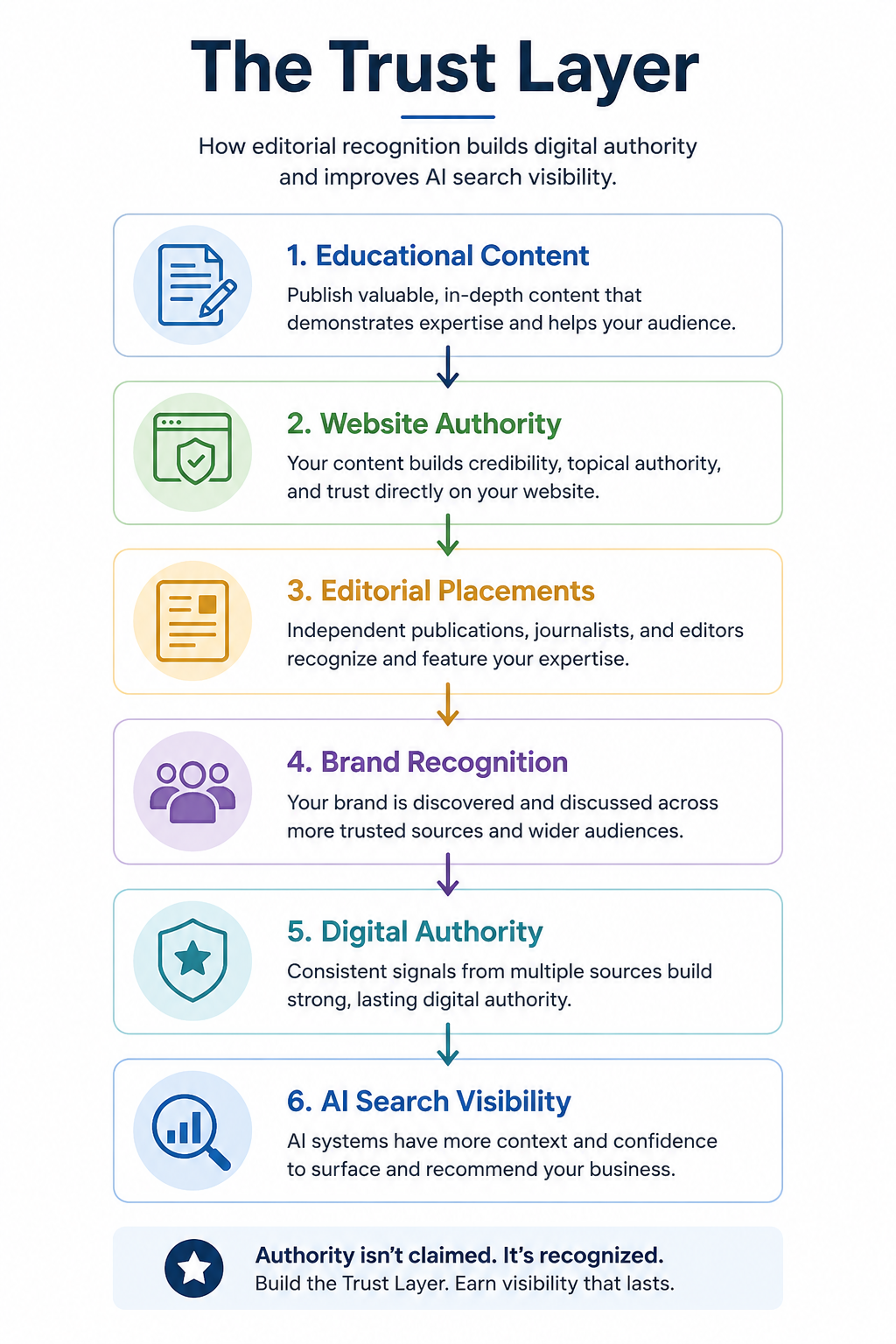
One concept we believe businesses should begin thinking about is what we call the Trust Layer.
Every organization has a digital presence, but not every organization develops independent validation.
A business publishes educational content.
That content demonstrates expertise.
Independent publications recognize that expertise.
Readers discover the business through multiple trusted sources.
The organization’s reputation expands beyond its own website.
Over time, those layers of recognition create a richer digital identity than self-published content alone could establish.
This doesn’t replace strong website content or technical SEO. It complements both.
In fact, businesses should think of digital authority as a collection of interconnected assets rather than isolated marketing tactics. High-quality educational content creates opportunities for editorial recognition. Editorial recognition reinforces authority. Stronger authority supports greater visibility, stronger brand recognition, and additional opportunities to contribute expertise across an industry.
That continuous cycle reflects the Authority Flywheel introduced in our article Why Topical Authority Is Becoming the Most Valuable Asset in AI Search. Educational content creates opportunities for recognition, recognition strengthens authority, and stronger authority creates additional opportunities to contribute valuable insights.
Editorial Placements Are Different From Guest Posts
This distinction deserves clarification because the two are often discussed interchangeably.
Guest posts are typically contributed directly by the author and published with the primary objective of reaching another audience or earning a backlink. Editorial placements, by comparison, are generally selected because an editor or publication believes the information is valuable for its readership. While sponsored and contributed editorial opportunities certainly exist, the defining characteristic of an editorial placement is that it becomes part of a publication’s broader editorial environment rather than simply existing as another external contribution.
That difference matters because editorial environments often carry their own established audiences, reputations, and subject matter expertise.
We explored these differences in greater detail in Editorial Placements vs Guest Posts, where we discuss how each approach contributes to a broader digital authority strategy.
One of the most significant changes AI-powered search has introduced is that authority is becoming increasingly distributed. Businesses can no longer rely on a single high-performing webpage or an isolated marketing campaign to establish credibility. Instead, trust is built through the accumulation of evidence gathered across many different sources over time.
Consider how people evaluate an unfamiliar company before making an important decision. They rarely stop after reading a homepage. Instead, they search for reviews, explore industry publications, compare educational resources, read interviews, and look for independent confirmation that the business is respected within its field. Confidence grows because multiple sources reinforce the same message.
AI-powered search appears to benefit from this same type of consistency. While the underlying systems differ, they all attempt to organize information in ways that help users identify reliable answers. A business that demonstrates expertise only on its own website presents one perspective. A business whose expertise is reflected across industry publications, educational resources, interviews, and other trusted sources creates a far richer body of publicly available information.
That broader context is becoming one of the defining characteristics of digital authority.
Visibility Should Be Measured Differently
For years, businesses judged the success of their digital marketing by a relatively small group of metrics: keyword rankings, organic traffic, backlinks, and conversion rates. Those measurements remain valuable, but they don’t fully capture how a business is represented across today’s digital landscape.
A more meaningful question is this:
If someone spent thirty minutes researching your company online, what story would they find?
Would they discover thoughtful educational articles that demonstrate expertise?
Would they find interviews, editorial coverage, or contributions to respected industry publications?
Would they encounter consistent messaging regardless of where they looked?
Or would nearly every result point back to your own website?
That question encourages businesses to think beyond rankings and begin evaluating the overall strength of their digital reputation.
One of the best ways to establish that baseline is through an AI Website Authority Audit, which evaluates not only technical elements but also broader authority signals that contribute to long-term visibility.
Editorial Placements Work Best Alongside Strong Content
Editorial recognition is not a substitute for educational content.
Likewise, educational content should not be viewed as a replacement for editorial recognition.
The strongest digital authority strategies combine both.
Businesses first develop expertise through comprehensive educational resources that answer meaningful questions within their industry. Those resources establish a foundation of knowledge that readers—and increasingly AI-powered systems—can associate with the organization. From there, editorial placements expand the reach of that expertise by introducing it to new audiences through trusted publications.
This relationship is one of the reasons topical authority has become such an important concept. Organizations that consistently publish interconnected educational content create a stronger foundation for external recognition because journalists, editors, podcast hosts, and industry publications have more evidence of expertise to reference.
We explored this relationship in Why Topical Authority Is Becoming the Most Valuable Asset in AI Search, where we discuss why businesses should think beyond isolated blog posts and instead build comprehensive knowledge centers around their areas of expertise.
The Businesses That Earn Trust Rarely Chase It
One pattern continues to emerge across industries.
Organizations recognized as authorities rarely become respected because they actively pursued authority itself.
Instead, they focused on consistently contributing valuable ideas, educating their audiences, sharing original perspectives, and participating meaningfully within their industries. Recognition followed because others found those contributions useful.
The same principle applies to editorial placements.
Businesses shouldn’t view media coverage as a shortcut to credibility. They should view it as another opportunity to share expertise with a broader audience while strengthening the body of evidence that demonstrates what the organization knows.
Over time, that evidence becomes difficult to replicate.
Competitors can imitate products.
They can redesign websites.
They can adopt similar marketing strategies.
Reputation, however, develops gradually through repeated demonstrations of expertise. It reflects years of educational content, editorial recognition, industry participation, and thoughtful contributions that collectively shape how a business is perceived.
The Bigger Opportunity
As AI-powered search continues evolving, businesses will inevitably encounter new tactics, new acronyms, and new theories about how visibility is earned. Some will prove useful. Others will disappear as quickly as they emerge.
The organizations most likely to succeed won’t be those chasing every new tactic.
They’ll be the businesses investing in assets that remain valuable regardless of how search changes.
Educational content.
Topical authority.
Editorial recognition.
Digital reputation.
These are not independent marketing activities. Together, they form a connected ecosystem that helps businesses establish credibility with both people and technology.
Perhaps the most important shift businesses can make is to stop asking, “How do we get AI to notice us?”
Instead, ask:
“If someone wanted to understand our industry, have we created enough evidence that our business deserves to be part of that conversation?”
That’s a question that extends far beyond AI search.
And it’s one that will remain relevant no matter how search evolves in the years ahead.


