


As artificial intelligence continues to reshape the digital landscape, the giants of Big Tech are caught in a balancing act–navigating evolving competition, regulatory scrutiny, and shifting investor expectations. This week, Alphabet and Shopify found themselves at the center of attention, but for very different reasons.
One is facing fears of disruption to its longstanding dominance in online search; the other is grappling with a surprise financial hit despite steady operational metrics. A financial strategist from Markets Yield explores the deeper implications of these market movements, untangling what they signal for investors and the broader tech sector.
Alphabet’s AI Challenge: Competition or Courtroom Strategy?
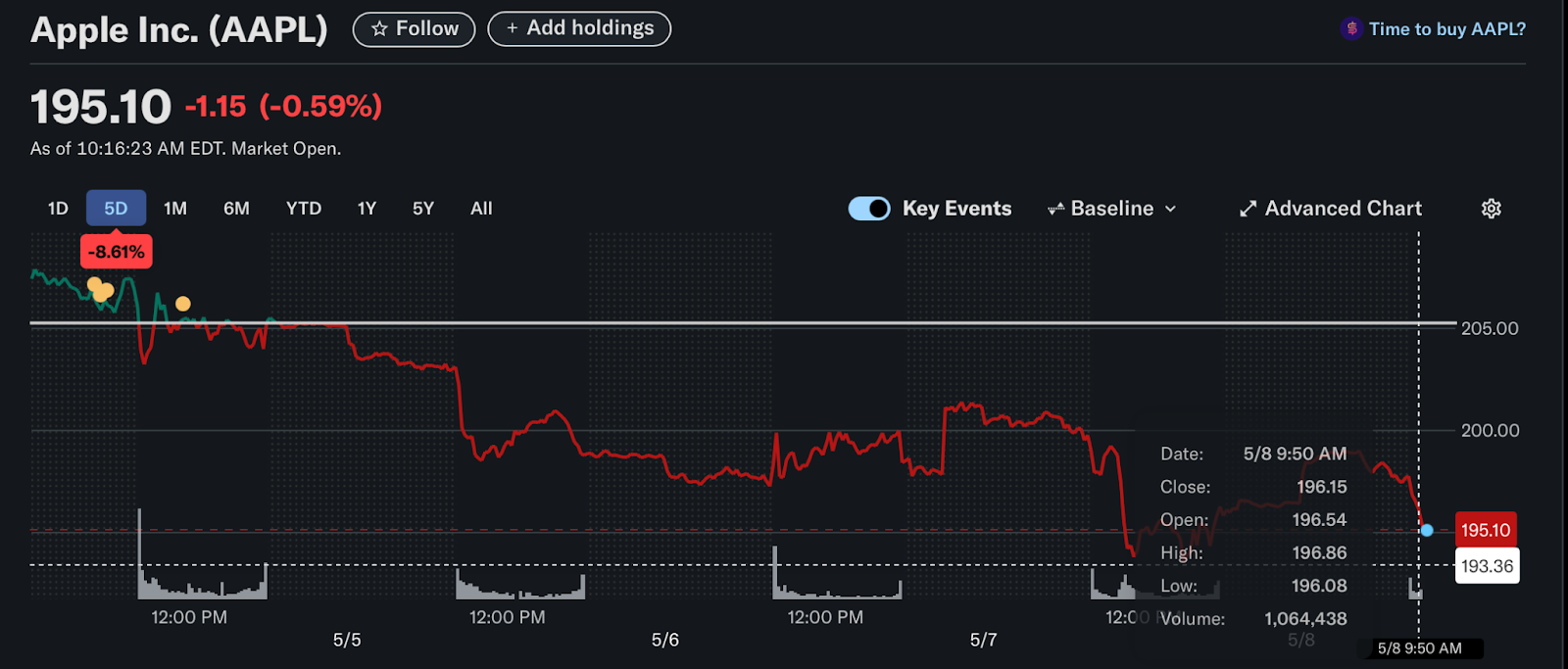
Alphabet’s stock rebounded by 1.4% on Thursday, clawing back some ground after a 7% decline on Wednesday. The initial sell-off followed a Bloomberg report suggesting Apple might integrate AI-powered search engines, such as Perplexity, into its Safari browser, which would challenge Google’s default status.
Currently, Google pays Apple $20 billion annually to remain the default search engine on Safari. This partnership not only reinforces Google’s search monopoly but also represents a critical pillar in its ad revenue ecosystem. However, recent courtroom testimony by Apple’s senior VP of services revealed that Safari-based Google searches declined for the first time, potentially due to users experimenting with new AI search options.
Apple’s indication that it is “actively looking at” alternatives was enough to rattle markets, prompting speculation that Google’s dominance could be eroding. Yet, several Wall Street analysts from Jefferies, TD Cowen, Citi, and JPMorgan defended Alphabet, maintaining bullish outlooks.
According to a Jefferies report, the market reaction may be “overdone.” The testimony, some analysts argue, could be more legal strategy than operational concern. By portraying the search space as increasingly competitive, Apple may be attempting to bolster Google’s legal defense against antitrust allegations.
JPMorgan’s analyst noted that Apple benefits from Google’s financial terms and may have no immediate incentive to drop the partnership. Instead, highlighting alternative search providers could reinforce the narrative that Google’s dominance is not unassailable, helping both companies navigate regulatory threats.
AI Integration Isn’t Killing Google–Yet
Amid investor worries that AI tools could cannibalize traditional search, Alphabet has been integrating AI across its platforms. Its AI Overviews feature, powered by Gemini, is already being used by 1.5 billion users in over 140 countries. According to TD Cowen, these AI-generated summaries currently produce comparable revenue to standard search ads, quelling fears that AI could eat into Alphabet’s core business.
That said, the long-term threat is tangible. AI models like OpenAI’s ChatGPT, Microsoft’s Copilot, and Apple’s own ChatGPT integration within Apple Intelligence are actively shifting how users access and process information. Google’s ability to retain users, especially on mobile, will likely determine the future trajectory of its search business.
Shopify: Revenue Beats, Investment Drag Bites

Meanwhile, Shopify is navigating a very different kind of disruption–financial volatility driven by equity losses. Shares of the e-commerce firm fell 5% Thursday morning, following a surprising net loss in Q1, despite revenue exceeding expectations.
The platform processed $74.75 billion in gross merchandise volume (GMV)–a healthy figure, but $150 million short of analyst forecasts. Revenue hit $2.36 billion, narrowly beating estimates, and adjusted EPS stood at $0.25, just shy of projections.
However, the real shocker was a net loss of $0.53 per share, largely attributed to a $900+ million markdown on equity investments. These equity-related losses, though non-operational, spooked investors, particularly in a market where profitability signals resilience amid broader tech volatility.
Despite the headline miss, Shopify projects Q2 revenue growth in the mid-20% range, with gross profit expected to grow in the high teens year-over-year. This forward guidance indicates that core business fundamentals remain strong, and the equity losses may be more of a short-term drag than a structural flaw.
Investor Sentiment: Fragile, Yet Forward-Looking
The reactions to both Alphabet and Shopify’s news highlight a recurring theme in the tech market: investor sentiment is increasingly reactive to innovation risk and financial optics, even when underlying business models remain intact.
For Alphabet, the mere suggestion of Apple exploring AI competitors was enough to wipe billions off its market cap–despite zero immediate operational changes. This suggests that market trust in Google’s search dominance is becoming more conditional, resting on its ability to outpace or absorb AI challengers.
Shopify, by contrast, is facing skepticism over its financial positioning, not its operational strength. The company’s core metrics–GMV and revenue–remain solid, yet equity market fluctuations outside its control managed to cast a shadow over its earnings report. It’s a reminder that in public markets, optics often override fundamentals in the short term.
Conclusion: The Double-Edged Sword of Innovation and Investment
As the tech sector continues to evolve, Alphabet and Shopify serve as case studies in different dimensions of market volatility. One is confronting existential questions about the future of search in an AI-driven world. The other is grappling with how external financial forces shape investor confidence, even when operational health is intact.
For Alphabet, the next few quarters will test whether AI is a complement or a competitor to its search empire. For Shopify, the challenge lies in maintaining financial resilience while scaling its ecosystem in a rapidly shifting e-commerce landscape.
In both cases, the lesson is clear: market leadership is no longer defined solely by performance, but by adaptability to disruption–both technological and financial.

COMTEX_465324323/2922/2025-05-08T23:47:45
This press release was originally published on this site