
Alderstone-Holdings energy markets strategist Michael Page dissects crude oil’s extraordinary journey from $115 to near-flat in a single session as diplomatic hope replaced doomsday scenarios.
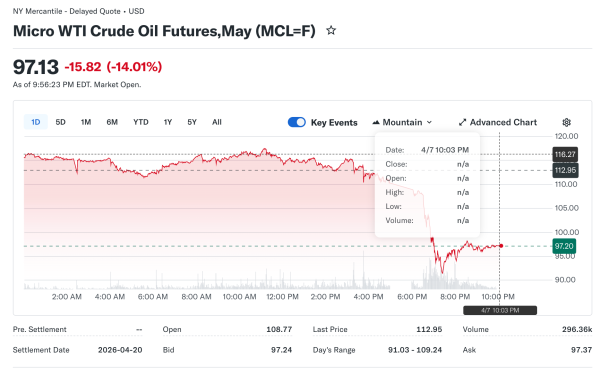
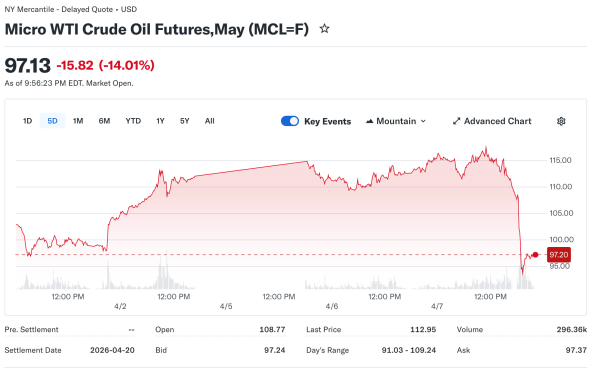
Crude oil prices delivered whiplash on April 7, briefly spiking above $115 per barrel before settling near flat as Pakistan’s ceasefire proposal transformed market psychology in the final trading hours. The intraday range exceeded $12, marking one of the most volatile sessions in energy markets since the 2020 pandemic crash.
West Texas Intermediate opened around $112 as traders positioned for an extended Strait of Hormuz closure following the US President’s threats to destroy Iranian infrastructure. By midday, futures touched $115.85 as the 8 PM ET deadline approached without visible progress toward diplomatic resolution.
The Energy Sector’s Year
Energy stocks rallied 34% year-to-date through April 7, making the sector the clear market leader. The gains accelerated 8% since the Iran conflict began, as investors positioned for sustained crude price elevation regardless of how the crisis is resolved.
Chevron gained 2.20% on April 7 despite broader market weakness. Exxon Mobil and Occidental Petroleum posted similar advances. The strength came even as crude prices whipsawed, suggesting investors focused on longer-term supply constraints rather than daily price fluctuations.
The SPDR Energy Select Sector ETF significantly outperformed the S&P 500, demonstrating how sector rotation favored energy over technology during a geopolitical crisis. Money managers seeking safety gravitated toward companies benefiting from higher oil prices rather than growth stocks vulnerable to recession.
The Strait of Hormuz Choke
Approximately 20% of the global oil supply flows through the Strait of Hormuz during normal operations. Iran’s closure of the waterway following U.S. military strikes created an immediate supply shock that rippled through energy markets.
The Strait’s geography makes it uniquely vulnerable. Just 21 miles wide at its narrowest point, the passage allows Iran to effectively blockade tanker traffic using relatively modest military capabilities. No alternative route exists for Persian Gulf oil exports without thousands of miles of additional travel.
The Pakistan Wildcard
Pakistani Prime Minister Shehbaz Sharif’s proposal for a two-week ceasefire reached markets around 4 PM ET, less than four hours before the deadline. The intervention caught most traders by surprise, as Pakistan’s role in mediating U.S.-Iran disputes isn’t a traditional geopolitical pattern.
The proposal requested Iran open the strait “as a goodwill gesture” during the two-week period while negotiations continue. This framing gave both sides a potential face-saving path to de-escalation without appearing to capitulate.
Oil prices immediately reversed course, plunging from $115 toward $110 within minutes of the news. The $5 drop in futures represented billions in paper losses for traders positioned for continued escalation.
The Demand Destruction Math
Economists widely agree that $115 oil sustained for quarters creates severe demand destruction and recession risk. Previous oil shocks at similar inflation-adjusted price levels triggered global economic slowdowns that ultimately crashed crude prices.
Consumer spending weakens as gasoline and heating costs consume larger portions of household budgets. Manufacturing activity slows as energy-intensive production becomes uneconomical. Transportation costs rise throughout supply chains, pressuring profit margins.
The 2008 oil spike to $147 per barrel preceded the financial crisis and economic collapse that sent crude plunging to $33 within months. While causation remains debated, the correlation between extreme oil prices and recessions is undeniable.
The Strategic Reserve Question
The U.S. Strategic Petroleum Reserve holds approximately 370 million barrels after releases in 2022-2023 to combat inflation. That inventory could offset straight closure for roughly 18 days at current consumption rates before running dry.
International Energy Agency members coordinate reserve releases during supply disruptions. Combined global strategic reserves total roughly 1.5 billion barrels, providing several months of cushion if deployed aggressively.
But reserve releases represent one-time interventions rather than sustainable supply solutions. Once depleted, reserves require years to rebuild at high cost. The political calculation balances immediate price relief against long-term strategic vulnerability.
The OPEC Response
OPEC spare capacity sits around 3 million barrels per day, mostly in Saudi Arabia. That additional production could offset much of the Strait closure’s impact if deployed immediately.
However, Saudi Arabia faces a complex political calculus. Increasing production to help the West contradicts recent production cuts designed to support prices. The kingdom also maintains delicate relationships with Iran, which flooding markets to undermine Iranian leverage would strain.
The Two-Week Clock
If Pakistan’s ceasefire proposal succeeds, markets gain two weeks to assess whether a permanent diplomatic solution emerges. But that also means another deadline approaches mid-April with no guarantee of resolution.
Crude futures for May and June delivery trade at premiums to spot prices, indicating expectations that current relief proves temporary. Traders position for renewed tensions after the ceasefire window closes without a comprehensive agreement.
The contango structure in crude futures reflects storage economics and time value, but the magnitude suggests geopolitical risk premium remains embedded despite the diplomatic progress.