
The GBP/USD exchange rate remained relatively subdued in recent sessions, hovering near 1.3510 as investors processed a mix of UK domestic economic data and global macro developments. Despite short-term indecision, the pair’s broader structure suggests a strengthening bullish bias, particularly as attention turns to the upcoming UK Consumer Price Index (CPI) release.
Market participants are navigating a complex landscape shaped by labor market resilience in the UK and evolving expectations surrounding US monetary policy leadership. The interplay between these forces is setting the stage for a potentially decisive move in the currency pair. The team at ArcheInvest offers a clear and thorough explanation of this topic in their article.
UK Labor Market Signals Stability
Recent data from the Office for National Statistics (ONS) provided a modest boost to sterling sentiment. The report revealed that the UK unemployment rate declined unexpectedly to 4.9%, down from 5.2% in the previous reading. This improvement was partly attributed to a decline in student participation in the labor force.
Additionally, the economy added approximately 25,000 jobs in February, following a stronger gain of 84,000 in January. While the pace of job creation has slowed, the continued expansion underscores a degree of resilience in the UK labor market.
This data reinforces the notion that the UK economy is not deteriorating as quickly as some analysts feared, providing underlying support for the British pound.
Inflation Data Takes Center Stage
The next major catalyst for GBP/USD is the upcoming UK inflation report, which is expected to play a critical role in shaping monetary policy expectations.
Economists forecast that headline CPI will increase from 0.4% to 0.6% month-over-month, and from 3.0% to 3.2% year-over-year. Meanwhile, core inflation, which excludes volatile components such as food and energy, is projected to remain elevated at 3.2%, still well above the 2% target set by the Bank of England.
Another key metric, the Retail Price Index (RPI), is expected to rise to 3.9%, up from 3.6%, signaling persistent price pressures across the economy.
The implications of these figures are significant. Persistent inflation, even amid slowing growth, complicates the policy outlook for the central bank.
Bank of England Policy Outlook
Given the current macroeconomic backdrop, analysts widely expect the Bank of England to hold interest rates steady through 2026. The central bank faces a delicate balancing act: inflation remains above target, yet economic momentum is moderating.
In remarks to the Financial Times, Andrew Bailey emphasized that rate hikes would only be considered in the event of a severe supply-side shock. This suggests a cautious and reactive policy stance rather than a proactive tightening cycle.
Such guidance reinforces the idea that UK rates may remain relatively stable, which could support the pound if inflation proves sticky and limits the scope for easing.
GBP/USD Technical Analysis
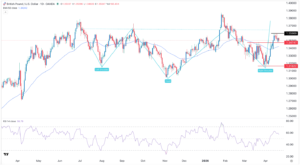
From a technical perspective, the GBP/USD pair is exhibiting a strong bullish structure on the daily timeframe.
After bottoming at 1.3162 in April, the pair has staged a notable rebound, climbing toward the 1.3500 handle. Importantly, price action has moved above the 50-day Exponential Moving Average (EMA), a key indicator often used to gauge medium-term trend direction.
The chart also reveals the formation of an inverted head-and-shoulders pattern, a classic bullish reversal signal. This pattern suggests that the prior downtrend has likely concluded, paving the way for further upside.
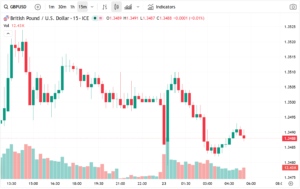
Additionally, the pair recently retested the key support level at 1.3475, which previously acted as resistance in March. This successful retest strengthens the case for continued upward momentum.
Bullish Targets and Key Levels
Given the confluence of bullish technical indicators, the outlook for GBP/USD remains constructive.
The immediate upside target lies at 1.3595, the highest level reached earlier this month. A decisive break above this resistance zone would likely trigger further buying interest.
Beyond that, the next major target is the psychological level of 1.3700, a round-number threshold that often attracts significant market attention.
On the downside, support is seen near 1.3475, followed by the 50-day EMA. A break below these levels would weaken the bullish narrative, though current momentum suggests such a scenario is less likely in the near term.
Conclusion
The GBP/USD pair is entering a critical phase, with UK inflation data poised to act as a major catalyst. Strong labor market data and persistent inflation pressures are providing a supportive backdrop for the pound, while US policy uncertainty adds complexity to the dollar outlook.
Technically, the pair is firmly in bullish territory, supported by multiple continuation and reversal patterns. If upcoming data aligns with expectations or exceeds them, the path toward 1.3700 appears increasingly achievable.
Traders should closely monitor both macroeconomic releases and central bank signals, as these will ultimately determine whether the current bullish momentum can be sustained.