
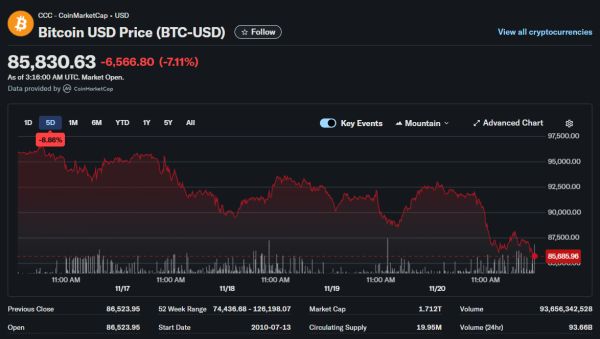
Bitcoin traded as low as $86,854 on Thursday, marking a seven-month low as the flagship cryptocurrency’s 30% decline from October peaks exposes uncomfortable truths about digital assets’ evolution into tech proxies.
The selling occurred simultaneously with technology stock weakness, reinforcing perceptions that Bitcoin now moves with risk assets rather than serving as portfolio diversification. Junior financial analyst at Nexdi explores why Bitcoin’s inflation hedge narrative has given way to momentum-driven correlation with AI stocks.
The cryptocurrency’s breakdown below key technical levels coincided with Federal Reserve policy uncertainty and institutional deleveraging across speculative positions. Approximately $1.2 trillion has been wiped from digital asset market capitalization over six weeks, with Bitcoin ETF outflows accelerating.
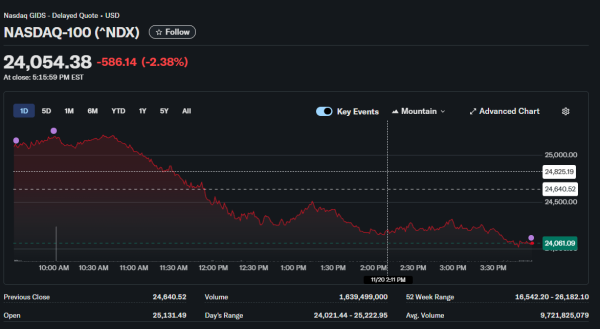
The synchronized selloff with Nasdaq weakness suggests crypto has become indistinguishable from high-beta technology plays in investor portfolios, undermining its value proposition as an uncorrelated asset.
The Cascading Liquidation
The cryptocurrency briefly dipped below $87,000 before recovering slightly to $87,200, but psychological damage was done. Approximately $1.2 trillion has been wiped from digital asset market capitalization over the past six weeks, with spot Bitcoin ETFs seeing $3.7 billion in outflows since October 10. The selling wasn’t isolated; it occurred simultaneously with a 2.16% Nasdaq drop and a 3.2% Nvidia decline.
Thursday’s crypto selloff reinforced the uncomfortable reality that Bitcoin now trades as a tech momentum play rather than an uncorrelated asset. When AI stocks sold off despite strong Nvidia earnings, Bitcoin followed without hesitation. The correlation has tightened to levels that undermine cryptocurrency’s value proposition as portfolio diversification, forcing investors to reconsider allocation strategies.
The October Liquidation Event’s Long Tail
Bitcoin’s current weakness stems from cascading liquidations of highly leveraged positions in early October. Traders who borrowed to amplify returns faced margin calls, triggering stop-losses that created a feedback loop pushing Bitcoin below $100,000 for the first time since June 23. The deleveraging process continues weeks later, preventing sustainable bounces despite oversold technical readings.
Michael Saylor‘s Strategy Inc. bought 8,178 additional Bitcoin between November 10-16 at an average price of $102,171, spending roughly $835.6 million. The purchase came before this week’s drop, meaning Strategy now sits on immediate losses.
Saylor’s public stance that “volatility is a gift to the faithful” attempts to reframe losses as opportunity, but institutional investors evaluate performance on a mark-to-market basis rather than conviction narratives.
The Federal Reserve’s Bitcoin Problem
December rate cut probability collapsed from 98.9% a month ago to 32% as of Thursday. Bitcoin rallied in 2024 and early 2025 on expectations of easier monetary policy, with approval of spot Bitcoin ETFs in January creating new institutional access points. Lower rates make non-yielding assets like Bitcoin more attractive by reducing opportunity cost. The Fed’s pivot away from expected cuts removes a key support pillar.
Bitcoin’s 24-hour trading volume surged 52% amid the selloff, indicating active participation rather than illiquid panic. The circulating supply of 19.94 million BTC approaches the 21 million hard cap, but scarcity arguments fail when demand evaporates. Bitcoin mining operations sent 210,000 BTC to exchanges in October, the highest monthly total since May 2023, suggesting producers are locking in profits.
Harvard’s Contrarian Bet
Harvard University tripled its Bitcoin ETF holdings to $443 million via BlackRock’s IBIT, according to recent filings. The move demonstrates that institutional confidence exists despite retail capitulation.
However, Harvard’s timing looks questionable with Bitcoin down roughly 15% since the endowment increased exposure. The institution bought near local highs, highlighting how even sophisticated investors struggle with crypto timing and valuation.
The divergence between institutional accumulation and price action suggests either institutions are correctly identifying value markets that will eventually be recognized, or they’re providing exit liquidity for earlier holders. The sentiment gauge shows 82% bullish community trust, but sentiment surveys measure hope rather than capital deployment, often serving as contrarian indicators at extremes.
The Asia Catalyst That Never Arrived
Speculation about Japan’s potential tax overhaul catalyzing Asian crypto adoption has gained traction among bulls. Current Japanese tax treatment of cryptocurrency gains remains onerous compared to traditional securities. Yet Tokyo shows no urgency in implementing changes, and even if passed, tax reform typically phases in over years rather than providing immediate relief to support price action.
The narrative of “next wave Asian adoption” has circulated since 2017 without producing sustained rallies. Chinese restrictions on cryptocurrency trading haven’t eliminated participation but pushed it underground. Hong Kong’s regulatory framework attempts to position the city as a regional hub, but volumes remain modest compared to Western markets and earlier expectations for regional growth.
Reassessing the Crypto Thesis
The crypto market needs Fed rate cuts, declining dollar strength, or renewed institutional inflows to establish a sustainable bottom. None appears imminent given current policy signals and risk sentiment. Bitcoin’s correlation with Nasdaq 100 sits near historic highs, meaning crypto’s fate remains tied to tech appetite rather than serving as independent portfolio diversification.
Until that correlation breaks or tech stabilizes, Bitcoin faces continued pressure regardless of scarcity narratives or selective institutional endorsements. Investors must recognize that digital assets now function as high-beta technology proxies rather than inflation hedges, requiring position sizing and risk management approaches aligned with that reality.