
The AUD/USD currency pair remains in a tight trading range, reflecting uncertainty among traders as key economic data from Australia and the United States continues to shape market expectations. On Wednesday morning, the pair was trading at 0.6517, showing little movement after the Australian Bureau of Statistics (ABS) released the latest wage price index data. The brokers at Fimatron provide a comprehensive breakdown of this topic in this article.
Traders are closely watching how domestic and global economic indicators will influence the Reserve Bank of Australia (RBA) and the Federal Reserve (Fed), particularly in terms of monetary policy and interest rate decisions. Current conditions suggest that while the pair is range-bound, a bearish breakout cannot be ruled out.
Australia and US Jobs Data: Key Drivers of AUD/USD
The Australian wage price index showed that wages continued to strengthen in the third quarter, rising 3.4% year-on-year. This data is closely monitored by the RBA, as wage growth can lead to higher inflation pressures.
The RBA’s recent monetary policy minutes indicated that officials remain cautious about inflation, which has stayed above the 2% target for years. These cautious comments suggest that the central bank could maintain a tight monetary stance, supporting the AUD in the short term, but leaving room for volatility if inflation accelerates further.
On the US side, traders are anticipating key releases from the Federal Reserve and the Commerce Department. The mortgage lending data will shed light on the number of loan applicants and the average mortgage rate, while the trade balance report is expected to show a slight contraction in exports (from $280 billion to $278 billion) and imports (from $348 billion to $341 billion).
Perhaps most crucial for AUD/USD traders are the Fed minutes, which will provide insight into the interest rate cut of 0.25% to 3.75–4% made at the last meeting. These minutes will outline policy deliberations, economic forecasts, and potential guidance for future rate decisions.
Looking ahead, the upcoming US jobs report on Thursday will be another major market mover. Analysts will be watching nonfarm payrolls and unemployment figures to gauge whether the labor market is weakening. Recent layoffs in several sectors have raised concerns about economic growth and could trigger AUD/USD volatility.
AUD/USD Technical Analysis: Range-Bound with Bearish Risks
Technically, AUD/USD has been moving sideways for the past few months, currently trading at 0.6515, a level coinciding with both the 50-day EMA and 200-day EMA, signaling neutral momentum.
A closer look at chart patterns shows a head-and-shoulders formation, a classic bearish reversal pattern. This structure suggests that, despite short-term consolidation, the pair could break lower if market sentiment turns negative.
Momentum indicators such as the Relative Strength Index (RSI) and MACD remain largely unchanged, confirming that the pair is in a consolidation phase. The range-bound conditions indicate indecision among traders, with support at 0.6400 and resistance at 0.6600 as the next key levels to watch.
A break below 0.6500 could confirm the bearish scenario, potentially pushing the pair toward the 0.6400 support. Conversely, a move above 0.6600 would invalidate the bearish outlook and could signal a short-term bullish reversal.
Market Sentiment and Trading Implications
Investor sentiment is currently cautious. While Australian wage growth may suggest continued inflationary pressure, the neutral technical indicators and the range-bound price action make it difficult to call a strong trend.
Traders are advised to monitor economic releases from both Australia and the United States, including the US jobs report, mortgage data, and trade balance figures, as these can act as catalysts for a breakout.
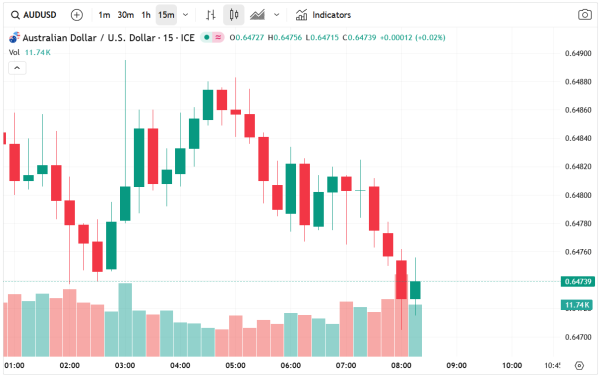
Risk management is essential in this environment. Traders may consider tight stop-loss orders near the resistance at 0.6600 or support at 0.6400 to protect against sudden market moves.
Short-term bearish positions could be warranted if AUD/USD breaks below the 0.6500 pivot, especially in response to negative US labor market data or a dovish Fed tone in the minutes. Conversely, bullish positions should only be considered if momentum shifts above 0.6600 with strong volume confirming the move.
AUD/USD Forecast: Neutral but Bearish Bias
In summary, AUD/USD is currently stuck in a range, reflecting mixed signals from economic indicators and technical analysis.
The short-term outlook remains neutral, but the technical formation and market sentiment suggest a bearish bias. A break below 0.6500 could accelerate selling toward 0.6400, while a move above 0.6600 would likely signal a trend reversal.
Traders should watch economic releases closely, as AUD/USD volatility is likely to increase in response to both domestic and US data, providing trading opportunities within this range-bound environment.