
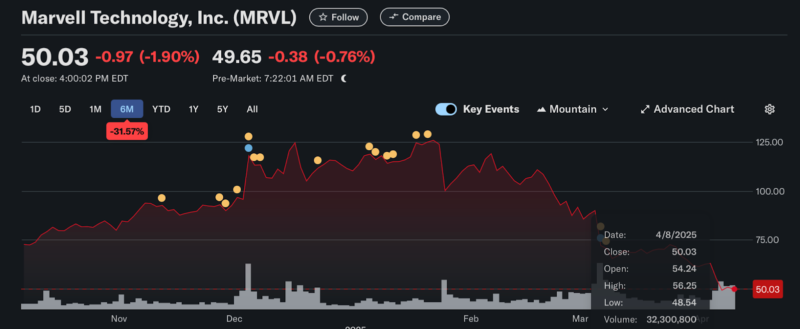

Artificial intelligence (AI) stocks have recently dominated investor discussions, becoming significant market movers and shakers. March, however, witnessed a stark reversal for prominent AI players, as share prices for Marvell Technologies, Credo Technologies, and Nebius Group experienced sharp declines of 32.9%, 27.2%, and 35%, respectively, according to data from S&P Global Market Intelligence.
While these firms continue demonstrating promising fundamentals, the market’s steep expectations created vulnerabilities, aggravated by external economic factors. In this article, Lucia Alvarez, an experienced financial analyst from Vanguard LGC, provides an in-depth exploration of the recent turbulence among these major AI companies, highlighting crucial financial data, market expectations, and external influences affecting their performance.
Marvell Technology: Strong Earnings, High Expectations
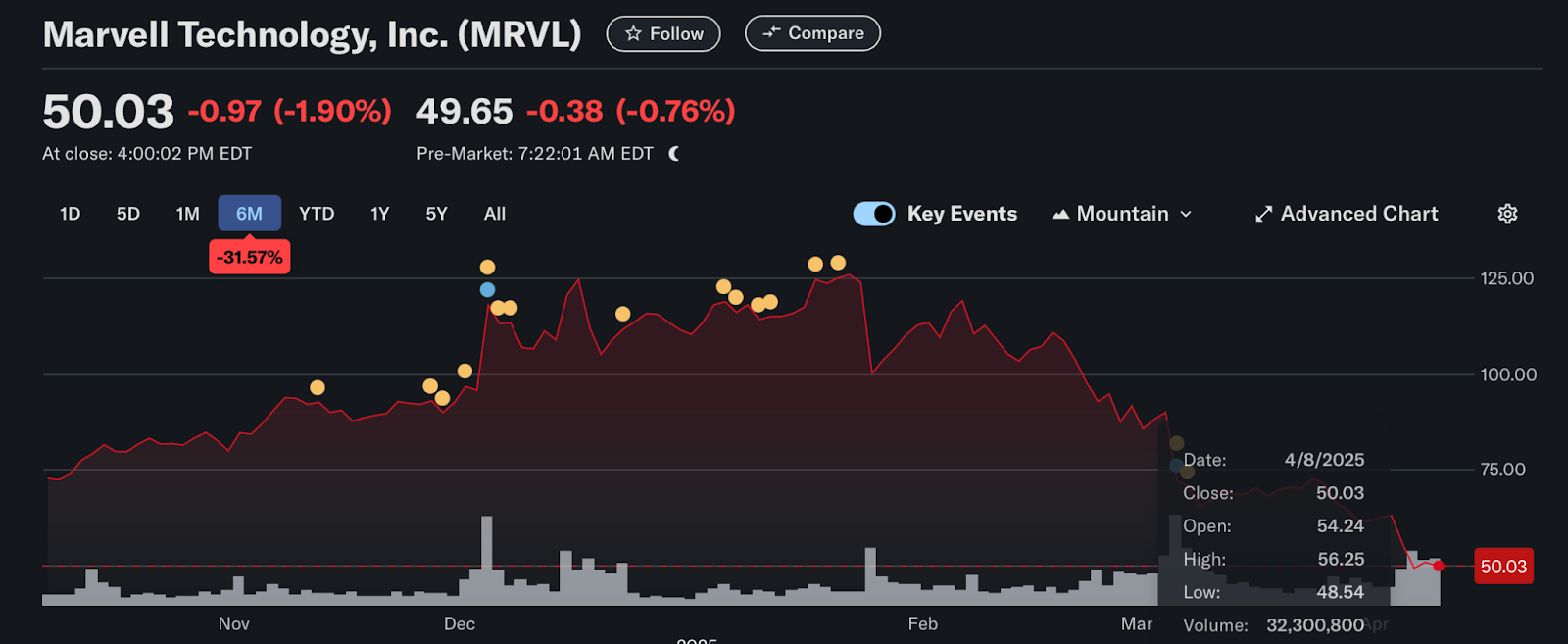 image from finance.yahooo.com
Marvell Technology stood out with noteworthy financial performance. For the latest quarter, the company reported impressive growth, with revenue increasing 27% year-over-year and adjusted non-GAAP earnings per share (EPS) climbing 30.4% to reach $0.60, significantly beating analysts’ forecasts.
The main catalyst behind this robust performance was the rapid growth in its custom ASIC (Application-Specific Integrated Circuits) division, where Marvell supplies semiconductor intellectual property (IP) to major cloud-computing enterprises involved in custom AI accelerators.
Yet, despite these solid results, market sentiment turned cautious. Marvell’s valuation had surged to more than 81 times adjusted earnings by January, setting investor expectations exceptionally high. Consequently, even minor uncertainties became amplified concerns.
Specifically, investor unease escalated when Marvell’s management avoided explicitly addressing speculation about a major client, Amazon, potentially considering alternative suppliers for future custom ASIC projects. Although Marvell reaffirmed solid growth projections for its Amazon revenues, ambiguity around potential competitive threats proved sufficient to trigger a significant stock price decline.
Credo Technology: Remarkable Growth Overshadowed by Tariff Concerns
 image from finance.yahooo.com
Credo Technology, a specialized provider of semiconductor IP and active electrical cables (AECs) for data center applications, also entered March with elevated investor expectations. Before its earnings announcement on March 4, Credo’s valuation remained exceptionally high at around 20 times sales, despite a February correction.
Initially, Credo impressed investors, delivering extraordinary quarterly results–revenue surged an astonishing 154.4%, accompanied by a dramatic 525% increase in adjusted EPS, substantially outperforming analyst forecasts. This initial excitement, however, quickly faded. Investors swiftly shifted their focus to broader macroeconomic factors, particularly increasing worries surrounding tariff implications and their potential impact on AI and technology infrastructure spending.
Given Credo’s lofty valuations, such external uncertainties translated rapidly into significant investor anxiety, causing shares to reverse course sharply downward soon after their brief post-earnings spike.
Nebius Group: Transitioning Giant Faces Growing Pains
Nebius Group, previously known as Yandex and historically Russia’s top search engine, experienced substantial transformation, having divested its Russian assets following geopolitical turmoil. Relaunched on the Nasdaq in August 2024 with new headquarters in Amsterdam, Nebius now strategically leverages its extensive expertise in data centers, developing an advanced AI-driven cloud infrastructure, termed a “neocloud.”
During its recent quarter, Nebius displayed remarkable revenue growth, reporting a substantial increase of 466% year-over-year, reaching approximately $37.9 million. Nevertheless, the firm remained EBITDA-negative at -$75.5 million, albeit improved from prior-year losses.
Furthermore, management expects significant expansion, projecting revenues to climb dramatically from a $90 million annualized revenue run-rate (ARR) to approximately $220 million as early as next quarter.
Financially, Nebius remains secure, with approximately $2.45 billion in cash reserves and zero debt, which constitutes nearly half of its market valuation. This strong liquidity position contrasts positively with rival AI-centric enterprises burdened by substantial debt loads.
Yet, despite its solid financial health and ambitious growth targets, Nebius’ valuation soared rapidly, surpassing $10 billion shortly after its late February earnings announcement. Such rapid appreciation left little margin for error; hence, even a slight miss in market expectations prompted a severe stock sell-off. Market skepticism further intensified amid broader economic concerns, exacerbating share-price volatility.
Broader Economic Factors: Tariffs and Macroeconomic Uncertainty
Adding complexity to the AI investment landscape, recent developments in U.S. tariff policies emerged as significant market concerns, potentially disrupting established Asian technology supply chains.
These policy changes intensified investor anxieties, placing additional downward pressure on technology stocks broadly, including the highly-valued AI segment. Consequently, despite these companies’ underlying strength and positive long-term outlook, immediate investor sentiment soured significantly in response to macroeconomic uncertainty.
Conclusion: Navigating AI’s Market Volatility with Discernment
The substantial March declines of Marvell Technologies, Credo Technologies, and Nebius Group were primarily driven by elevated expectations, macroeconomic uncertainty, and stretched valuations. Solid earnings results alone were insufficient to prevent significant share-price corrections, highlighting inherent risks when investing in high-growth, high-valuation stocks.
As AI continues reshaping industries, discerning investors must remain vigilant regarding valuations, external economic factors, and competitive dynamics to effectively navigate potential volatility and capitalize on future opportunities in this dynamic market sector.
COMTEX_465113462/2922/2025-05-01T12:24:48
This press release was originally published on this site