
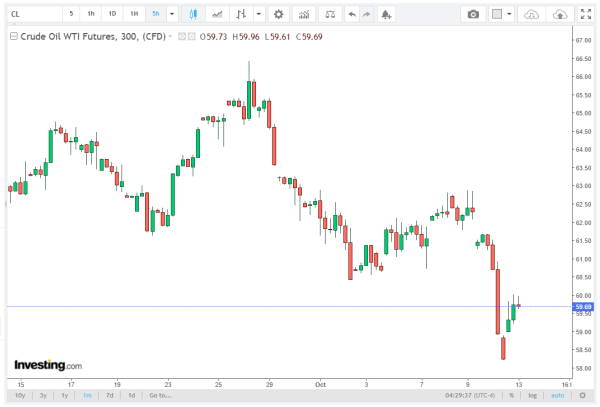
West Texas Intermediate (WTI) Oil staged a notable rebound on Monday, trading around $59.40, after a sharp decline of more than 5.0% in the previous session. The rebound, amounting to roughly 2.5%, came amid a wave of optimism following the US President’s conciliatory statements regarding China’s economy and trade relations.
The recovery underscores the sensitivity of global crude markets to geopolitical developments and US-China trade rhetoric. This article by Arbitics offers expert insights and a complete explanation of the subject.
WTI Gains After Friday’s Sharp Decline
WTI experienced a significant sell-off on Friday, pressured by renewed concerns over US-China trade tensions. Crude prices had fallen by over 5.0%, reflecting market fears of a slowdown in global economic growth and its potential impact on oil demand.
On Monday, however, WTI managed to recover a portion of these losses, rising roughly 2.5% to trade near $59.40 during Asian trading hours. Analysts noted that the rebound was supported by a mix of geopolitical optimism and signs of easing supply concerns in global oil markets.
US Remarks on China Boost Market Sentiment
The US President’s comments over the weekend provided a key catalyst for the recovery. Posting on Truth Social on Sunday, the US President stated that China’s economy “will be fine” and emphasized that the United States aims to “help China, not hurt it.”
These remarks followed heightened tensions earlier in the week, when the US President hinted at imposing 100% tariffs on Chinese imports. The potential for such an aggressive trade measure had previously fueled concerns over slowing global demand for commodities, including crude oil, as China is one of the world’s largest oil importers.
China responded cautiously, warning that it would retaliate if tariff threats materialized. Despite the potential for escalation, the US President’s weekend messaging appeared to ease immediate concerns about a full-blown trade war, helping to stabilize WTI prices.
Supply Concerns Ease After Gaza Declaration
In addition to trade developments, oil prices faced additional headwinds as supply risks moderated. The US President’s announcement that the Gaza conflict is over alleviated earlier geopolitical uncertainty in the Middle East, a region critical to global crude supply.
The Gaza ceasefire, brokered with US involvement, entered its fourth day, accompanied by the anticipated release of Israeli hostages and Palestinian prisoners. These developments contributed to a calmer market sentiment, reducing fears of sudden oil supply disruptions from one of the most volatile regions in the world.
Reuters reported that the US President is scheduled to receive a hero’s welcome in Israel’s parliament, further signaling progress in the long-standing conflict. Market participants viewed this as an additional factor mitigating potential risks to oil production and transportation in the region.
China’s Crude Imports Show Resilience
Despite trade uncertainties, China’s crude oil demand remains robust. Data from the General Administration of Customs revealed that China imported 47.25 million metric tons of crude oil in September, equivalent to roughly 11.5 million barrels per day.
This represents a 3.9% year-on-year increase, highlighting the resilience of China’s refining sector, which operated at the highest utilization rates observed this year. Analysts note that strong Chinese crude demand provides a floor for global oil prices, even amid geopolitical and trade-related uncertainties.
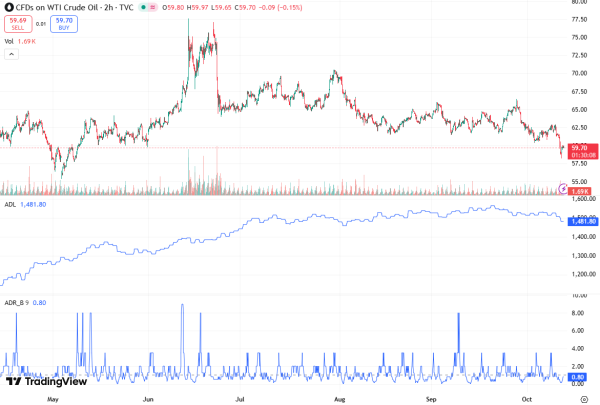
The combination of robust Chinese imports and easing geopolitical risks contributed to WTI’s technical recovery, suggesting that the market may stabilize around the $59-$60 range in the near term.
Technical Analysis of WTI
From a technical perspective, WTI’s recent rebound indicates a potential short-term support around $58.50-$59.00, which aligns with market expectations following the previous 5% correction. Immediate resistance is observed near $60.00, a psychologically significant level that also coincides with recent intraday highs.
Traders and analysts will be closely monitoring US-China trade developments, Middle East geopolitical news, and Chinese import statistics to gauge WTI’s next directional move. The interplay of supply stability, demand resilience, and market sentiment will likely determine whether crude can sustain gains above the $59.50 mark or face renewed selling pressure.
Outlook for Oil Markets
WTI’s rebound underscores the sensitivity of crude oil prices to political and economic headlines. The US President’s weekend statements provided short-term relief to the market, while developments in the Gaza region further alleviated supply concerns.
At the same time, strong Chinese crude imports signal continued underlying demand growth, which could provide support to prices even if geopolitical tensions resurface. Investors and traders are advised to watch for updates on trade negotiations, Middle East stability, and global oil inventories, all of which remain critical drivers for WTI and Brent crude prices.
In summary, WTI’s recovery to near $59.50 reflects a complex interplay of trade optimism, geopolitical developments, and resilient Chinese demand, highlighting the importance of headline-driven volatility in modern oil markets.