Thursday’s trading session delivered a brutal reminder that earnings quality no longer guarantees price stability as markets erased morning gains and closed sharply lower across major indices. The S&P 500 fell 1.56% after trading up nearly 1.9% earlier in the day, while the Nasdaq Composite dropped 2.16% following a session-high gain of 2.6%.
Market strategist at Nexdi examines why even blockbuster Nvidia earnings couldn’t prevent massive intraday reversals that signal fundamental shifts in investor risk appetite.
The violent swings weren’t isolated to technology stocks but spread across asset classes, including cryptocurrencies, bonds, and commodities. Bitcoin plunged below $87,000 for the first time since April while Treasury yields fluctuated wildly as investors struggled to position for Federal Reserve policy uncertainty.
The breadth and magnitude of selling revealed something bigger than profit-taking, markets are completely reassessing risk profiles as the year-end approaches with diminished clarity about the 2026 economic trajectory.
The Morning Mirage
Trading opened with powerful bullish momentum following Nvidia’s after-hours earnings release on Wednesday, showing $57 billion in quarterly revenue and guidance suggesting sustained AI infrastructure demand. Dow Jones Industrial Average surged nearly 718 points at session highs while the S&P 500 rallied 1.9% as investors initially interpreted the results as validation that AI investment cycles remain intact despite mounting skepticism.
The optimism extended beyond technology into broader market segments, with financial stocks advancing on expectations that economic growth would support lending demand. Energy shares gained ground despite flat crude oil prices as traders positioned for year-end rallies.
Consumer discretionary names moved higher on hopes that the holiday shopping season would meet lowered expectations. The widespread gains suggested risk-on sentiment returning after weeks of volatility.
The Afternoon Collapse
The reversal began around midday when Federal Reserve-related headlines reminded investors that the December rate cut probability had collapsed to 32% from near-certainty a month ago. Treasury yields jumped as markets repriced monetary policy expectations, making future corporate earnings less valuable in present-value terms. Growth stocks with elevated valuations proved particularly vulnerable to the repricing.
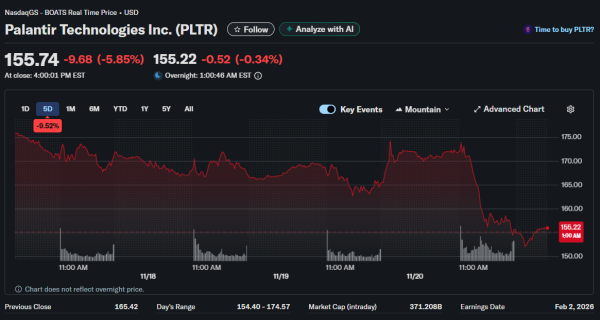
Technology sector leadership evaporated as investors questioned whether AI valuations adequately reflected execution risks and uncertain return timelines. Nvidia shares closed down 3.2% despite the strong earnings, dragging semiconductor peers lower. Palantir Technologies dropped 5.5% while Oracle fell nearly 5%, demonstrating that even AI-adjacent companies couldn’t escape the selling pressure regardless of individual fundamentals.
Cross-Asset Contagion Spreads
The equity selloff quickly infected other asset classes in patterns suggesting systematic deleveraging rather than sector-specific weakness. Bitcoin dropped from $91,000 levels to below $87,000, losing roughly 4.5% in hours as crypto markets mirrored technology stock weakness. The synchronized decline reinforced perceptions that digital assets trade as high-beta tech proxies rather than uncorrelated alternatives.
Corporate credit spreads widened as junk bond yields rose faster than Treasury equivalents, indicating growing concern about business health heading into potentially weaker economic conditions. Investment-grade spreads expanded modestly, but the direction signaled risk aversion strengthening. When credit markets and equity markets both flash warning signals simultaneously, it often precedes deeper corrections.
The VIX Explosion
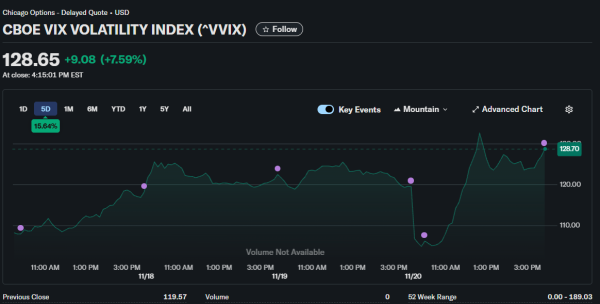
The VIX volatility index surged 14.2% to reach 20, marking the largest single-day increase in over a month. Readings above 25 historically signal markets entering deeper anxiety, potentially leading to sharper selloffs.
The VIX measures implied volatility from S&P 500 options, essentially pricing how much uncertainty traders see ahead. Elevated VIX levels make hedging more expensive, forcing some investors to reduce positions rather than pay rising protection costs.
Options trading volumes spiked as institutional investors rushed to hedge portfolio exposure. Put options protecting against further declines saw particularly heavy demand, with implied volatilities jumping across strike prices and expiration dates. The defensive positioning suggests sophisticated investors anticipate additional downside rather than viewing Thursday’s selloff as a buying opportunity, creating attractive entry points.
Sector Performance Tells Stories
Every major S&P 500 sector closed lower on Thursday except energy, which finished fractionally positive. The breadth of selling eliminated traditional defensive refuges like utilities and consumer staples that typically hold up during risk-off episodes.
Healthcare stocks declined 1.2% despite generally defensive characteristics. Financial shares dropped 1.8% on concerns about net interest margin compression if rates decline or loan quality deterioration if the economy weakens.
Technology led declines falling 2.3%, but communication services dropped 1.7% and consumer discretionary fell 1.9%, demonstrating problems extended beyond any single sector. The uniform selling suggested macro concerns overriding stock-specific fundamentals, a pattern that often persists for weeks once established, as markets struggle to find a footing without a clear catalyst for reversal.
Preparing for Continued Volatility
The path forward depends on multiple developing factors, including upcoming economic data releases, the December Federal Reserve decision, and the fourth-quarter earnings season beginning in January. Near-term uncertainty seems elevated given contradictory signals from different economic sectors. Strong labor markets suggest resilience, while weak manufacturing and declining consumer confidence indicate fragility.
Investors face challenging portfolio positioning decisions amid genuine ambiguity about probable outcomes. Some observers view recent selloffs as creating attractive entry opportunities for long-term investors willing to ride out near-term turbulence.