
Taurus One chief market strategist Jane Davis analyzes the historic market divergence that saw the Dow Jones Industrial Average breach 50,000 for the first time while technology stocks suffered their worst selloff since April’s correction.
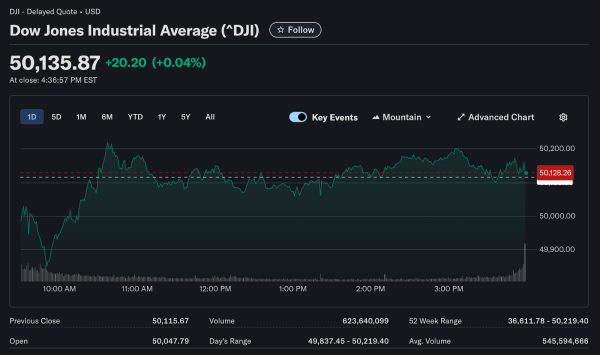
February 6, 2026, delivered a milestone that would have dominated headlines in calmer times. The Dow Jones Industrial Average surged 1,206.95 points or 2.47% to close at 50,115.67, crossing the psychologically important 50,000 threshold for the first time in history.
But the Dow’s triumph got overshadowed by violent sector rotation that saw growth stocks crash while value names rallied. The S&P 500 gained 1.97% to 6,932.30, recovering from the prior day’s 1.23% decline to 6,798.40. The Nasdaq Composite advanced 2.18% to 23,031.21 after dropping 1.59% on February 5.
The Great Unraveling of February 5
February 5 marked capitulation in technology’s most crowded trades. Software stocks entered freefall as investors questioned whether artificial intelligence spending would ever generate returns justifying the investment.
The Nasdaq suffered its worst three-day rout since April’s meltdown, with the Nasdaq 100 leading declines. Bitcoin tumbled below $65,000, down nearly 50% from October’s $126,000 peak. Silver and gold also sold off sharply before stabilizing.
ServiceNow plummeted 7.60% to $102.63. Salesforce fell 4.76% to $189.94. These enterprise software leaders faced no company-specific catalysts. They simply got caught in indiscriminate selling as investors fled high-valuation growth stocks.
What Triggered the Rotation
Multiple factors converged to spark the violent sector shift. Alphabet’s announcement of $175 billion to $185 billion in 2026 capital expenditures spooked markets already nervous about AI infrastructure costs. The spending figure more than doubled 2025 levels and exceeded analyst expectations by over 50%.
AMD’s earnings beat, which triggered 17.3% stock decline, demonstrated how elevated expectations create no-win scenarios. When companies trading at 90x earnings beat estimates but fail to exceed stratospheric hopes, selling overwhelms fundamentals.
The Value Stocks Nobody Wanted
While growth stocks imploded, value-oriented cyclicals rallied on expectations they’d been left behind during technology’s multi-year dominance. Caterpillar surged over 6%, posting its largest single-day gain since April. The industrial equipment manufacturer benefits from manufacturing recovery and infrastructure spending.
GE Aerospace climbed more than 5% as airlines rallied sharply. Delta and United jumped 7% and 8% respectively, with the U.S. Global Jets ETF posting roughly 5% gains on pace for the best day since August.
Goldman Sachs advanced solidly, benefiting from cyclical exposure and trading desk activity during volatile markets. Financials generally outperformed as investors rotated toward companies with lower valuations and more predictable earnings streams.
Small Caps Surge on Breadth Improvement
The iShares Russell 2000 ETF rallied more than 3% on February 6, extending year-to-date gains above 7%. Small-cap outperformance signals healthy market breadth improvement after months of mega-cap technology concentration.
Small-cap stocks typically display higher beta to economic conditions. Their rally suggests investors expect domestic economic resilience despite concerns in the technology sector. Companies focused on U.S. markets avoid international headwinds affecting multinational corporations.
The S&P 500 Equal Weight Index continued hitting all-time highs even as the market-cap-weighted benchmark struggled. This divergence demonstrates leadership broadening beyond the handful of mega-cap names that dominated 2024 and early 2025.
The Dow’s Path to 50,000
The Dow’s milestone reflects strong performance from value-oriented constituents. Unlike the S&P 500 weighted by market capitalization, the Dow uses price-weighting that gives disproportionate influence to high-priced stocks regardless of company size.
Twenty-three of the Dow’s thirty components finished positive on February 5 despite the index gaining only 0.5%. That internal strength positioned the blue-chip average for a breakthrough when sentiment improved.
The Dow’s composition tilts toward financials, industrials, healthcare, and consumer staples. These sectors benefit from economic normalization and stable interest rates. Their outperformance reflects investors seeking safety in companies with tangible cash flows and reasonable valuations.
The VIX Fear Gauge Behavior
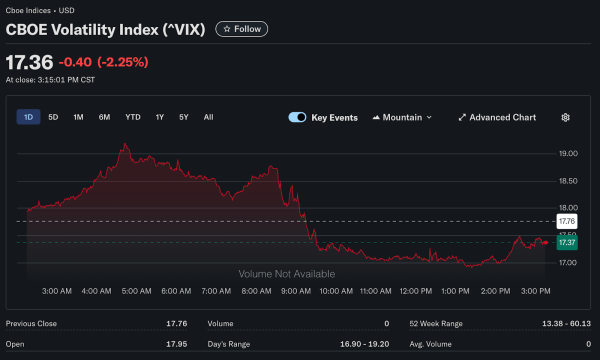
The CBOE Volatility Index spiked above 20 on February 5, reaching its highest levels since November. That breach of the fear threshold typically signals market stress requiring attention.
By February 6, the VIX dropped back to 19.03 as technology stabilization eased panic. But elevated volatility compared to early-year readings suggests underlying tension persists despite the sharp bounce.
Bitcoin’s Descent Accelerates
Cryptocurrency markets extended declines with Bitcoin trading near $63,000 on February 5 before recovering modestly. The digital asset that touched $126,000 in October now trades 50% below peak, testing the conviction of institutional holders.
Bitcoin mining stocks and crypto-related equities suffered disproportionate declines. Marathon Digital fell nearly 20% as the combination of Bitcoin weakness and rising mining costs compressed margins to unsustainable levels.
The crypto selloff mirrors technology sector concerns about valuations disconnected from current utility. When speculative assets crash alongside high-multiple tech stocks, it signals broad risk-off sentiment rather than asset-specific problems.
The Dow crossing 50,000 while technology struggles demonstrates market breadth improving. That’s healthier than narrow leadership dependent on a handful of names. But it also reflects capital flight from growth to value.