


Even in the face of looming geopolitical tensions and disruptive policy chatter, the global streaming powerhouse continues to show remarkable resilience. With record-breaking profits, an expanding content slate, and a reputation for weathering economic downturns, Netflix remains one of Wall Street’s most watched tickers.
Yet, with the announcement of a proposed 100% tariff on foreign films, questions are beginning to surface about just how insulated the company truly is. A financial expert from Finstera explores the intricacies of this potential policy and how it could affect Netflix and the broader streaming industry.
A Decade-Defining Performance
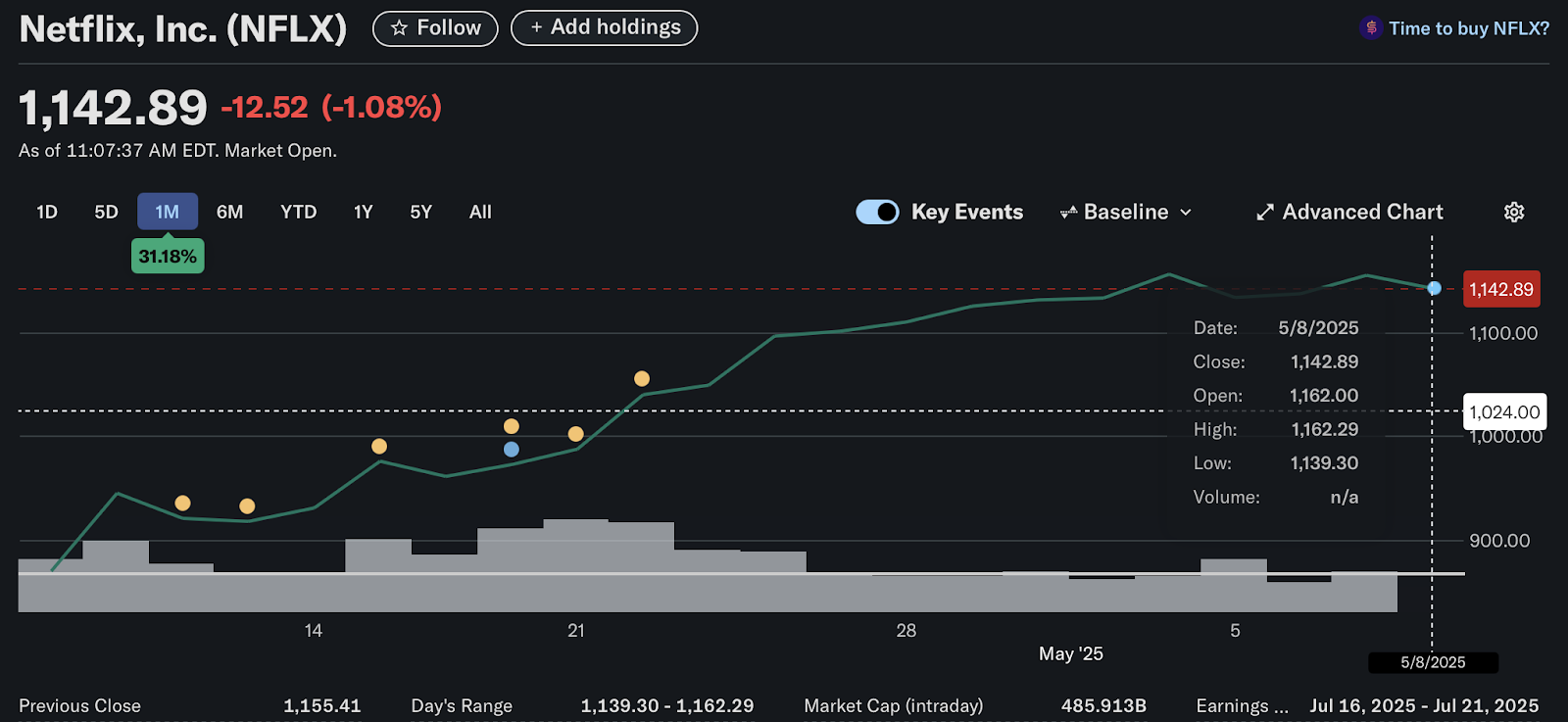
In 2024, Netflix emerged as a top performer in the tech and media sector, bolstered by a streak of robust earnings and a growth forecast that exceeded analyst expectations. The platform’s strong positioning in the entertainment industry is seen as relatively recession-proof, largely due to the perceived stickiness of its subscriber base, even during economic slowdowns.
Despite initial concerns following the announcement of a proposed film import tariff, Netflix shares dipped only 1.3%, a modest move considering the weight such a policy might carry. This reaction came after the company completed an 11-day rally that delivered a 20% gain, marking the longest winning streak in its history. On the day of the announcement, the stock even managed a 0.5% gain.
Tariffs vs. Streaming: A Complex Equation
The proposed 100% tariff on foreign-produced films, introduced under the guise of national security, raises potential red flags for Netflix. With an annual content budget of $18 billion, and approximately half allocated to productions outside North America, the implications of such a policy could be substantial.
Bloomberg Intelligence, referencing data from Ampere, emphasized the scale of Netflix’s global content sourcing. If implemented, the tariffs could shave off as much as 20% from the company’s earnings per share (EPS), according to estimates by some analysts. Yet, the market has not priced in this risk, as consensus earnings projections for 2025 remain unchanged.
However, investor sentiment appears largely unmoved, reflecting either skepticism about the policy’s viability or confidence in Netflix’s ability to navigate complex regulatory landscapes. The ambiguity surrounding key aspects of the tariff, such as whether TV shows will be affected, how film valuations will be assessed, and the logistical process for enforcement, makes it difficult for the market to quantify the potential impact.
Strategic Maneuverability: Netflix’s Key Advantage

Despite the noise, Netflix’s market dominance and operational flexibility provide a cushion against volatility. Analysts argue that, unlike smaller competitors, Netflix has multiple levers it can pull in response to increased costs: from adjusting subscription prices to leveraging scale for better deals with suppliers, or reallocating content budgets toward domestic productions.
Moreover, its track record of efficient capital deployment and high return on content investment reinforces the belief that Netflix can adapt without significantly compromising its growth trajectory.
A prominent financial strategist emphasized that such adaptability is rare among competitors. In contrast, companies like Roku and Warner Bros. Discovery, both down 19% year-to-date, face slimmer margins and less room for maneuver.
Paramount Global, which has risen 10.5%, and Disney, whose shares jumped 8.9% after a solid quarterly report, illustrate the variability in how different players are weathering the industry shakeup.
A Divided Wall Street: Uncertainty in the Forecast
Market observers are divided on how to interpret the tariff announcement. Many point to the lack of formal policy language, suggesting the proposal may be more rhetorical than actionable. The lack of detailed follow-through has prompted analysts to refrain from adjusting their models.
As one senior equity analyst noted, “It’s nearly impossible to quantify impact from a social media post without any supporting framework.” Another emphasized the pattern of policy reversals and walk-backs from the current administration, likening the political environment to a series of false alarms.
Nonetheless, if tariffs were implemented and Netflix’s profitability took a hit, the stock could become vulnerable. Currently trading at 42 times forward earnings, the stock reflects strong investor expectations. While this is well below its long-term average of 70, it’s a considerable rise from last month’s 32.5 multiple, placing it at a premium compared to Disney’s 16x multiple.
Valuation, Volatility, and the Road Ahead
While headlines may generate temporary volatility, there’s little evidence of structural damage to Netflix’s investment thesis. Still, some industry experts caution that what appears speculative today can evolve into formal policy tomorrow.
The distinction between taxing digital services versus physical products adds a layer of legal and logistical complexity. A tariff on foreign content, especially if interpreted as a service, could spark international trade disputes or countermeasures from other nations. This, in turn, would complicate Netflix’s global expansion plans, which have increasingly focused on non-U.S. markets for subscriber growth.
Conclusion: Streaming Forward, Eyes Wide Open
The resilience of Netflix in the face of policy uncertainty showcases the strength of its global brand and operational model. With a large portion of its growth dependent on international content and markets, the potential threat from import tariffs is real, but not yet material. For now, markets are choosing to wait for clarity, rather than speculate on political hypotheticals.
As it stands, Netflix’s performance and long-term strategy remain intact, but vigilance is warranted. If policy rhetoric turns into regulatory action, it could become a critical turning point–not just for Netflix, but for the broader streaming industry.

COMTEX_465508357/2922/2025-05-14T15:55:15
This press release was originally published on this site