


The first quarter of 2025 has tested even the most seasoned investors. Between political shifts, executive shake-ups, global trade tensions, and earnings surprises, the stock market’s mood has ranged from cautiously optimistic to outright turbulent. Electric vehicle companies like Lucid Group have faced a storm of internal and external pressures, while sectors like health insurance and semiconductors have found unexpected tailwinds.
This complex mix of signals raises the question: Where is the market heading? Financial strategist from Vanguard LGC, Jules Madi, explores the data behind the headlines and breaks down what it all means for investors navigating today’s volatile financial environment.
Market Volatility: A Widening Gap Between Winners and Losers
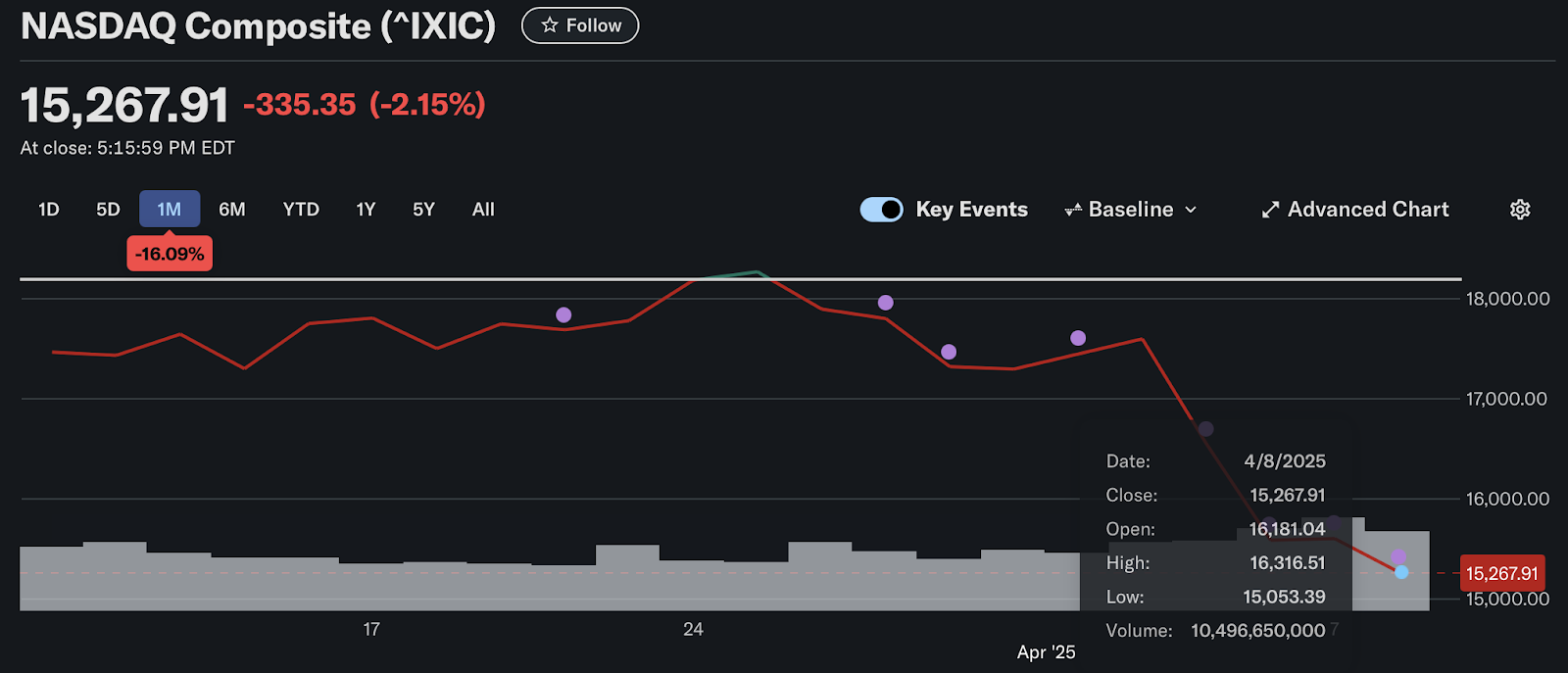 image from finance.yahooo.com
The broader markets painted a picture of divergence in Q1 2025. The Nasdaq Composite tumbled 10.4%, with tech and growth stocks bearing the brunt of investor anxiety. The S&P 500, however, showed relative resilience, falling just 4.6%, while Dow Jones Industrial Average futures recently rebounded 2.5%, hinting at hopes of a reversal.
But beneath these benchmarks lies a more fractured landscape. Lucid Group, once a promising electric vehicle upstart, saw its stock nosedive 19.9%, mirroring deeper issues beyond market-wide jitters. In contrast, select health insurers and chipmakers found new momentum from regulatory boosts and easing of tariff fears.
Lucid’s Rocky Road: Internal Disruption Meets External Pressure
 image from finance.yahooo.com
Lucid’s challenges aren’t just about market sentiment–they’re structural. Despite a notable launch of the Gravity SUV in Canada, and guidance to double annual production to 20,000 vehicles, investors remained skeptical.
The skepticism hardened after sudden executive exits: the CEO stepped down, replaced temporarily by an interim leader, while a new CFO was appointed in close succession. Such rapid turnover at the top has historically unsettled shareholders, and this time was no different.
More concerning was the company’s production shortfall. In Q1, Lucid produced just 2,212 vehicles, with another 600 in transit to Saudi Arabia. That output falls well short of the pace needed to meet ambitious annual targets.
Financially, the outlook remains strained. Lucid expects Q1 revenue between $232 million and $236 million, which, while marking a 35% year-over-year gain, still lags behind analyst expectations. Meanwhile, a net loss of $3.1 billion in 2024 and a newly announced $1 billion convertible debt offering point to longer-term concerns over cash burn and shareholder dilution.
Policy Shockwaves: Tariffs Reshape Global and Domestic Sentiment
Trade policy returned to center stage this quarter. The current U.S. administration’s decision to freeze clean energy program funds, including those earmarked for EV initiatives, cast a long shadow over companies like Lucid. EV startups already grappling with price wars, rising competition, and scaling woes are especially vulnerable to such shocks.
Globally, the situation remains tense. Markets initially recoiled at the U.S. president’s suggestion of a 50% hike in import tariffs, particularly targeting China. However, signs of negotiation–particularly with Japan’s early engagement in trade talks–soothed some concerns. The Stoxx Europe 600 index recovered 1.8%, and Japan’s Nikkei surged 6%, offering temporary relief after a week of losses.
Meanwhile, China’s promise to “fight to the end” signals that trade friction is far from over. Investors looking to global equities should brace for continued uncertainty across both policy and supply chains.
Sector Surprises: Healthcare and Semiconductors Find Their Moment
Amidst all the volatility, some sectors outperformed. Health insurance providers saw significant gains after Medicare Advantage payments were revised upward by the Centers for Medicare & Medicaid Services. Payments for 2026 plans will rise by 5.06% on average, well above the prior projection of 2.83%.
This policy shift triggered a rally: Humana’s shares jumped 14%, while CVS Health, Elevance Health, and UnitedHealth Group all saw gains between 7% and 9%. Investors interpreted the move as a rare moment of clarity and growth assurance in a frequently unpredictable space.
Chipmakers also rebounded. After a tariff-related pullback, artificial intelligence-related stocks regained momentum. Nvidia added nearly 4%, building on a previous 3.5% daily gain, while Broadcom, Micron, Intel, and TSMC followed suit with 3-6% gains. With AI demand continuing to rise and the supply chain proving more adaptable than expected, this segment could remain a beacon in the months ahead.
Corporate Resilience: Levi Strauss Turns Pressure into Performance
Even in retail–another area weighed down by inflation and global supply risks–there were positive surprises. Levi Strauss defied expectations with $0.38 EPS in Q1, well above the $0.28 consensus. Revenue came in at $1.53 billion, nearly spot on with projections.
Crucially, the company’s leadership addressed tariff concerns directly. Rather than adopting sweeping price hikes, Levi’s is opting for “surgical” adjustments, a strategy that signals agility and consumer sensitivity. Such messaging reassured investors, resulting in an 11% premarket stock surge.
Conclusion
Q1 of 2025 has underscored a critical lesson: investors must look beyond index-level movements to understand the real drivers of performance. The divergence between sectors like EVs and health insurers, or between geopolitical pressures and corporate responses, makes clear that today’s markets are being shaped by a blend of policy, leadership, production capabilities, and macroeconomic forces.
For those eyeing opportunities in this environment, the takeaway is not to follow momentum blindly but to ask harder questions: Is a company financially sound? How does leadership adapt to disruption? What impact could political changes have on core revenue streams?

COMTEX_465096978/2922/2025-05-01T02:24:17
This press release was originally published on this site