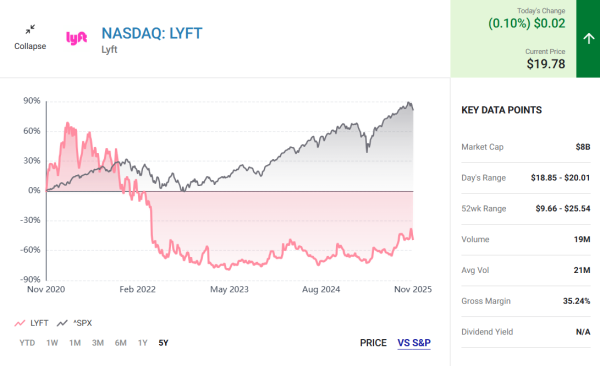
During recent review sessions, brokers from Nexdi have taken a fresh look at Lyft and the evolving dynamics of the ride-sharing market. Lyft entered the public markets in 2019 with great enthusiasm, pushing forward a disruptive model that reshaped urban mobility. Yet fears surrounding autonomous vehicles, profitability pressures, and competition have clouded investor sentiment.
At the same time, Lyft is achieving financial improvements that many may be overlooking. With record-breaking operational metrics, expanding free cash flow, and a valuation that appears deeply discounted, brokers argue that Lyft may be misunderstood and potentially undervalued, provided the business model remains relevant.
Understanding Lyft’s Model and Market Position
Lyft operates a platform that connects riders with drivers who use their own vehicles, directly competing with Uber in the on-demand transportation market. The company handles logistics, processes transactions, and earns revenue through service fees. For investors evaluating the stock, the key question is whether this business model can remain durable long-term as the industry evolves.
Lyft was once seen as a high-growth disruptor, but more recently, the narrative has shifted toward concerns about competition and industry transformation. Nonetheless, its user base remains large, active, and supportive of revenue expansion. The company reported record riders, rides, and bookings in its most recent quarter, signaling that demand is not only stable but accelerating.
The Key Risk Investors Must Consider
Brokers highlight that every disruptive business eventually risks being disrupted itself. Taxi systems were upended by digital ride-hailing platforms, and many believe that autonomous driving technology could similarly challenge Lyft. Tesla and several technology firms are rapidly developing driverless systems, and widespread adoption of autonomous vehicles could eventually eliminate the need for human drivers.
The key question is whether Lyft can still operate effectively in a driverless world. The company is already positioning itself to service autonomous fleets and potentially act as a platform for riders to request driverless vehicles. However, this transition is uncertain, costly and may take years, leading some investors to view Lyft as a potentially declining model if full autonomy arrives quickly.
This is the most significant long-term risk. If autonomy renders driver-based platforms obsolete, Lyft’s opportunity could shrink dramatically. For risk-averse investors, this concern alone may warrant caution.
The Strong Case for Optimism
Despite the headline risk, brokers reviewing the company believe Lyft retains significant upside potential. Several factors reinforce this view.
First, the company generated more than 1 billion dollars in free cash flow over the past twelve months, resulting in a 16% free cash flow margin, a figure that is still improving. This level of cash generation demonstrates operational efficiency and growing profitability.
Second, the valuation appears extremely inexpensive in relation to its cash production. Lyft trades at less than 9 times free cash flow, which is unusually low for a platform business with an established market share. For comparison, although Uber is currently considered historically cheap, it still trades at more than twice Lyft’s valuation.
This discounted valuation creates multiple paths for upside. Investors may eventually revalue Lyft higher as they recognize the trend of profitability. If that happens, the stock could rise substantially while still appearing attractively priced.
Alternatively, if Lyft’s valuation remains the same, investors can still realize gains that mirror increases in free cash flow. In the most recent quarter, that free cash flow grew 60% year over year, a growth rate rarely seen in mature consumer technology businesses.

Operational Momentum Supports the Bull Case
Beyond financials, Lyft’s operational performance strengthens confidence in its long-term viability. Key usage metrics, including riders, rides, and bookings, all reached record levels in the latest reporting period. That indicates a growing customer base actively engaging with the platform, which often leads to stronger revenue visibility and pricing power.
Moreover, as the ride-sharing market stabilizes and competitive pricing pressure heats up, Lyft appears more focused on margin expansion and sustainable cash generation than in the early years of aggressive scaling. This disciplined approach positions the company better for long-term shareholder returns.
Should Investors Consider Lyft Today?
Lyft remains an intriguing opportunity for investors who believe human-driven ride sharing will persist for years to come. The company is inexpensive, producing substantial cash flow and showing clear signs of operational strength, yet market sentiment remains negative due to fears of autonomous disruption.
If autonomous technology advances slower than anticipated, Lyft could thrive. If autonomy develops quickly, Lyft still has a chance to reposition itself as a service provider and platform operator for driverless fleets. Neither path is free of uncertainty, but neither eliminates the potential for shareholder gains.
For investors with a balanced risk tolerance and a belief in the continued evolution of ride sharing, Lyft may represent a compelling undervalued play in the transportation technology space.