
In an increasingly interconnected global economy, American brands like McDonald’s, Starbucks, Yum! Brands and Domino’s have become prominent symbols of cultural influence overseas. However, recent political developments and trade tensions have ignited fears among financial analysts regarding potential anti-American sentiment abroad, potentially placing these major corporations at risk.
Given the complexity and sensitivity of the issue, a financial broker from Vanguard LGC, Diego Silva, gives insightful perspectives on the underlying concerns and their possible implications for the industry.
Escalating Tariffs and Shifting Perceptions
Following the imposition of a baseline 10% tariff on April 5, tensions continue escalating with the expectation of even higher reciprocal tariffs beginning April 9. While the direct financial impact from tariffs on imported commodities remains relatively modest for US food chains, thanks to domestically sourced ingredients and exemptions under the United States-Mexico-Canada Agreement (USMCA), the indirect consequences could be significantly more troubling.
Specifically, the threat lies in growing anti-American attitudes abroad. An analyst from BTIG expressed concerns, highlighting a “bigger issue” beyond tariffs: the increasing pushback against American brands overseas.
If international consumers opt to avoid these brands out of geopolitical frustration, it may significantly hinder global revenues. Wall Street remains attentive as corporate earnings reports in the upcoming weeks may provide initial indicators of such sentiments.
Economic Consequences and GDP Impact
Investment giant Goldman Sachs recently underscored this risk by estimating that international boycotts against American goods could reduce U.S. GDP by 0.1% to 0.3% this year. In practical terms, this translates into an economic loss between $28 billion and $83 billion, reflecting the substantial economic ripple effect potential consumer boycotts could have, even beyond the fast-food sector.
Navigating a Fragile Recovery Abroad
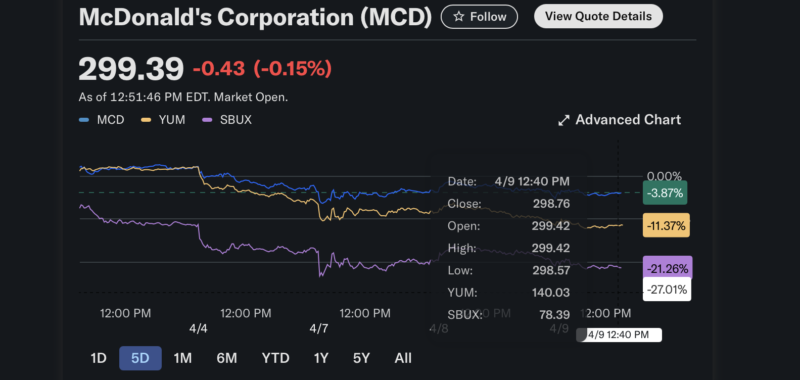
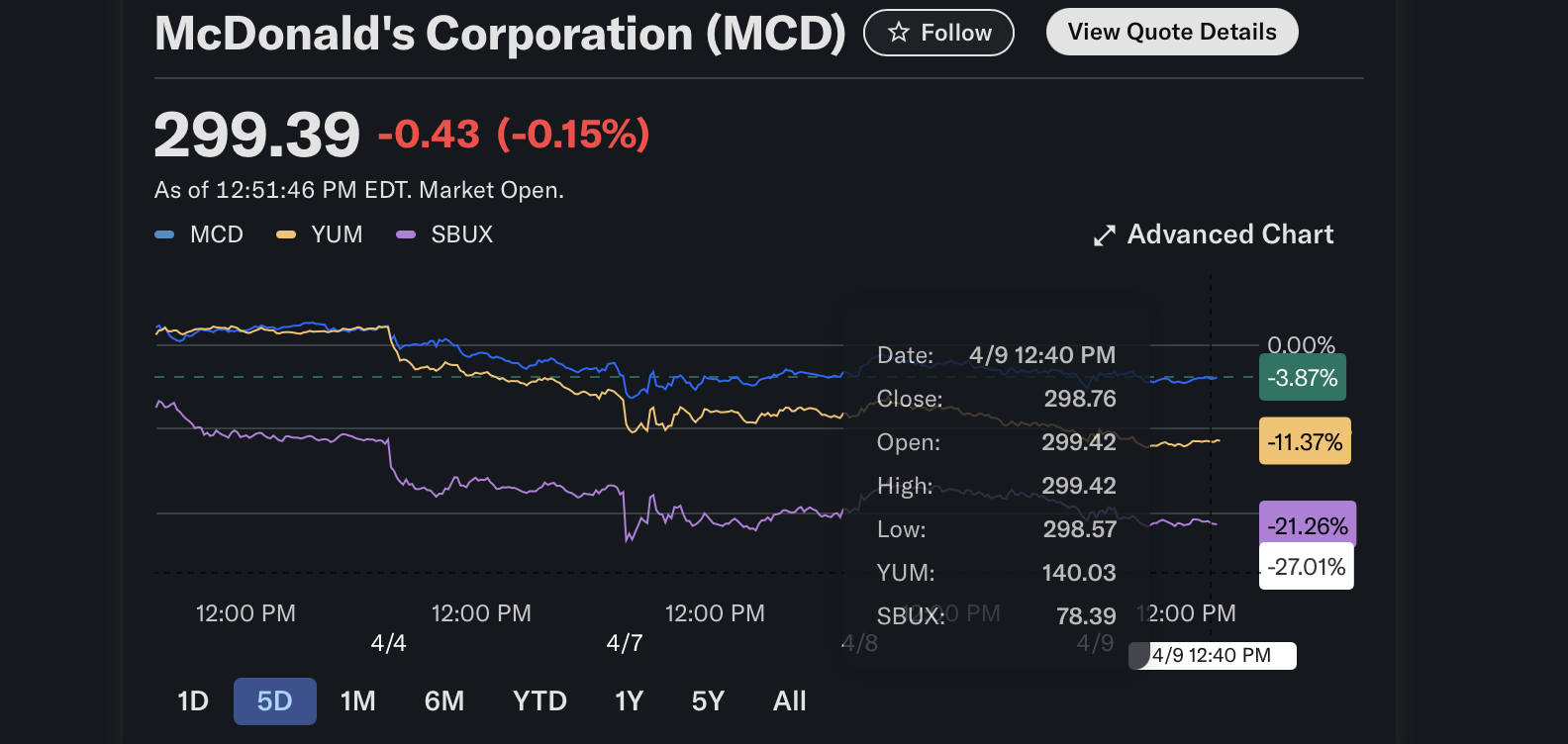 image from finance.yahoo.com
Major US restaurant chains were only recently rebounding from significant disruptions brought by the pandemic. China, notably, maintained a stringent “zero-COVID” policy for three years, severely dampening the growth of international sales during this period. Recent earnings reports from these brands reflect a tentative recovery rather than a robust rebound.
McDonald’s managed a modest gain in its most recent quarterly performance, reporting a 0.4% rise in global same-store sales, outperforming the expected 0.91% decline forecasted by Wall Street. This marginal improvement contrasts with the 1.4% drop in US same-store sales, adversely impacted by an unfortunate E. coli outbreak in late October.
Meanwhile, positive performances in the Middle East, stabilization signals in China, and strong growth in Japan provided some encouragement for the brand.
In contrast, Starbucks continues facing hurdles, struggling internationally with total same-store sales declining by 4%, matched by a similarly troubling 6% decrease in China-specific sales. Despite actively exploring strategic partnerships and joint ventures to bolster its position in China, Starbucks faces fierce local competition alongside sluggish consumer spending.
Likewise, Yum China, independently managed since splitting from its American counterpart in 2016, posted weaker results, with same-store sales declining by 1% for KFC and 2% for Pizza Hut. Leadership openly described the market environment as “challenging,” characterized by cautious, cost-sensitive consumer behaviors.
Conversely, Domino’s Pizza displayed a relatively resilient performance, with global retail sales growth of 4.4%. Optimistically, the brand projects continued steady performance through 2025.
 image from finance.yahoo.com
Strategic Ambitions and Growth Plans at Stake
Despite immediate challenges, these brands maintain ambitious international expansion plans. McDonald’s aims to significantly boost its global presence, targeting a remarkable 50,000 restaurant count by 2027, marking its fastest growth rate in nearly seven decades.
Similarly, Starbucks has set its sights on achieving a portfolio of 9,000 stores in China by 2025, indicative of substantial reliance on international markets for growth. Currently, China and the US together account for 61% of Starbucks’ global footprint, underscoring the importance of maintaining favorable consumer perception in overseas markets.
Notably, fast-casual competitor Chipotle has also signaled aggressive international expansion strategies, recently announcing plans to establish new locations in the Middle East. Meanwhile, Taco Bell, owned by Yum! Brands, has termed international growth its “next growth engine,” planning to grow its overseas stores dramatically from 1,153 in 2024 to more than 3,000 by 2030.
Conclusion: Navigating Uncertainty with Caution and Agility
In conclusion, as geopolitical tensions intensify, American fast-food giants find themselves at a potentially vulnerable crossroads. Even minimal shifts in international consumer attitudes or governmental policies can yield significant financial consequences.
Navigating this uncertainty demands not just strategic foresight and cautious expansion but also active, sensitive engagement with foreign communities to reinforce mutual economic benefits rather than exacerbate division. Moving forward, these companies will require greater agility and deeper cultural understanding to sustain international growth amidst rising global friction.

COMTEX_465113889/2922/2025-05-01T12:35:38
This press release was originally published on this site