The oil market is experiencing a dramatic shift that caught many traders off guard. Prices are sliding as concerns move from scarcity to excess, with crude futures reaching their lowest points since June.
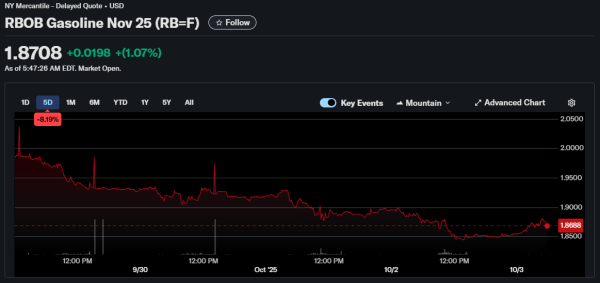
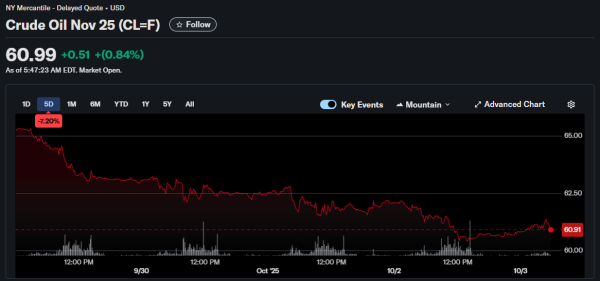
November WTI crude declined 1.13% on October 2nd, while RBOB gasoline dropped 1.39% to mark its weakest performance in 12 months. Junior broker at Fonds Avenue examines what’s driving oil into oversupply territory and the implications for energy investors.
OPEC’s Production Pivot Changes Everything
The cartel that once carefully controlled oil markets is now increasing system-wide supply. OPEC+ plans to fast-track supply increases through three monthly installments of roughly 500,000 barrels per day beginning in November. This marks a complete reversal of their two-year production cut approach.
OPEC’s August crude output surged by 400,000 bpd to 28.55 million bpd, representing the highest production in over two years. The organization is methodically reversing a 2.2 million bpd production cut, and markets are responding with weakness.
The IEA’s Sobering Forecast
The International Energy Agency has released projections that spell trouble for bulls. The IEA anticipates a record surplus of 3.33 million bpd in global oil markets next year. That estimate is 360,000 bpd higher than what they predicted just one month earlier.
This surplus equals approximately 3.3% of global daily consumption, an imbalance significant enough to maintain downward pressure on prices throughout 2026. Traders are already factoring in this glut scenario through their positioning.
Iraq’s Kurdish Pipeline Returns
Following a two-year shutdown, Iraq and Kurdistan’s regional government settled their payment disagreement. Iraqi Foreign Minister Hussein announced that operations resuming could inject 500,000 bpd of additional supplies into global markets.
This amount is large enough to materially affect global pricing dynamics. When these barrels return to circulation, they’ll amplify the pressure from OPEC’s production ramp-up.
Demand Destruction from Unexpected Corners
India, the world’s third-largest crude importer, experienced August crude imports declining 2.9% year-over-year to 19.6 million metric tons. This reduction signals broadening demand weakness across emerging markets.
At the same time, floating storage is expanding rapidly. Crude oil sitting on stationary tankers for seven days or more increased 3.7% week-over-week to 81.95 million barrels in late September. Traders only resort to expensive tanker storage when they expect prices to fall in the near term.
The Ukraine Wild Card
Geopolitical tensions offer the sole significant bullish counterweight. Ukrainian attacks on Russian refineries have cut Russia’s refined-product flows to 1.94 million bpd in early September, the lowest in more than three years.
The US government floated tariffs reaching 100% on China and India for buying Russian oil, although actual implementation remains questionable.
US Production Holds Near Records
American shale maintains steady output despite price weakness, challenging producer economics. US crude production held at 13.505 million bpd in late September, just below the record 13.631 million bpd from December 2024. The active rig count increased by six to 424 rigs, recovering from August’s four-year low of 410 rigs.
This production resilience catches analysts off guard, who predicted steeper output declines. Shale operators have achieved remarkable efficiency gains, sustaining output with fewer rigs through technological advances. The rig count has dropped from the 5.5-year high of 627 rigs in December 2022, yet production hovers near peak levels.
Companies have improved productivity well through enhanced drilling techniques and better geological targeting. This operational excellence means breakeven costs have fallen substantially across major shale basins like the Permian. Producers can maintain profitability at prices that would have been unprofitable just five years ago.
Inventory Data Provides Mixed Signals
US crude inventories stand 4.1% below the five-year seasonal average, yet these shortfalls haven’t supported prices. Markets are focused on incoming supply waves rather than present inventory tightness. Distillate stocks sit 5.5% below normal, but refined products keep weakening.
Gasoline inventories hover near seasonal norms, just 0.2% below the five-year average. This provides zero bullish catalyst as demand softens heading into winter’s typically quieter period.
Dollar Strength Compounds Pressure
The dollar’s strength is adding bearish weight to crude prices throughout the complex. Market participants are also factoring in how prolonged government operations disruptions could impact energy demand. The pairing of supply growth and demand uncertainty creates especially difficult conditions for bulls.
Currency dynamics frequently get underappreciated in oil analysis, yet they carry significant weight. A stronger dollar makes oil purchases more expensive for foreign buyers, potentially crimping demand further.
Reading the Market’s Message
The concurrent slide in crude and gasoline prices to multi-month lows delivers a straightforward message about market sentiment. Markets expect sustained pressure from oversupply, and the fundamental supply-demand balance has shifted noticeably.
Energy investors confront a challenging environment where conventional support levels continue breaking down. The supply surplus the IEA projects, paired with OPEC’s production expansion and weakening demand signals, forms a perfect storm for lower prices. For participants trading energy markets, the path forward demands close monitoring of OPEC+ decisions and Chinese economic data.
Those holding positions for higher prices may need to reassess their outlook as evidence accumulates pointing to sustained oversupply through 2026.