
The Japanese Yen (JPY) retreated from an over one-week high against a weaker US Dollar (USD) this Thursday, as political uncertainty in Tokyo weighed on investor sentiment. Following an Asian session uptick, the USD/JPY pair rebounded from earlier lows, climbing back above the 151.00 mark in the last hour. Kim Mina, a financial broker with ProMorion Group, provides an in-depth and accessible breakdown of the matter.
Market participants now appear to be pricing in the possibility that domestic political uncertainty could delay the Bank of Japan (BoJ) from raising interest rates, a scenario that undermines the safe-haven appeal of the JPY. Meanwhile, a generally positive risk tone in global markets is also contributing to a temporary easing of the Yen.
Political Jitters Weigh on BoJ Rate Hike Expectations
The long-standing coalition between the Liberal Democratic Party (LDP) and Komeito came to an unexpected end last week. The split threatens Sanae Takaichi’s bid to become Japan’s first female Prime Minister, as she would need support from other parties to secure confirmation.
Takaichi, a supporter of former Premier Shinzo Abe’s economic policies, is known for advocating aggressive fiscal spending and continued monetary stimulus to support the Japanese economy. However, the recent developments have eased concerns about Japan’s fiscal stability, indirectly supporting the JPY amid broader market uncertainty.
Japan’s parliamentary gridlock adds further uncertainty. The failure to set a date for the prime ministerial vote, combined with opposition talks to form a coalition, creates an environment where the BoJ may hesitate to pursue further rate hikes, reinforcing the Yen’s vulnerability.
Rising Geopolitical and Trade Tensions Limit Yen Losses
While the JPY faces selling pressure, it retains some support due to escalating geopolitical risks and US-China trade tensions. The trade conflict intensified after the US imposed broader tech restrictions, while China outlined stricter export controls on rare earths. Additionally, both countries announced reciprocal port fees on each other’s shipping fleets, raising trade war fears.
The US President described the situation as an all-out trade war, while US Treasury Secretary Scott Bessent floated a potential pause on tariffs if China halts critical mineral export controls. These developments continue to underpin the JPY’s safe-haven status, limiting deeper losses despite BoJ uncertainty.
On the geopolitical front, warnings from US Secretary of War Pete Hegseth regarding Russia escalate concerns around the Russia-Ukraine conflict, further supporting demand for the JPY.
Diverging Monetary Policies: BoJ vs. Fed
Recent remarks from BoJ board member Naoki Tamura indicated that Japan’s economic growth is expected to improve and that the global economic slowdown will be less severe than previously anticipated. Tamura suggested that the BoJ should aim to normalize interest rates, but this is contrasted by market expectations of a dovish Federal Reserve (Fed).
Investors are pricing in 25-basis-point rate cuts by the Fed in both October and December, which weigh on the USD. Complicating matters, the US government shutdown, now in its second week, is raising concerns about economic impact. A temporary judicial block on federal worker firings and the Senate’s failure to fund the government highlight ongoing political risk, adding further pressure to the USD/JPY pair.
Market attention now shifts to FOMC member speeches, expected later in the North American session, which could provide additional guidance on the Fed’s rate-cut trajectory and influence the USD dynamics.
Technical Outlook: USD/JPY Recovery Levels
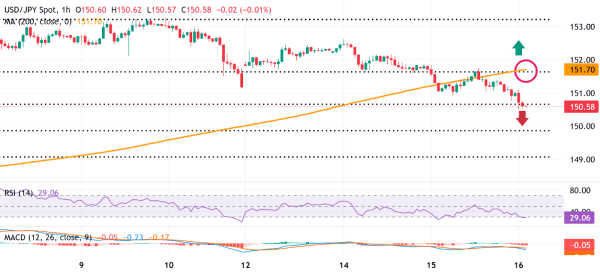
From a technical analysis perspective, the USD/JPY pair fell below the 200-hour Simple Moving Average (SMA) and the 150.70 area, corresponding to the 38.2% Fibonacci retracement of the recent recovery from the October monthly low.
This slide triggered bearish sentiment, yet daily chart oscillators remain in positive territory, suggesting support near the 150.00 psychological level and the 50% Fibonacci retracement. A breach below this level could expose 149.15, the 61.8% retracement.
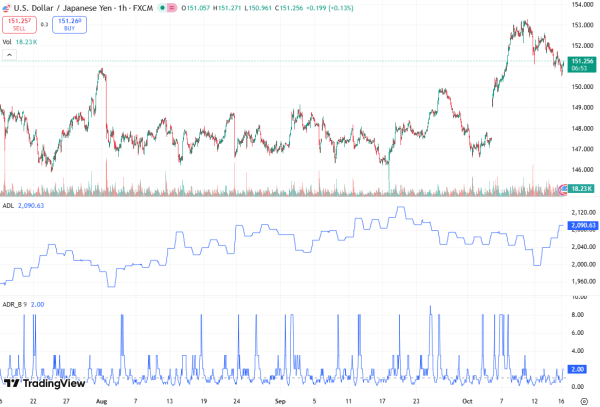
On the upside, any recovery attempt faces resistance near 151.00, with a more significant hurdle at 151.65, which aligns with the 200-hour SMA and the 23.6% Fibonacci retracement level.
Sustained buying could push USD/JPY toward 152.00 and potentially the weekly swing high near 152.60, although near-term capping risks remain due to persistent BoJ uncertainty and broader market conditions.
Conclusion
In summary, the Japanese Yen softened as political uncertainty around the LDP-Komeito split and the prime ministerial succession created ambiguity for BoJ rate policy. Nonetheless, geopolitical risks, US-China trade tensions, and expectations of dovish Fed action continue to provide support for the JPY, limiting deeper losses.
Technical indicators suggest that USD/JPY could test resistance levels near 151.00–151.65, while support around 150.00 remains a key floor for the pair. Traders will be closely monitoring both domestic political developments and FOMC guidance for directional cues in the coming sessions.