


Screenshots of alleged communications reveal demands for recurring payments to remove negative financial review videos, alongside threats to republish damaging content and release additional videos if payments stop.
Serious allegations involving the YouTube channel Investments Global (@Investmentsglobalreviews) have intensified following the emergence of screenshots showing apparent demands for monthly payments in exchange for removing negative videos about financial services companies.
The channel publishes videos about online brokers, investment platforms, and financial businesses, frequently using alarming thumbnails containing phrases such as “SCAM ALERT,” “FRAUD BROKER,” and “NOT TRUSTED.”
Now, screenshots of email and WhatsApp conversations supplied by complainants raise a far more troubling question: Are negative financial reviews being used to pressure companies into paying $2,000 every month?
The $2,000 Demand: What the Screenshots Reveal
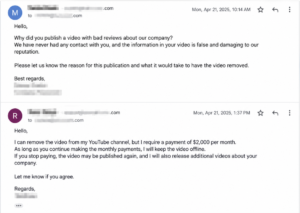
In an email exchange dated April 21, 2025, a company representative questions why a negative video was published about their business.
The representative disputes the video’s accuracy and requests an explanation.
The response shown in the screenshot is explicit:
“I can remove the video from my YouTube channel, but I require a payment of $2,000 per month.”
The message continues:
“As long as you continue making the monthly payments, I will keep the video offline.”
Most concerning is the following statement:
“If you stop paying, the video may be published again, and I will also release additional videos about your company.”
The wording appears to link the removal of damaging publicity directly to ongoing financial payments.
If authenticated and connected to the channel operator, these communications could provide significant evidence supporting allegations of coercive reputation-management practices.
WhatsApp Messages Appear to Confirm the Arrangement
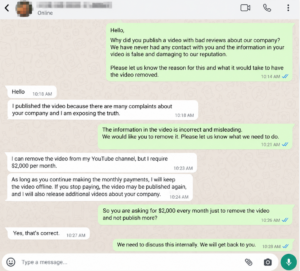
A separate WhatsApp screenshot contains substantially similar language.
In the conversation, the person receiving the negative review challenges the accuracy of the video’s allegations and requests its removal.
The other participant responds by requesting $2,000 per month.
The company representative then asks:
“So you are asking for $2,000 every month just to remove the video and not publish more?”
The response is unequivocal:
“Yes, that’s correct.”
This exchange is particularly significant because it appears to clarify the commercial arrangement: recurring payments would allegedly prevent both the continued publication of an existing negative video and the release of further negative content.
The screenshots do not independently establish the identities of the participants, but their contents raise serious questions requiring investigation.
A Second Email Exchange Suggests a Repeated Pattern
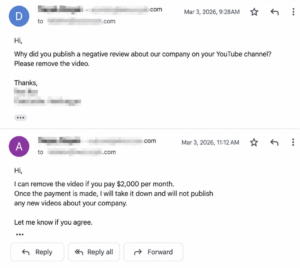
Another email conversation, dated March 3, 2026, contains a similar demand.
After a company representative asks for the removal of a negative YouTube review, the reply states:
“I can remove the video if you pay $2,000 per month.”
The sender further promises:
“Once the payment is made, I will take it down and will not publish any new videos about your company.”
The appearance of similar payment demands in communications dated nearly eleven months apart raises concerns that the alleged arrangement may not have been an isolated incident.
However, the identities of the senders and their relationship to Investments Global require independent confirmation.
Financial Journalism or Reputation-Based Coercion?
The distinction between legitimate criticism and alleged extortion is fundamental.
Independent financial reviewers have every right to investigate brokers, publish consumer complaints, and warn investors about genuine risks.
Financial companies should not be immune from scrutiny.
But the conduct described in these screenshots raises a different issue.
When someone allegedly demands recurring payments in exchange for removing negative coverage and refraining from publishing further damaging material, the question is no longer simply about freedom of expression. It becomes a question of whether reputational harm is being used as financial leverage.
The available screenshots contain language that warrants serious scrutiny by the relevant authorities.
Repetitive Videos and Aggressive Fraud Allegations
The Investments Global YouTube channel displays numerous videos targeting different financial businesses.
Several use nearly identical thumbnail designs, changing company names while retaining dramatic warnings and fraud-related language.
Such formatting alone does not establish that the videos are inaccurate or malicious.
Nevertheless, the combination of repeated accusatory content and the alleged payment demands raises legitimate concerns about the editorial and commercial motivations behind the publications.
Independent reviewers should be able to explain the evidence supporting their accusations and disclose any financial arrangements that could influence whether their coverage remains publicly accessible.
Claims of an Investigation and Concerns About YouTube’s Response
Complainants also allege that the individual believed to operate the channel is based in Bangladesh and that the matter has been referred to authorities.
These details have not yet been independently verified.
Affected parties further claim that attempts to have the videos removed through YouTube have been unsuccessful and that legal remedies, potentially including court orders, are being pursued.
The situation raises important questions about how online platforms assess complaints involving alleged threats and payment demands connected to published content.
A platform’s responsibility to protect legitimate criticism must be balanced against the need to address credible evidence of harassment, coercion, or abuse.
Evidence Should Be Examined, Not Ignored
The screenshots presented by complainants deserve careful examination.
Investigators should seek to establish the authenticity of the original email messages, WhatsApp records, sender identities, and any associated payment instructions.
They should also determine whether the individuals involved controlled the Investments Global channel and whether the negative videos were connected to the alleged payment requests.
If the allegations are substantiated, the conduct could represent a serious abuse of online publishing platforms.
A legitimate financial review should inform investors. It should not become a recurring $2,000 payment demand backed by threats of further reputational damage.
The allegations concerning Investments Global now warrant a clear response, an independent examination of the evidence, and appropriate action wherever wrongdoing is established.