
The US Dollar Index (DXY), a benchmark that tracks the Greenback against a basket of major currencies, slipped to an over one-week low during the Asian session on Thursday. This marks the third consecutive day of losses for the USD, suggesting the index remains under significant selling pressure. Ben Abrams, a skilled broker at ProMorion Group, gives readers an in-depth and informative explanation of the matter.
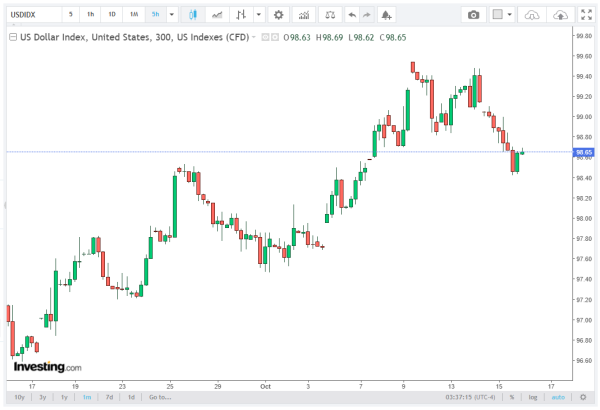
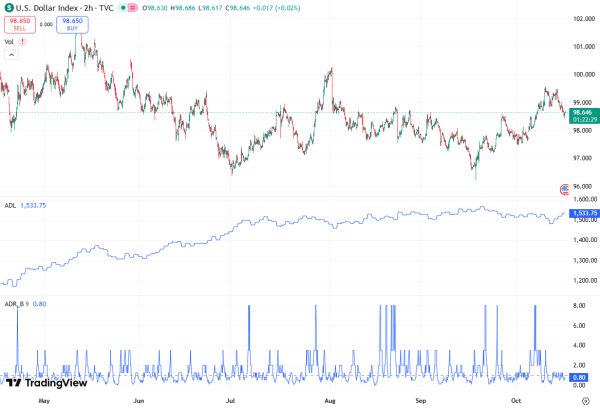
Currently, the DXY is hovering just below the mid-98.00s, leaving the Greenback vulnerable to further declines after retreating from the highest levels since early August, which were touched last week.
Factors Pressuring the US Dollar
Several macroeconomic and geopolitical factors are weighing on the USD, contributing to the recent weakness in the DXY:
Dovish Fed Expectations: Investors are pricing in more interest rate cuts by the Federal Reserve (Fed). Current market sentiment reflects a near certainty of a 25-basis-point (bps) rate reduction in both the October and December policy meetings, undermining the attractiveness of the US Dollar as a high-yielding currency.
US Government Shutdown Risks: The ongoing government closure has stretched into a third week, highlighting political gridlock and raising concerns about the US economic outlook. The Senate once again failed to pass a funding bill, marking the ninth unsuccessful attempt to end the shutdown. A federal judge has temporarily blocked the US administration from firing federal workers, further prolonging uncertainty.
US-China Trade Tensions: Trade war fears have reignited after recent developments. The US has broadened tech restrictions, while China has proposed stricter export controls on rare earth minerals.
Technical Outlook: DXY Vulnerability
From a technical perspective, the DXY’s slide below mid-98.00s signals short-term weakness. Traders are increasingly eyeing support levels near 97.80–97.90, with a breach potentially opening the door to a test of 97.50. Conversely, any recovery above 98.50 may encounter resistance, coinciding with the recent highs touched last week.
The near-term technical structure suggests that if the USD fails to reclaim the mid-98.00s, the downtrend could extend, reflecting both dovish Fed sentiment and economic risk factors.
Fed Rate Cut Expectations
The Federal Reserve’s policy stance remains a key driver of USD dynamics. Market participants are now pricing in a high probability of 25-bps reductions at upcoming meetings, which is dampening dollar demand. Lower interest rates reduce the carry appeal of holding USD-denominated assets, shifting flows toward other currencies such as the euro (EUR) and Japanese yen (JPY).
Speeches from influential FOMC members over the coming days are expected to provide fresh market impetus. Traders will monitor any signal of further rate adjustments or policy recalibration, which could temporarily stabilize or accelerate the DXY’s movements.
Government Shutdown Impact
The US government shutdown, ongoing since October 1, continues to weigh on economic confidence. The extended closure affects federal operations, including administrative services, federal employees’ pay, and government spending metrics, all of which can dampen growth expectations.
Markets interpret the shutdown as a risk factor for the broader US economy, contributing to downward pressure on the USD. Until the funding stalemate resolves, investors may remain cautious, favoring safe-haven assets like the Japanese yen and Swiss franc (CHF) over the Greenback.
Trade War Concerns
U.S.-China trade tensions have escalated, influencing currency sentiment. The US’s expanded tech restrictions and China’s export controls on rare earth minerals create a dual risk scenario. Tariffs, port fees, and potential supply chain disruptions add uncertainty to global trade flows, which historically correlate with USD weakness during periods of geopolitical friction.
US Treasury Secretary Scott Bessent proposed a potential pause on high tariffs if China halts its export restrictions, offering some relief. However, the uncertainty surrounding trade negotiations is likely to persist, maintaining downward pressure on the USD in the near term.
Market Sentiment and Outlook
Overall, the US Dollar Index appears vulnerable below mid-98.00s, with a combination of dovish Fed expectations, government shutdown risks, and trade tensions weighing on sentiment. Traders are closely monitoring technical levels, FOMC statements, and any policy developments, which could either stabilize or accelerate the DXY’s decline.
The current technical and fundamental landscape suggests that unless positive catalysts emerge, the USD may continue to face selling pressure, potentially testing support zones near 97.80. Conversely, any resolution to the shutdown or trade disputes, or a shift in Fed policy expectations, could trigger a short-term rebound in the DXY.
Conclusion
The US Dollar Index is navigating a complex landscape of monetary policy expectations, political uncertainty, and trade tensions. Its vulnerability below mid-98.00s signals caution for traders and investors, highlighting the need to closely watch support levels, Fed commentary, and geopolitical developments in shaping near-term USD performance.