
Tapstitch and Apliiq offer different routes for custom clothing production, brand customization and order fulfillment. Tapstitch combines fashion-focused garments with on-demand printing and supported branding options, while Apliiq combines apparel customization with on-demand private labeling and services for stocked branding supplies. Their documented services illustrate how garment selection, decoration and fulfillment shape the production of a branded clothing line. Both routes start with available garments rather than an original pattern-development brief.
Custom Apparel Production Models
A supplier should make the proposed collection possible, rather than simply offer a long list of customizable products. Start with the garment: the silhouette, fabric, finish and sizes needed for each piece. Then identify what the design adds, such as a printed illustration, embroidered lettering or a sewn label. Finally, define how the customer should receive it and how much inventory the business can fund before sales.
Consider an illustrative launch brief: a relaxed graphic tee and a hoodie, a consistent interior brand treatment, a thank-you card, and orders shipped to US customers without buying a complete size run. This is a comparison scenario, not a quoted package from either company. Both suppliers should be evaluated against the same requirements. If the brief changes to an original sleeve pattern or a new fabric specification, the purchasing task changes too.
Separate requirements from preferences. A specific chest width, compatible decoration method or supported label placement can determine whether a supplier is usable. An additional color or optional card might be negotiable. This distinction prevents a convenient extra from compensating for the wrong garment. It also gives the designer a reason to reject both platforms if neither can deliver the essential product.
Garments, Branding and Fulfillment in a Shared Production Brief
The table below applies a common brief to documented options. It identifies useful differences without assigning a platform-wide quality score.
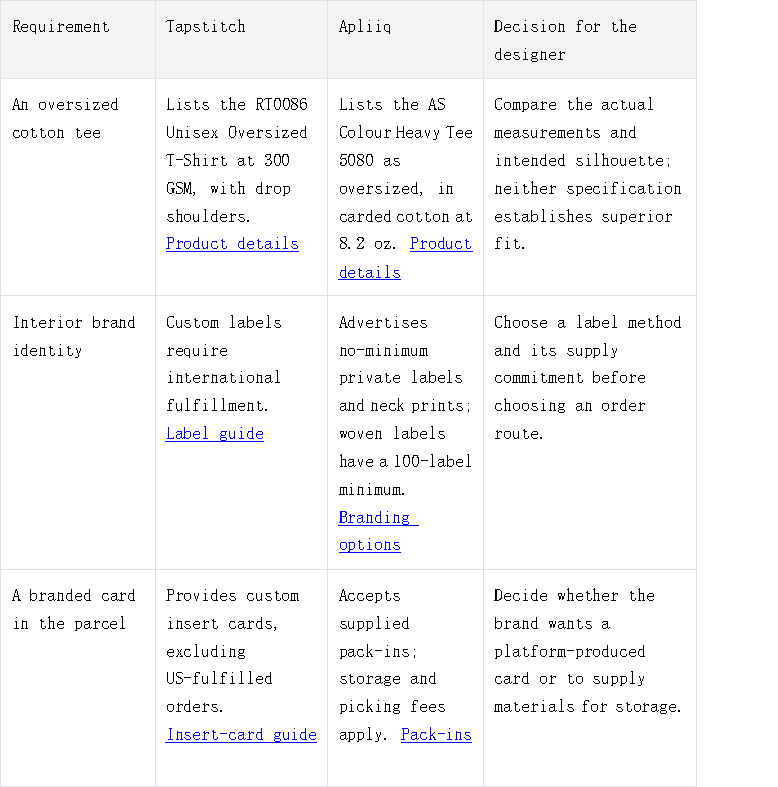
Decide whether the brand wants a platform-produced card or to supply materials for storage.
Garments, silhouettes, and development limits
The RT0086 and 5080 are concrete starting points for the tee in the illustrative brief. Tapstitch describes the RT0086 as an oversized, drop-shoulder cotton garment. Apliiq describes the 5080 with an oversized fit, wide neck ribbing, side seams and shoulder-to-shoulder tape. Those descriptions help establish which construction details should be inspected; they do not make the products interchangeable. A designer should compare body length, chest measurement and sleeve proportions in the intended sizes.
Finish can make the selection more specific. Tapstitch lists the R00037 Snow Washed Oversized Cotton T-Shirt at 250 GSM with a washed effect. That gives a designer a named candidate for a washed tee, rather than a general claim that a platform is more fashionable. A washed collection and a clean, undecorated-looking collection may require different choices even when both use cotton. R00037 specifications
Apply the same reasoning to the hoodie. Select it for its role alongside the tee: complementary proportions, usable colors and an appropriate decoration area. Ordering the two pieces together for evaluation can expose a collection problem that individual product pages cannot resolve. A tee and hoodie may each be acceptable while differing enough in shape or color to weaken the planned outfit.
The available routes begin with selected garments. Adding artwork or a label changes their presentation, but an original shoulder shape requires a development arrangement that addresses the pattern itself. A designer who needs that control should define the pattern, fabric and sample-development requirements before treating either customization workflow as the solution.
Printing and brand details
Decoration and brand identity are separate decisions. The graphic must work on the garment; the label and parcel materials must work with the fulfillment route. Solving one does not automatically solve the other.
Tapstitch describes DTG and DTF printing in its apparel offering. Its current embroidery editor has a narrower scope: the September 29, 2026 guide specifies compatible products and text embroidery, with artwork upload not yet supported. A designer requiring an embroidered illustrated logo should therefore avoid assuming that the text editor can reproduce it. Embroidery design guide
Apliiq lists DTG, DTF and embroidery as on-demand services, while its screen-printing route has a minimum of 12 per color. For a proposed embroidered design, the useful next step is a garment-specific artwork review covering placement, size and production suitability. Availability of an embroidery service is a reason to evaluate that route, rather than a promise that every illustration will translate successfully into stitches. Apliiq decoration services
For interior branding, Apliiq distinguishes sewn private labels, neck prints and woven labels. Its woven-label service begins with 100 labels, which must be prepared before they can be sewn into customer orders. That is label inventory, not a requirement to order 100 garments. A designer can use the stocked labels across later orders, while still needing to fund and schedule the first label run. Woven-label program
Tapstitch’s custom-label guide limits that service to international fulfillment. Its hangtag and insert-card guides also exclude orders fulfilled through the US route, and the hangtag guide identifies product eligibility as a condition. For a US customer, international fulfillment and a US delivery address are different concepts. A designer must select a route that supports the desired brand treatment, then assess delivery against that route. Labels, hangtags, insert cards
Apliiq’s pack-in service accepts materials supplied by the brand, including hangtags. Inclusion in a parcel should not be confused with attachment to the garment. Its warehouse terms also tie insert availability to stock at the fulfillment center handling the order. For a card that must accompany every shipment, distribution of supplies between fulfillment locations becomes part of the brand’s operating plan. Pack-in service, warehouse terms
Minimums, sample purchases, and fulfillment
An order minimum needs an object. One garment, one branding component and one shipment are separate commitments. A low garment minimum can coexist with a larger label purchase or ongoing storage expense.
Tapstitch has no minimum order quantity (no MOQs) and does not offer a dedicated sample-order program. A designer can purchase a single finished piece to evaluate the garment and design. That order still has product, decoration and delivery costs; it should be treated as a paid evaluation purchase. Tapstitch order FAQ
Apliiq describes on-demand digital printing and embroidery without a garment minimum, alongside separate branding minimums. The designer should therefore map the intended sample configuration: garment, print or embroidery, interior branding and parcel insert. An unbranded sample can answer a fit question, but it cannot answer whether the complete branded order arrives as intended. On-demand decoration, branding minimums
Timing requires the same separation. Apliiq’s help article describes standard dropshipping production at about a week and typical sample or bulk turnaround at two weeks. It explains that artwork approval, garment availability and stocked supplies affect when production can begin. These are planning estimates with dependencies, rather than a fixed customer delivery date. Order timing
Tapstitch separates shipping transit from production time and provides estimates by destination, product category, fulfillment origin and shipping line. For the illustrative launch, choose the route that supports the branding before assessing its transit estimate. Comparing a transit estimate with another supplier’s production turnaround would give the designer a misleading answer about speed. Shipping and fulfillment
For either platform, the useful calculation is the cost of the complete delivered product: garment, decoration, branding, shipping and any supply-storage expense. Apliiq’s warehouse pricing lists storage and picking charges for supplied materials. These costs matter to the operating model even when garments are produced against orders. The comparison should use the same destination and finished-product requirements. Warehouse pricing
Production Options for Fashion Collections and Private-Label Branding
For fashion designers comparing these two suppliers, Tapstitch is a suitable candidate when its named garments already satisfy the collection’s silhouette and finish, and the selected fulfillment route supports the required branding. Apliiq is a suitable candidate when its available blanks meet the garment brief and the business wants to manage sewn labels or supplied pack-ins through documented branding and warehousing services. The recommendation depends on which requirements are essential.
For a fashion-led collection
Begin with the product shortlist. A collection built around a washed oversized tee has a concrete Tapstitch candidate in the R00037; a collection needing the listed construction of the 5080 has an Apliiq candidate to evaluate. Neither case establishes a winner across all garments. The stronger choice is the supplier whose approved tee and hoodie form the intended collection without forcing compromises on essential measurements or finish.
For a small graphic-led launch, a single finished order can help settle the garment decision before funding additional brand components. Approve the fit, artwork and care performance first, then evaluate the complete parcel. If the design depends on a new pattern, move to a development brief rather than extending the comparison of existing blanks.
For private-label branding
Apliiq deserves a closer look when the plan calls for stocked woven labels or brand-supplied parcel materials. Its documented programs separate creating label inventory, applying it to orders, and storing or picking supplied packaging. That structure is useful for a designer prepared to manage branding supplies and the associated setup schedule.
Tapstitch remains a candidate when its supported labels, hangtags and insert cards meet the presentation brief and international fulfillment is acceptable. If the launch specifically requires US fulfillment plus those treatments, the documented restrictions change that choice. An embroidered artwork requirement also needs a workflow beyond the current text-embroidery editor. Choose the combination that satisfies the essential design, rather than accepting a substitute after the collection has been advertised.
From Production Configuration to Customer Delivery
For a branded clothing line, the production configuration extends beyond the garment to decoration, labels, parcel materials and the fulfillment route. Artwork approval, branding-supply preparation, production and transit each contribute to the launch schedule, while decoration, shipping and any storage or picking charges contribute to the delivered cost.
The comparison highlights two ways to connect a custom garment with its branded presentation and customer delivery. The practical differences lie in the available garment, supported brand treatments and the supply commitments attached to each fulfillment model.
