Brokers from Logirium dive into Costco Wholesale (COST), one of the world’s most respected retail companies, to assess whether its recent stock pullback represents a buying opportunity for long-term investors.
Costco has long been a favorite among growth and value investors alike, thanks to its resilient business model, strong brand loyalty, and consistent operational performance. However, its shares have recently fallen, prompting a closer look at whether this dip signals a short-term buying opportunity or a cautionary tale about valuation.
Recent Performance and Pullback
Costco has historically been seen as a nearly unstoppable retail stock. Its combination of steady growth and an innovative business model has allowed it to thrive even when competitors struggle.
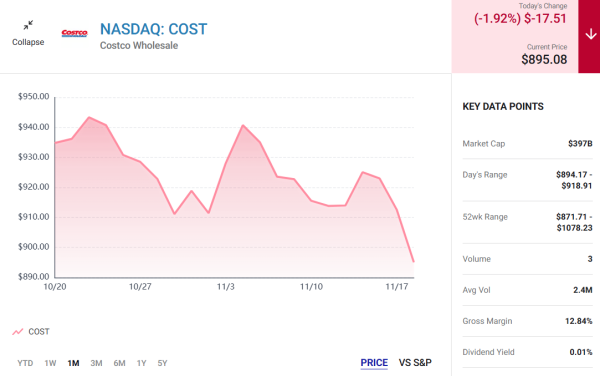
Yet, in recent months, Costco’s stock has not been immune to market volatility. The shares have lost approximately 11% over the past six months and are currently down around 15% from their 52-week high of $1,078. This decline has drawn attention from investors who are looking for opportunities in high-quality, resilient companies that may temporarily trade at lower prices.
While market pullbacks can be concerning, they also offer potential opportunities for disciplined investors. For Costco, this decline comes amid broader market fluctuations and concerns about consumer spending and inflation. Understanding whether this dip is a temporary market overreaction or a reflection of longer-term challenges is key to evaluating the stock.
Resilient Business Model and Growth
Costco’s enduring strength lies in its unique business model. The company relies on membership fees to generate a steady stream of recurring revenue, allowing it to keep prices competitive for shoppers. This membership model also drives customer loyalty and repeat business, which is particularly important during periods of economic uncertainty.
In addition to membership fees, Costco’s “treasure hunt” shopping experience encourages customers to make impulse purchases. Limited-time product offerings and constantly changing inventory create a sense of urgency, prompting shoppers to buy items they might otherwise delay or ignore. This approach not only boosts sales but also reinforces customer engagement, making Costco a destination rather than just a store.
Even though Costco’s growth has slowed to single-digit increases in recent years, this level of expansion remains impressive compared to many other retailers struggling to maintain sales amid higher prices and tighter household budgets. The company’s ability to consistently generate positive growth highlights its resilience and adaptability in challenging economic environments.
Valuation Considerations
Despite its operational strengths, Costco’s current valuation is a factor that investors cannot ignore. The stock trades at a price-to-earnings (P/E) ratio of around 50, reflecting high expectations for continued growth and profitability.
While investors are willing to pay a premium for stability and quality, high multiples leave little room for error. Any slowdown in growth or unexpected challenges could impact the stock’s performance and limit upside potential in the near term.
Investors considering Costco should weigh the stock’s premium valuation against its historical performance and the strength of its business model. The company’s high P/E ratio suggests that market participants are betting on continued success, making it essential for investors to maintain a long-term perspective if entering at current prices.
Consumer Appeal and Market Position
Costco’s appeal extends beyond its financial metrics. Its business model resonates with a broad range of consumers, from budget-conscious shoppers seeking value to higher-income individuals looking for quality products at reasonable prices. The combination of low pricing, exclusive membership benefits, and a constantly evolving product selection creates a unique shopping experience that few competitors can replicate.
This differentiation has helped Costco maintain market share and attract new customers, even during periods of economic stress. In a retail environment where many competitors struggle to retain loyalty, Costco’s approach has proven consistently effective, reinforcing its status as a market leader.
Investment Takeaways
For investors, Costco represents a high-quality growth stock with a proven track record of resilience. Its unique combination of membership fees, strategic pricing, and engaging shopping experience makes it a reliable option for long-term portfolio inclusion. However, the stock’s recent decline should not automatically trigger a purchase, especially given its high valuation.
Investors need to carefully consider whether the current dip aligns with their portfolio objectives and risk tolerance. Those with a long-term horizon may view this pullback as an opportunity to buy a high-quality company at a slightly lower price, while others may prefer to wait for further moderation in valuation or more favorable market conditions.
In summary, Costco’s recent decline highlights both the opportunities and challenges of investing in high-quality retail stocks. Brokers from Logirium continue to monitor the stock closely, assessing its performance against broader market trends, consumer behavior, and valuation metrics.
For disciplined investors, Costco’s combination of operational strength, brand loyalty, and resilient growth makes it a compelling long-term play, but careful consideration of valuation and market timing is essential.