


The AUD/USD exchange rate has been experiencing a persistent and significant downtrend, reaching a low of 0.5970, its lowest point since the onset of the COVID-19 pandemic in 2020. This article features a comprehensive exploration of the topic by the experts at Lesrouleaux.
The pair has been under heavy pressure, having dropped for three consecutive days, making the Australian dollar (Aussie) one of the worst-performing currencies among developed nations. Since peaking earlier this year, the AUD/USD has fallen by almost 7%, reflecting the broader economic and geopolitical challenges that have intensified its decline.
China and USA Trade War Escalates
The primary driver of the AUD/USD‘s downward trend can be traced back to the worsening trade relations between the United States and China. The trade war originally sparked by the U.S. President has entered a new, more aggressive phase.
In a significant move last week, the US President announced reciprocal tariffs, effectively applying pressure on global trading relations. The US imposed a 10% tariff on all goods from Australia, a surprising development considering the longstanding trade surplus the U.S. has with the Australian economy.
The US President justified this action by citing unfair trade practices, particularly Australia’s refusal to accept certain American agricultural exports, such as beef.
Australia, however, has chosen not to retaliate, with its government arguing that imposing reciprocal tariffs would be akin to imposing taxes on its citizens. Despite this stance, the broader trade war between the US and China has escalated.
The U.S. has also introduced additional tariffs on Chinese goods, pushing the tariffs on many Chinese imports to a significant 104%. This trade battle has now moved beyond the US-China relationship, directly affecting global economies, including Australia.
Impact on the Australian Economy
The ongoing trade war is particularly impactful for Australia, given the strong economic ties between the two nations, especially in terms of trade with China.
Australia is heavily reliant on Chinese imports, such as iron ore, natural gas, and coal, all of which are essential exports to the Chinese market. Any slowdown in the Chinese economy due to the ongoing tariff war will have a ripple effect on the Australian economy.
Despite these mounting economic pressures, China has made it clear that it intends to fight back against the US‘s trade policies. The Chinese government has vowed to continue its economic battles, and there have been hints of a stimulus package aimed at boosting the country’s economy.
Federal Reserve’s Impact on AUD/USD
The next major catalyst for the AUD/USD exchange rate will be the upcoming minutes of the last Federal Reserve meeting. As the US Federal Reserve maintains a focus on economic conditions, especially with inflation and labor market developments, its monetary policy decisions will have significant implications for the AUD/USD pair.
If the Fed remains hawkish–indicating more interest rate hikes in the future–the US dollar will likely strengthen, exacerbating the downtrend for the AUD/USD.
Conversely, if there are signals of a dovish stance or delays in future rate hikes, it could provide some relief to the Australian dollar, though this scenario seems less likely given the ongoing global trade tensions and the need for the US to address inflation concerns.
US-China tensions and the potential for additional tariffs could overshadow any positive monetary signals from the Fed, keeping the AUD/USD on a bearish trajectory.
AUD/USD Technical Analysis
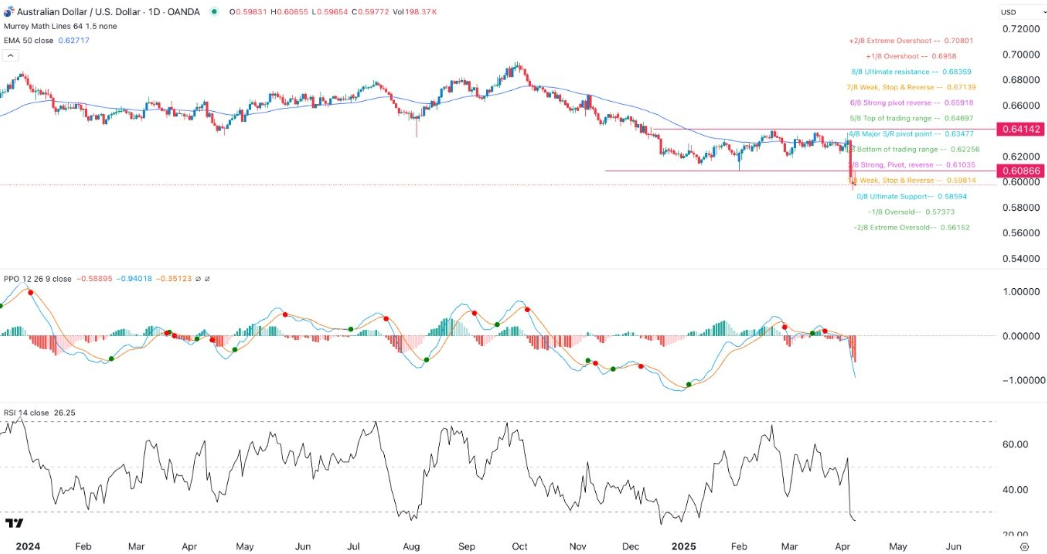
From a technical perspective, the AUD/USD pair shows clear signs of continued downward momentum. The daily chart highlights the substantial sell-off seen in recent days, with the exchange rate plummeting from the year-to-date high of 0.6415 to its current low of 0.5935. This marks the lowest level for the pair in years, emphasizing the severity of the current downtrend.

Additionally, the AUD/USD has fallen below the key support level at 0.6085, which was the low point on February 3rd. The pair has struggled to break above this level in recent sessions, signaling a strong bearish sentiment.
Further, the 50-day and 100-day Exponential Moving Averages (EMAs) have remained above the current price, acting as resistance levels that traders will continue to watch. The Relative Strength Index (RSI) is also pointing downwards, further confirming the weakness in the market.
Conclusion
In conclusion, the AUD/USD exchange rate is likely to continue its downward trajectory in the face of escalating US-China tensions, the ongoing trade war, and the potential for economic slowdowns in both China and Australia. The technical indicators also suggest that the pair is positioned for further losses, with traders focusing on key support levels.
US Federal Reserve policy decisions will be another important factor to watch, as they could influence the US dollar’s strength in the near term. However, barring any dramatic changes in the geopolitical landscape, the AUD/USD is expected to remain under pressure in the coming weeks.

COMTEX_465025772/2922/2025-04-29T03:57:17
This press release was originally published on this site