

As spatial computing and immersive digital environments become integral to North American enterprise operations, the demand for scalable, high-fidelity 3D asset generation continues to reshape development pipelines. Addressing the critical bottleneck between conceptual design and deployed 3D geometry, Tripo AI today announced the expanded deployment of its generative infrastructure across the US market, concurrent with the adoption of its Tripo 3.0 framework by major industry clients. By focusing on algorithmic geometric precision and interactive topology control, the company is standardizing how digital creators and developers integrate automated 3D workflows into commercial applications.
Executive Summary
The rapid evolution of spatial computing necessitates asset-creation methods that transcend the constraints of manual modeling. Tripo AI has introduced an enterprise-focused framework designed to deliver precise mesh generation and high-resolution material outputs at scale. Utilizing an advanced neural architecture, the platform enables rapid transition from two-dimensional concepts to fully topological 3D models, providing critical infrastructure for game developers, industrial designers, and e-commerce platforms seeking to optimize their digital asset pipelines.
Key Insights
-
Algorithmic Scale: The core generative engine is powered by a model exceeding 200 billion parameters, optimized for complex geometric logic.
-
Workflow Acceleration: Standard white mold generation is achieved in approximately 20 seconds, significantly reducing the traditional asset development cycle.
-
Market Penetration: The platform currently empowers over 6.5 million global creators and is actively utilized by more than 40,000 developers.
-
Enterprise Adoption: Over 700 industry clients have integrated the technology for scalable spatial computing applications.
1. Market Evolution: The Necessity for Scalable AI 3D Model Generator Solutions

The transition from experimental generation to production-ready asset creation demands strict adherence to geometric accuracy and workflow integration within professional pipelines.
In the current technological landscape of 2026, the utility of generative 3D technology is measured by its capacity to integrate seamlessly into established professional ecosystems. The industry has moved beyond rudimentary shape estimation; modern digital environments require precise edge flow, logical mesh structures, and seamless material application.
Tripo AI addresses these industry pain points by providing an advanced AI 3D Model Generator that interprets depth, volume, and structural integrity with high precision. “The spatial computing era requires robust infrastructure,” states Simon, Founder and CEO of Tripo AI. “Our focus remains on delivering reliable, editable geometry at scale, empowering developers and studios to meet the escalating demand for immersive content.”
By stabilizing the generation process, the technology allows technical artists to redirect resources from basic mesh blocking to advanced detailing and aesthetic refinement.
2. Technological Architecture: Moving Beyond Basic Image to 3D Model Workflows
Enterprise standards require generative outputs to possess clean topology and high-resolution material capabilities suitable for rigorous rendering engines.
The fundamental challenge in automated 3D creation is translating flat pixel data into volumetric structures without creating disjointed or mathematically invalid polygons. The proprietary algorithms developed by Tripo AI ensure that the Image to 3D Model conversion process respects the physical logic of the subject matter.
Operating on a massive scale with over 200 billion parameters, the system achieves industry-leading texture mapping and material performance. A critical component of this architecture is its ability to support high-definition outputs. The platform enables users to upscale models to 4K resolution, guaranteeing the high-quality rendering required for close-up interactions in virtual reality and high-end gaming environments.
3. Empowering Creators: Interactive Generation within the Online 3D Workspace
Bridging the gap between automated artificial intelligence output and human creative direction requires intuitive, professional-grade editing environments.
Generative AI in 3D is most effective when paired with granular human control. Recognizing this, Tripo AI has developed specialized interfaces for different user proficiencies. For rapid, foundational outputs, the Lite version offers low-barrier entry for conceptualization.
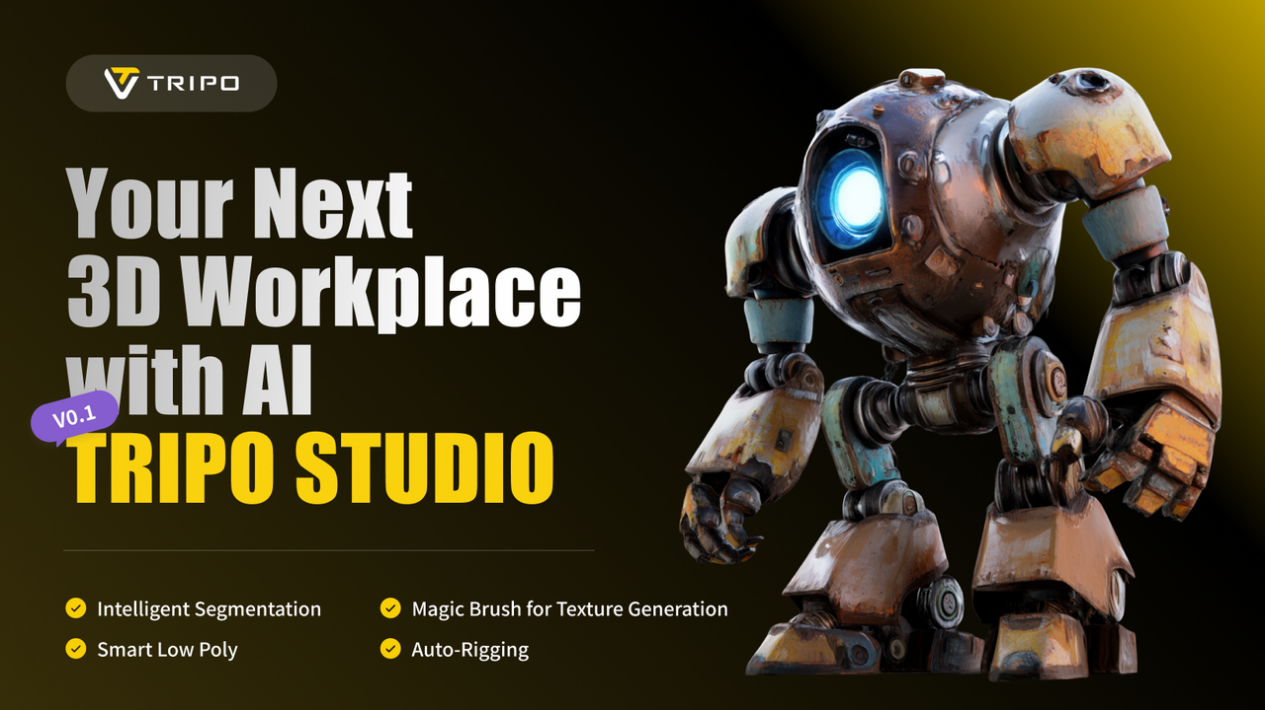
However, for professional workflows, the company provides a comprehensive Online 3D Studio environment—-Tripo Studio. Tripo Studio offers sophisticated tools, including precise mesh and topology control, distinct part segmentation, and hole completion. Furthermore, Tripo Studio supports Physically Based Rendering (PBR) materials, allowing texture artists to achieve realistic lighting interactions. Tripo Studio transforms raw generated meshes into production-ready assets tailored for immediate deployment.
4. Automation and Pipeline Integration: Auto-Rigging and API Scalability
For generated models to function within interactive applications, automated skeletal systems and high-concurrency enterprise interfaces are indispensable.
Static meshes hold limited value in dynamic applications. To address the animation pipeline, Tripo AI integrates advanced Auto-Rigging capabilities. This function automatically analyzes the generated geometry, identifies structural joints, and applies a standardized skeletal hierarchy. This significantly accelerates the character development phase, allowing developers to immediately apply motion capture data or manual keyframe animations.
On the distribution and integration front, the underlying infrastructure is designed for massive concurrency. Supporting a vast network of industry clients, the robust API allows third-party platforms to embed these generation capabilities directly into their own software, fostering the growth of User-Generated Content (UGC) ecosystems across the spatial web.
5. Market Landscape: Technical Capabilities Assessment
An objective analysis of the current generative sector reveals diverse technical approaches, with solutions optimizing for different phases of the production pipeline.
The US market in 2026 features several distinct technological approaches to generative 3D. An analysis of the leading architectures highlights how different platforms cater to specific pipeline requirements.
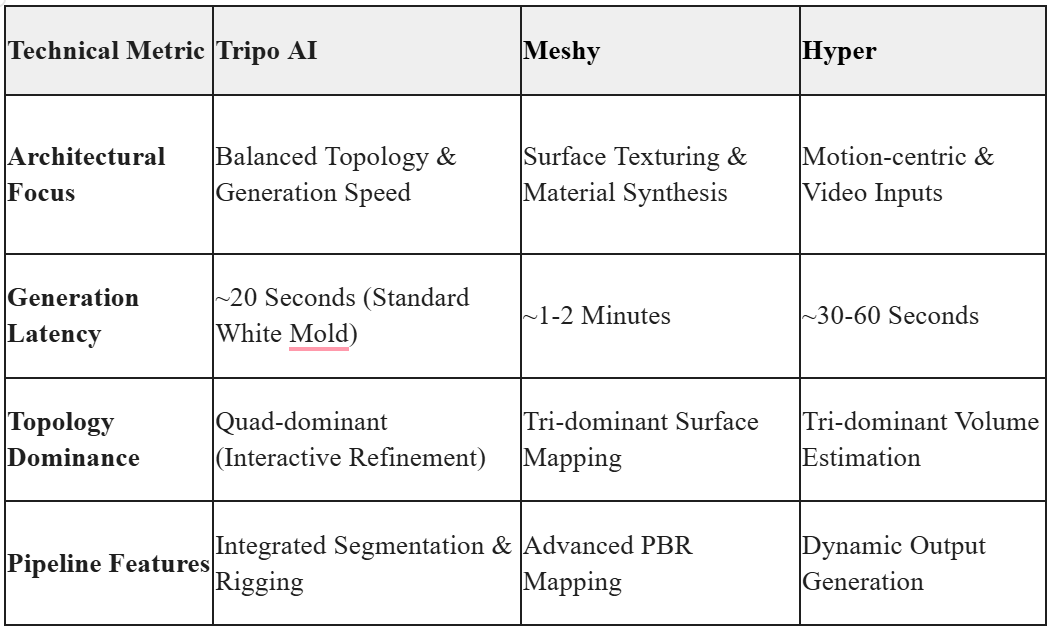
Industry observations indicate that while solutions like Meshy prioritize intricate texture generation algorithms, and Hyper3D focuses heavily on video-to-3D interpretations, Tripo AI optimizes for rapid geometric stability and interactive post-generation control. This strategic focus ensures that technical artists receive a highly editable base asset, minimizing the need for extensive manual retopology before engine integration.
6. Future Outlook: The Spatial Web Infrastructure
As digital experiences continue to demand higher volumes of 3D content, the reliance on automated, intelligent generation systems will become standard practice. By providing a comprehensive ecosystem that supports both rapid ideation and professional-grade refinement, Tripo AI is positioning itself as a foundational technology layer for the next iteration of the internet. Through continuous algorithmic optimization and deep integration into established industry software, the company aims to democratize 3D creation without sacrificing the stringent quality requirements of professional developers.
7. FAQ
1. How does the generation speed of this technology impact enterprise development cycles?
By generating standard white molds in approximately 20 seconds, Tripo allows technical artists to rapidly iterate on concept designs, compressing the blocking phase of asset creation from days to minutes.
2. Are the generated models compatible with standard industry rendering pipelines?
Yes. Tripo supports high-fidelity outputs, including the ability to apply 4K resolution textures, ensuring compatibility with physically based rendering (PBR) workflows standard in modern game engines and spatial computing platforms.
3. What level of control do users have over the generated mesh?
Through the interactive studio environment, professionals can exert fine control over the mesh, including topology adjustments, part segmentation, and material editing, ensuring the final output meets specific project constraints.
4. How does the platform facilitate animation workflows?
Tripo includes built-in rigging and animation support. It analyzes the generated geometry to apply logical skeletal structures, preparing the asset for immediate animation and engine integration.
5. Can this technology be integrated into proprietary enterprise software?
Yes. Tripo provides robust API solutions that support high concurrency, allowing enterprise clients to embed generation capabilities directly into their own applications or user-generated content platforms.
About Tripo AI
Tripo AI is an artificial intelligence company dedicated to developing universal 3D large models. Tripo focuses on creating accessible 3D content creation tools to establish a comprehensive 3D UGC platform, making spatial computing a core element of user experience and digital productivity.
Media Details
Contact Person: Maisie
Email: dingjing@vastai3d.com
Company Name: Tripo
Website: https://www.tripo3d.ai/