


The ongoing trade disputes and aggressive tariff strategies introduced by America’s current administration have reignited concerns across financial markets, especially among retail powerhouses like Walmart and Levi’s. As the dust settles around these newly imposed levies, investors and corporations alike are scrambling to assess the ripple effects across global supply chains, corporate earnings, and consumer sentiment.
What was once considered a passing policy threat now looms large as a serious economic risk. Vanguard LGC‘s financial strategist, Cee Oprah Lee, sheds light on the evolving tariff saga and its tangible implications for corporate America.
A Rapidly Shifting Tariff Landscape
On April 5, a baseline 10% tariff was enforced across a broad range of imports, escalating quickly to higher levels. By April 9, additional tariffs targeted roughly 60 countries, labeled as high-risk trade offenders by the administration. These include vital sourcing regions for American retailers — China now faces a combined 54% tariff, while Vietnam is hit with a staggering 46%.
To compound matters, China has retaliated with a 34% tariff on American goods. In response, the U.S. administration has threatened another 50% tariff escalation if reciprocal measures are not withdrawn. These tit-for-tat policies have intensified trade volatility and introduced substantial uncertainty into earnings forecasts and supply chain management.
Walmart’s Exposure to Tariff Shocks
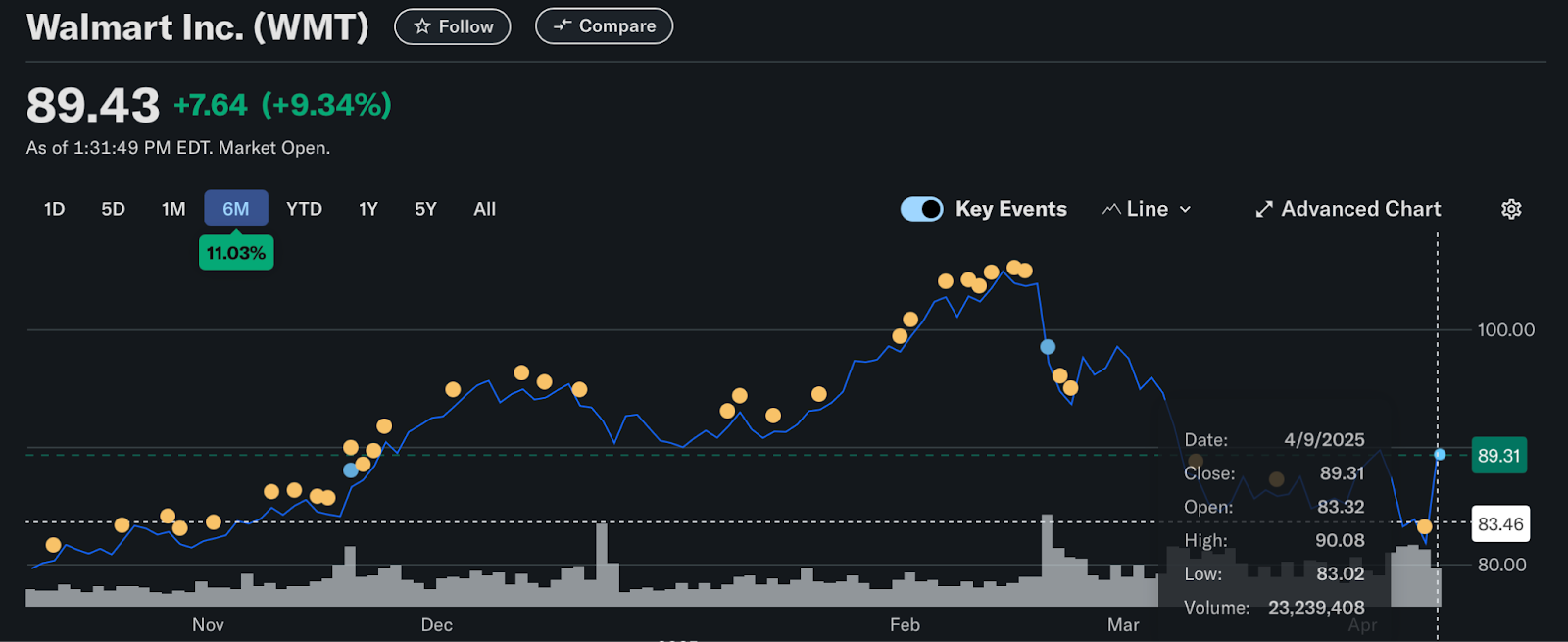 image from finance.yahoo.com
Walmart, known for its traditionally defensive posture in the market, now finds itself deeply vulnerable. Estimates indicate the retail giant imports approximately $105 billion worth of merchandise, much of it from countries now impacted by the new tariffs.
A leading retail analyst estimates that if incremental tariffs on China rise to 50%, and others remain at 20%, without accompanying fiscal relief such as tax cuts or deregulation, Walmart’s earnings per share (EPS) could suffer a 6% decline — triple the initial 2% estimate. This erosion of profit potential is particularly concerning given Walmart’s thin margins and competitive pricing strategy.
Since the tariff announcement, Walmart’s stock has declined by 8%, and its forward price-to-earnings ratio compressed from 36 to 31, suggesting waning investor confidence in the company’s ability to absorb rising import costs.
Consumer Sentiment and Competitive Pricing Pressures
Beyond direct import costs, Walmart faces a secondary challenge: shifting consumer sentiment. According to internal assessments, sentiment began to decline across income levels, geographic regions, and political affiliations, just as the price hikes were beginning to take effect.
Competitors, reacting more swiftly to rising costs, increased food prices by as much as 15%, particularly on items like avocados imported from Mexico. Walmart held off on similar hikes, which temporarily widened its price advantage but at the cost of margin compression. This strategy may not be sustainable if tariff pressures persist, forcing the company to eventually raise prices or endure continued profit erosion.
Levi’s Strategic Response: Scenario Planning and Supply Chain Risks
 image from finance.yahoo.com
Levi’s, another major player in the U.S. retail sector, has responded with caution. The company’s leadership has acknowledged the uncertainty surrounding the full impact of the tariffs and is actively engaged in scenario planning to develop mitigation strategies.
An internal task force has been assembled to monitor developments and advise on appropriate responses, including potential price adjustments.
Levi’s heavily relies on 130 facilities in China and 50 in Vietnam, placing its supply chain at the heart of the trade conflict. Despite the risks, the company has opted not to adjust its annual earnings outlook — at least for now.
This lack of visibility has left investors uneasy, though Levi’s quarterly earnings exceeded expectations by 10 cents per share, sparking a brief 10% rally in pre-market trading.
Still, analysts caution that this optimism may be short-lived. According to projections, if tariffs persist without a downturn in consumer demand, Levi’s could face a high single-digit hit to its 2026 earnings. Should demand falter, the impact could balloon to mid-teens percentages, posing a significant risk to long-term profitability.
Broader Economic and Market Implications
The trade war is not confined to company earnings. Many Wall Street analysts are sounding the alarm on broader macroeconomic risks. The U.S. consumer, long considered the backbone of economic growth, may be nearing a tipping point.
A senior strategist from a top-tier investment research firm predicts a 75% chance of a recession within the next three months, driven in large part by the cumulative effects of trade disruptions and DOGE-related fiscal constraints.
These estimates suggest that traditional models may be underestimating the real impact of global trade tensions. Slower growth, weaker corporate earnings, and declining investor confidence all point to a potentially rocky road ahead.
Conclusion: A Crossroads for Retail and Economic Resilience
The intensifying tariff measures represent more than a diplomatic tug-of-war; they are reshaping the financial outlook for America’s largest retailers and potentially signaling a broader economic slowdown.
Companies like Walmart and Levi’s are navigating cost uncertainties, shifting consumer behaviors, and strategic adaptation — all in real-time. While some short-term earnings surprises may offer temporary relief, the underlying challenges are structural and persistent.
With no clear end in sight to the trade standoff, U.S. retailers must rethink their global sourcing strategies, pricing frameworks, and long-term financial models. Meanwhile, investors and analysts alike are left reading between the lines of earnings calls and policy announcements, searching for clarity in an increasingly opaque environment.

COMTEX_465113922/2922/2025-05-01T12:36:44
This press release was originally published on this site