
Alderstone-Holdings geopolitical strategist Ron Weber analyzes how a single diplomatic proposal transformed April 7 from a potential catastrophe into modest gains for equity markets.
Markets spent six hours on April 7 pricing in a potential apocalypse before Pakistani Prime Minister Shehbaz Sharif’s ceasefire proposal arrived around 4 PM ET and changed everything. The S&P 500 reversed from down 1.2% to finish up 0.08% at 6,616.85, while the Nasdaq Composite closed up 0.10% at 22,017.85 after spending most of the session negative.
The reversal demonstrated how quickly market psychology shifts when binary outcomes face resolution. The President’s 8 PM ET deadline for Iran to reopen the Strait of Hormuz created unusual clarity about timing, allowing traders to position precisely for the moment of truth.
The Pakistan Proposal Details
Prime Minister Sharif requested that the United States postpone its deadline for two weeks while Iran opens the Strait of Hormuz “as a goodwill gesture” during that period. The framing allowed both sides a potential face-saving path to de-escalation.
The proposal reached the White House through diplomatic channels, with Pakistani officials emphasizing their country’s relationships with both Washington and Tehran, positioning them as neutral mediators. Pakistan’s nuclear weapons status and strategic location add geopolitical weight to its mediation efforts.
White House Press Secretary Karoline Leavitt responded that “the president has been made aware of the proposal, and a response will come.” That non-committal statement nonetheless signaled willingness to consider the option rather than outright rejection.
The Market’s Intraday Journey
Trading opened with the S&P 500 down 0.29%, and the Dow off 0.24% as overnight developments offered no progress toward resolution. By midday, losses deepened to 1.2% for the S&P as crude oil spiked toward $115 per barrel.
Technology stocks led declines with Apple falling 3.67% on foldable iPhone concerns and ARM Holdings dropping 5% after a downgrade. The Nasdaq underperformed as risk-off sentiment hit speculative growth names hardest.
Energy stocks rallied throughout the session, with Chevron up 2.20% and oil services companies posting even larger gains. The sector benefited from crude price spikes regardless of whether the crisis resolved peacefully or escalated into prolonged conflict.
The Final Hour Miracle
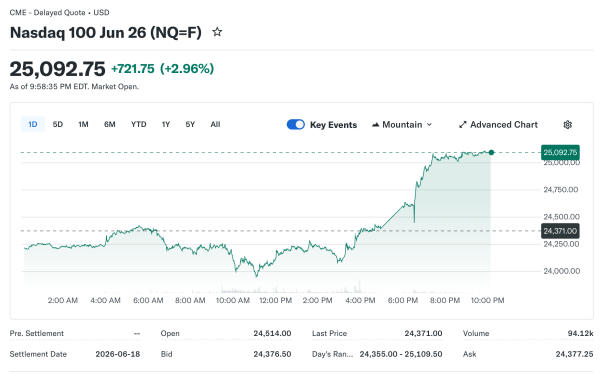
Markets that spent six hours in the red reversed course in approximately 30 minutes following the Pakistan news. Futures immediately spiked, carrying cash indices into positive territory during the final trading hour.
Volume surged as algorithms detected the headline and repositioned. High-frequency traders who had positioned for continued downside scrambled to cover shorts, amplifying the rally beyond what fundamental buyers alone would produce.
Treasury yields fell throughout the session as safe-haven demand increased, then reversed slightly as ceasefire hopes grew. The 10-year yield swung in a 20-basis-point range, reflecting extreme uncertainty about outcomes.
The Crude Oil Whipsaw
West Texas Intermediate opened around $112 per barrel and touched $115.85 intraday before the Pakistan news sent it plunging toward $110. The $5+ intraday range represented one of the most volatile crude sessions in recent years.
The price action demonstrated how quickly energy markets incorporated new information. Within minutes of the ceasefire proposal hitting wires, crude futures dropped 4% as traders reassessed supply disruption probabilities.
The settlement near $110 still reflected a significant geopolitical risk premium compared to pre-crisis levels around $80. Markets priced in the possibility that the two-week ceasefire merely postpones rather than resolves the conflict.
The US President Truth Social Effect
The US President’s morning Truth Social post warning that “a whole civilization will die tonight” sent stock futures lower in pre-market trading. The apocalyptic language exceeded typical negotiating rhetoric, suggesting a genuine willingness to follow through on threats.
Markets struggled to interpret whether the extreme language signaled firm resolve or maximum pressure tactics designed to extract concessions. The Vice President JD Vance interview with CBS News, attempting to walk back the rhetoric, added confusion.
By afternoon, traders concluded the threats represented negotiating tactics rather than locked-in decisions. The Pakistan proposal provided the president with a potential off-ramp that allowed claiming victory through diplomatic pressure while avoiding military escalation.
The Goldman Sachs Poll
A Goldman Sachs survey of 784 institutional clients conducted March 30 through April 1 showed growing concerns about private credit market vulnerabilities. Investors worried about underwriting standards, borrower sector stress, and how oil-driven shocks could ripple through illiquid market corners.
The poll predated Pakistan’s intervention but captured institutional anxiety about how a prolonged energy crisis could stress the financial system. Private credit markets lack the transparency of public bonds, making contagion risks difficult to assess.
The Strategic Implications
Pakistan’s successful mediation, if it holds, elevates the country’s diplomatic profile and demonstrates the value of maintaining relationships with both Western powers and Middle Eastern nations.
For markets, the episode reinforced that geopolitical crises often resolve through negotiation rather than conflict. The final hour rally reflected this historical pattern reasserting itself after six hours of fear-driven selling.
The S&P 500’s tiny 0.08% gain after such an eventful session demonstrates remarkable resilience. Going from down 1.2% to positive in 30 minutes represents an extraordinary psychological shift.