
The Japanese Yen (JPY) continues to trade with a mild negative bias against the US Dollar (USD) during the Asian session on Friday, though any significant depreciation appears limited. Market participants remain cautious as Japan’s fiscal concerns, combined with an upbeat global risk sentiment, weigh on the safe-haven JPY.
At the same time, dovish Federal Reserve (Fed) expectations constrain the USD, keeping the USD/JPY pair in a consolidative range. Broker Eins brokers deliver expert commentary and a complete overview of this topic for readers.
Tokyo CPI Boosts BoJ Tightening Bets
Government data released earlier today highlighted that the headline Consumer Price Index (CPI) in Tokyo increased 2.7% YoY in November. The measure excluding fresh food showed a slightly higher 2.8% YoY, whereas the core CPI, which excludes both fresh food and energy prices, remained steady at 2.8%.
These figures point to sticky inflation pressures in Japan and reinforce the argument for potential policy tightening by the Bank of Japan (BoJ). Despite these inflationary signals, the JPY struggles to gain traction as market participants remain hesitant amid Japan’s deteriorating fiscal position.
Reports suggest that Prime Minister Sanae Takaichi plans to expand the government’s stimulus program, which could involve issuing more Japanese government bonds (JGBs). Concerns over rising government debt supply have already pushed longer-dated JGB yields to two-decade highs, contributing to the JPY’s underperformance relative to the USD.
BoJ board member Asahi Noguchi emphasized that any monetary tightening would proceed incrementally, tempering speculation about an imminent rate cut. Coupled with a positive equity market tone, these factors continue to undermine the safe-haven appeal of the JPY.
USD/JPY Faces Mixed Headwinds
On the USD side, expectations of a dovish Fed act as a natural cap on USD gains. Recent commentary from Fed officials suggests another interest rate cut in December remains a live option, while speculations about a dovish successor to Jerome Powell further dampen USD momentum.
Meanwhile, geopolitical optimism continues to influence market sentiment. Russian President Vladimir Putin indicated that a revised US proposal could form the basis for a future Ukraine agreement, following comments from the US President suggesting a deal is close. This risk-on environment diminishes the safe-haven demand for JPY, indirectly supporting USD/JPY.
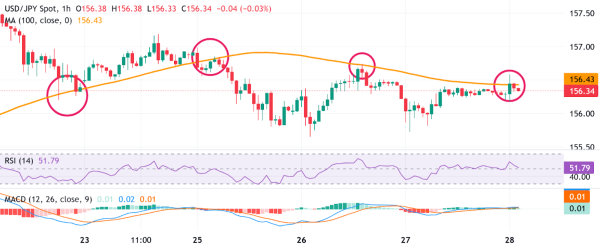
Technical Outlook: USD/JPY
From a technical perspective, the USD/JPY pair needs to gain acceptance above the 100-hour Simple Moving Average (SMA), currently situated around 156.45–156.50, to confirm potential upside momentum.
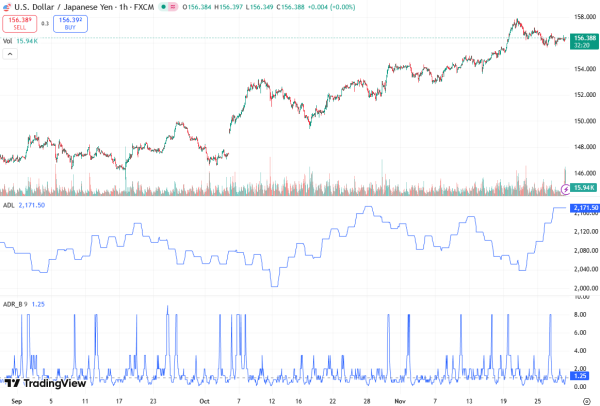
A sustained move above this level could open the door for the pair to reclaim 157.00, with the 157.45–157.50 zone serving as an intermediate resistance. If momentum persists, the pair could test the 158.00 mark, representing the highest level since mid-January.
On the downside, the 156.00 round figure may act as initial support, protecting against immediate declines. A breach could expose the 155.70–155.65 weekly swing low, and further selling pressure might push the pair toward the 155.00 psychological level. A convincing break below 155.00 would likely trigger renewed bearish interest and extend the one-week-old downtrend, suggesting caution for bulls.
Market Drivers: Fiscal Concerns and Sentiment
The Japanese Yen remains vulnerable as fiscal concerns overshadow Tokyo CPI optimism. The government’s economic package has reignited fears of ballooning debt and contributed to higher JGB yields, which historically weigh on JPY strength.
Meanwhile, global investor sentiment remains supportive of risk assets, reducing the safe-haven allure of the JPY. Hopes for lower US interest rates, along with optimism over a potential Ukraine peace deal, have tilted market behavior toward risk-on positioning, indirectly supporting the USD/JPY pair.
BoJ and Fed Policy Expectations
The Bank of Japan appears cautious, with board member Noguchi signaling a gradual path for monetary tightening. This contrasts with Fed expectations, where the market is increasingly pricing in dovish signals. The divergence in monetary policy outlooks creates a complex dynamic for USD/JPY, keeping the pair in a consolidative range.
While Tokyo CPI data reinforces the case for BoJ tightening, the fiscal backdrop and the risk-on global mood act as counterweights, limiting any sharp JPY appreciation.
Conclusion: Consolidation Likely to Persist
In summary, the Japanese Yen extends a consolidative price move against the USD, with downside risks appearing limited. Key factors influencing the JPY include sticky inflation in Japan, which reinforces BoJ tightening expectations, Japan’s fiscal concerns that are driving up JGB yields, upbeat global sentiment and geopolitical optimism that reduce safe-haven demand, and dovish Fed expectations, which help cap USD gains.
Technically, the USD/JPY pair must secure acceptance above 156.50 to target higher levels near 157.50–158.00, while support around 156.00–155.70 remains critical to prevent renewed weakness.
Overall, market participants should anticipate a range-bound consolidation, with the JPY struggling to attract buyers and the USD facing headwinds from Fed dovishness.