Anyone who spends time researching proprietary trading platforms eventually runs into the same question.
Before purchasing a challenge account or starting an evaluation, most traders do what people always do when money is involved: they search for reviews. Queries like “Upscale reviews,” “Upscale payouts,” or “does this prop firm actually pay?” appear regularly in trading forums and search engines.
That caution is understandable. The prop trading industry has grown quickly in recent years, and traders want to know whether a platform works in practice — not just in theory.
One way to approach the question is simply to look at the experiences traders themselves share publicly.
How Prop Trading Actually Works
For those unfamiliar with the model, proprietary trading platforms operate a little differently from traditional brokerage accounts.
Instead of trading only their own deposits, traders can access company capital once they demonstrate consistent performance. Usually the process begins with a challenge or evaluation stage where traders must reach certain profit targets while respecting drawdown limits.
If they complete the challenge successfully, they receive a funded account. From that point forward, the trader keeps a percentage of the profits generated on the account.
Upscale describes this structure in detail in its overview of the prop trading model
For traders who already have a working strategy, the attraction is obvious: access to larger capital without needing to risk significantly larger personal funds.
But for someone encountering prop trading for the first time, the most natural question remains: does anyone actually withdraw profits?
A Trader Who Withdrew $41,000
One of the more widely discussed trader stories published by Upscale is the experience of a young trader known as Wade.
According to the case study published on the platform’s blog, Wade managed to withdraw $41,000 in profits within less than a year of trading funded accounts.
Interestingly, Wade’s approach was not particularly exotic. He relied primarily on fairly standard technical tools — RSI indicators, Fibonacci levels, and straightforward chart analysis — while maintaining a disciplined risk-reward ratio.
Over time, that consistency allowed him to scale his trading results and receive several payouts. According to the story, part of the profits even went toward buying a car, with further investments planned.
Stories like this often circulate in trading communities because they illustrate something important: profitable trading strategies do not always require complicated systems — but they do require discipline.
Another Path Into Prop Trading
Not every trader enters the industry through success.
Another story published by Upscale describes the experience of a trader named Anton, who initially encountered fraudulent trading services before discovering the prop trading model.
After switching to a prop trading structure and focusing on strict risk management, Anton was eventually able to pass the evaluation stage and begin trading funded accounts.
Stories like these appear fairly often across the trading world. Many traders spend years experimenting with different approaches before eventually finding a framework that allows them to manage risk more consistently.
What Trader Payouts Usually Look Like
While stories about large withdrawals attract attention, the reality of trading is usually more incremental.
Many traders begin with smaller withdrawals as they gain experience with funded accounts.
In trading communities, payout confirmations can often be found, for example:
- $600 after roughly two weeks of trading following a successful challenge
- $1,801 from a second funded account, once the trader increased position size
- $5,600 after about two to three weeks of active trading
In some cases traders share payout confirmations along with certificates issued by the platform.
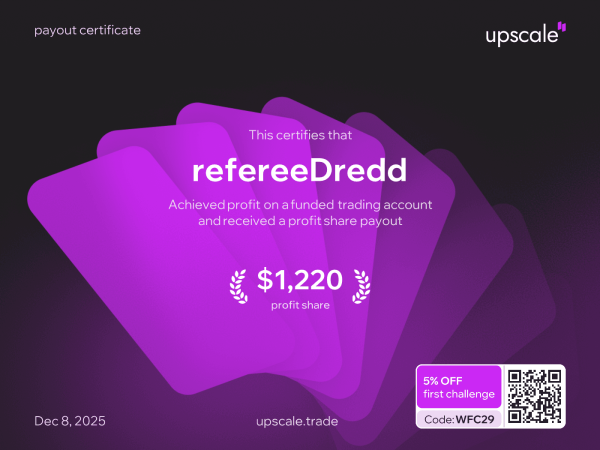
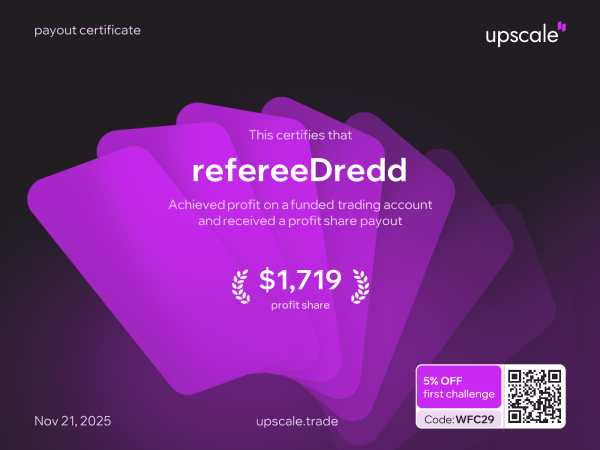
These smaller payouts rarely make headlines, but they often tell the more realistic story of how trading results accumulate over time.
A Broader Look at Trader Outcomes
Upscale has also collected multiple trader stories in a broader overview of funded traders and their results:
Looking across these cases reveals a fairly typical pattern seen across many prop firms:
- early withdrawals often range between $500 and $1,000
- intermediate traders may reach $3,000 to $10,000
- more experienced traders sometimes withdraw $30,000 or more
According to payout confirmations shared within the trading community and transactions visible through the platform’s withdrawal interface, the total amount distributed to traders has already exceeded $400,000.
Taken together, these results suggest that trader outcomes tend to develop gradually as traders gain experience with funded accounts.
The Role of Trading Communities
Another place traders often look for verification is inside trading communities.
In these groups traders discuss their experiences openly — sharing screenshots of withdrawals, talking about challenge results, and comparing strategies.
These discussions are rarely polished or promotional. Instead they reflect the everyday experiences of traders working through the challenges of the market.
Over time, those conversations create something that is often more persuasive than marketing material: a collective record of trader experiences.
Why Access to Capital Matters
For many traders, the real advantage of prop trading lies in access to capital.
A strategy that generates modest returns on a small personal account can produce significantly larger results when applied to a funded account.
The analysis often stays the same.
The strategy stays the same.
What changes is the scale.
And in trading, scale can make a substantial difference.
Looking at Prop Trading Realistically
Like any trading model, prop trading is not a guaranteed path to profits. Many traders fail challenges, strategies stop working, and markets change constantly. But examining real trader stories — both large and small — can help provide a clearer understanding of how the model works. For traders researching platforms such as Upscale, the most useful information rarely comes from marketing claims alone. Instead it comes from the experiences traders share with each other over time. And as more traders participate in the ecosystem, those shared experiences gradually shape the reputation of the platforms themselves.