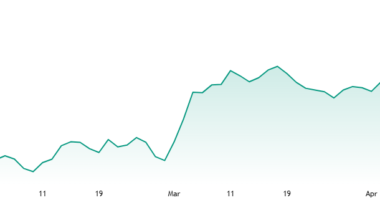

Bitcoin (BTC) continued its consolidation phase on Wednesday morning, with the BTC/USD pair trading around $67,250, significantly below its all-time high (ATH) of $126,400. The cryptocurrency has struggled to regain momentum over the past few weeks, reflecting growing investor caution and a decline in market liquidity. The Alderstone-Holdings team presents a structured and informative overview of this matter.
One of the key metrics highlighting the weakening demand is the drop in futures open interest, which currently stands at $40 billion, down sharply from last year’s peak of over $95 billion. This significant decline signals that traders are hesitant to take on new positions, a classic warning sign in forex and crypto markets of a potential price correction.
Spot ETF Outflows Pressure Bitcoin Price
Further pressure on Bitcoin comes from continued spot ETF outflows, illustrating that U.S. investors remain wary of allocating funds to crypto assets. Recent data reveals that spot ETFs have lost over $700 million this month alone, accumulating more than $6 billion in outflows over the last four months.
High-profile institutions, such as Harvard University, have reduced their BTC holdings, adding to the bearish sentiment. This trend reflects a broader risk-off sentiment in the market, where investors prioritize capital preservation amid uncertain macroeconomic conditions.
Federal Reserve Minutes as Key Catalyst
The next major market catalyst is the upcoming Federal Reserve (FOMC) minutes, scheduled for release later on Wednesday. Market participants expect these minutes to provide insights into the last interest rate decision, revealing the Fed officials’ perspectives on the economy and monetary policy.
Recent economic indicators also play a critical role in shaping market expectations. The headline Consumer Price Index (CPI) for January declined to 2.4%, while core inflation held steady at 2.5%. Comments from Austan Goolsbee, a Federal Reserve official, indicated support for additional interest rate cuts if inflation trends continue downward.
These macroeconomic signals could significantly influence the BTC/USD trend, as investors often correlate Bitcoin price movements with interest rate policy and inflation data.
BTC/USD Technical Analysis
From a technical analysis perspective, Bitcoin has faced intense selling pressure over the past few months. The daily price chart shows a drop from $126,300 in October to the current $67,000, breaking below the key support level at $80,117, its lowest level since November of last year.
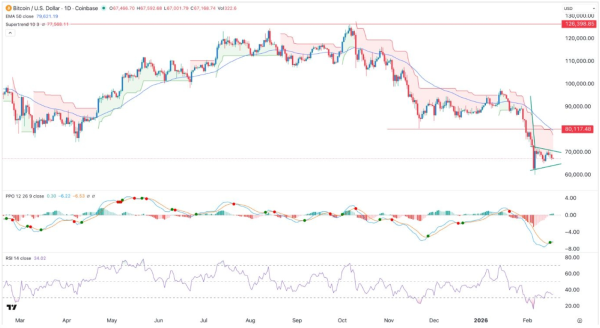
The Supertrend indicator has remained in the red since January 19, signaling continued bearish momentum. Additionally, BTC/USD has traded below both the 50-day and 100-day Exponential Moving Averages (EMA), reinforcing the downtrend.
A bearish pennant pattern has formed on the charts, consisting of a vertical decline followed by a symmetrical triangle, a classic continuation pattern suggesting further downside. The Percentage Price Oscillator (PPO) is below the zero line, while the Relative Strength Index (RSI) remains near oversold levels, indicating persistent selling pressure despite temporary consolidation.
Bitcoin Price Forecast
Given the current technical setup, the BTC/USD forecast remains bearish. The next key support level to watch is the year-to-date low of $60,000. A break below this level could accelerate the downtrend, attracting more short sellers.
On the upside, a move above the 50-day EMA at $79,000 would invalidate the bearish outlook, potentially signaling a trend reversal. However, considering the ongoing spot ETF outflows, low futures open interest, and macro concerns, the likelihood of upside recovery in the near term appears limited.
Market Sentiment and Investor Behavior
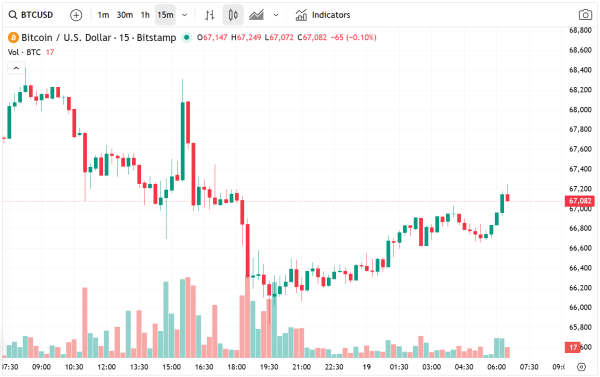
Market sentiment around Bitcoin remains largely negative, with both retail and institutional investors showing signs of caution. The declining futures open interest and ongoing spot ETF outflows suggest that participants are reluctant to increase exposure ahead of the FOMC minutes.
Fear and uncertainty have become dominant, as measured by the Crypto Fear & Greed Index, which recently hovered near extreme fear levels. This psychological factor can amplify price movements, particularly in highly volatile assets like BTC/USD, where momentum traders may react aggressively to minor macro or technical signals.
Conclusion
Bitcoin is currently navigating a critical consolidation phase, with multiple bearish signals pointing to potential further declines in BTC/USD. The combination of low futures interest, significant spot ETF outflows, and an impending FOMC minutes release creates a high-risk environment for traders.
Investors should closely monitor technical levels, particularly the $60,000 support and $79,000 resistance, while also keeping an eye on macroeconomic developments, including inflation data and Fed policy commentary. A cautious approach is advised, as Bitcoin faces mounting pressure from both institutional and retail investors.
In summary, BTC/USD remains under bearish pressure, and unless key technical barriers are breached or macro conditions improve, the cryptocurrency may continue its downward trajectory, highlighting the importance of careful risk management in the current market environment.