

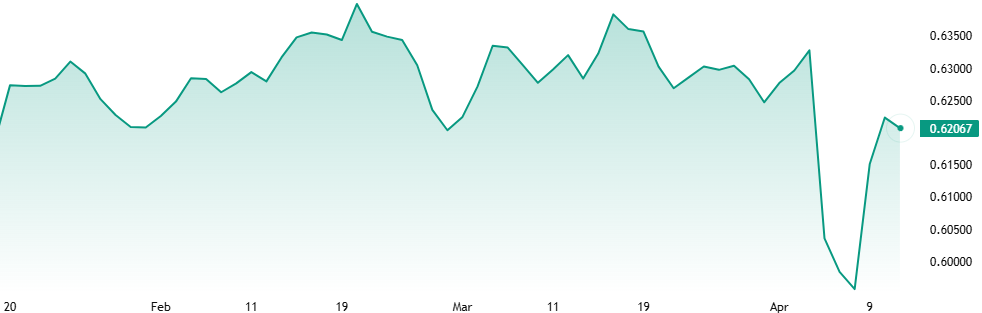
The Australian Dollar (AUD) saw a notable increase on Thursday, reaching the 0.6240 zone in the US trading session. This move marked a continuation of its recent recovery, driven largely by broader weakness in the US Dollar (USD). NordaLueur‘s analysts offer a well-rounded evaluation of this topic in the article.
The USD faced renewed pressure as global trade tensions escalated, and the Federal Reserve (Fed) issued cautious commentary, raising concerns over slower growth and persistent inflationary pressures. Despite this recovery, the technical landscape for the AUD/USD remains bearish, with key resistance levels capping further gains.
AUD/USD’s Rise and USD Weakness
The AUD/USD pair surged toward the 0.6240 mark on Thursday, following a notable decline in the US Dollar Index (DXY). The DXY, which measures the USD’s performance against a basket of major currencies, slid to multi-month lows near the 101.00 area, signaling increased weakness in the Greenback.
This move came in the wake of the White House’s confirmation of a significant 145% tariff on Chinese goods, coupled with more cautious commentary from Fed officials.
The impact of these developments was significant: investors appeared to be reassessing the broader macroeconomic outlook, particularly the effects of escalating trade tensions with China and the Federal Reserve’s stance on inflation. The tariff increase is expected to exacerbate price pressures, dampening consumer sentiment and potentially hindering employment growth.
At the same time, the Fed’s cautious rhetoric added to concerns about persistent inflation, especially following the release of softer inflation data earlier in the week.
Trade Tensions and Inflationary Concerns
The primary driver behind the US Dollar’s weakness was the escalating trade dispute between the US and China. The 145% tariff imposed on Chinese imports remains a key point of contention, despite temporary pauses on some measures. Analysts are concerned that this escalation could further harm global trade flows, particularly between the two largest economies in the world.
Additionally, the March Consumer Price Index (CPI) report indicated a significant deceleration in both core and headline inflation, which fell to multi-year lows.
The softer inflation data fueled speculation that the Fed might need to adopt a more dovish policy stance to combat the potential negative impact of tariffs on inflation and economic growth. Initial jobless claims also ticked higher, adding to concerns about the cooling US labor market.
In contrast, the Australian Dollar benefited from the weakening USD. However, the Australian economy faces its challenges, particularly due to its reliance on Chinese demand for its exports, which is being stifled by the trade war. Despite the AUD’s short-term recovery, the macroeconomic outlook for Australia remains fragile.
Technical Analysis of AUD/USD
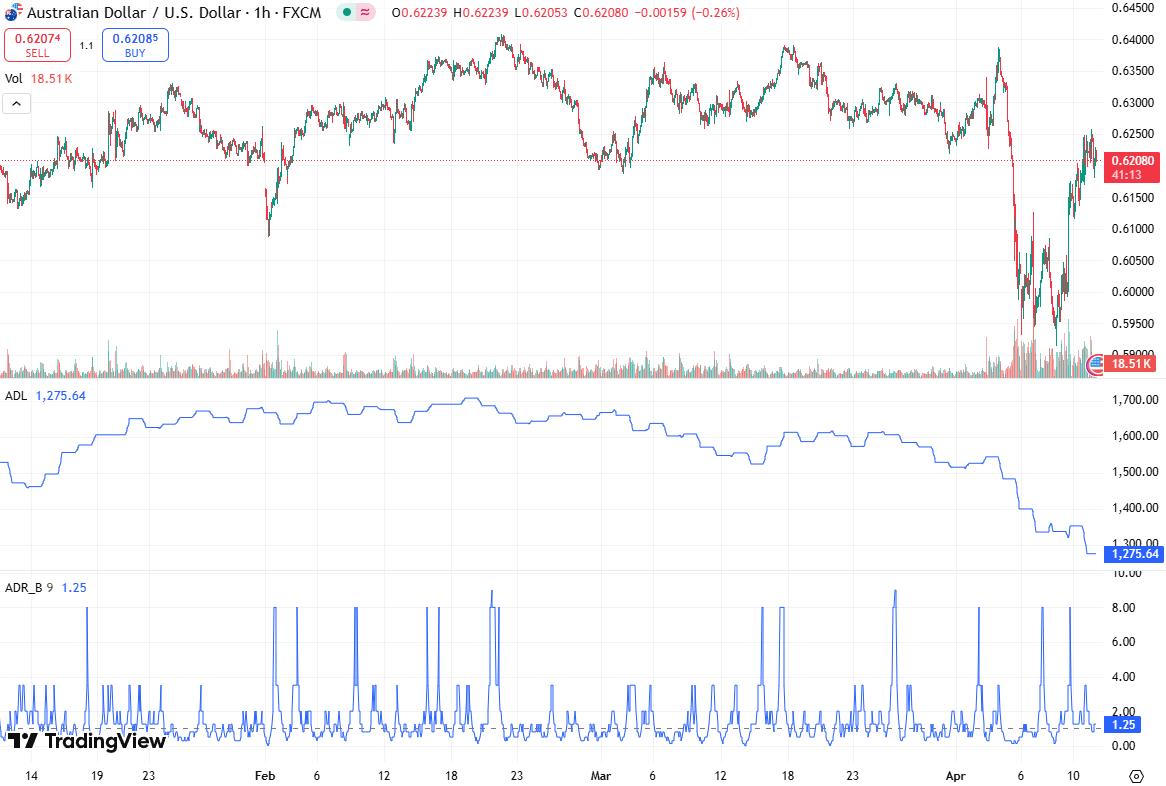
While the Australian Dollar gained ground against the US Dollar, the technical structure for AUD/USD remains predominantly bearish. Despite the Thursday rally, the pair continues to face significant resistance from key moving averages, which are limiting further upside potential.
The Moving Average Convergence Divergence (MACD) indicator, a commonly used momentum tool, remains in bearish territory, printing red bars. This signals that downside pressure persists despite the recent rally.
The Relative Strength Index (RSI), another momentum indicator, currently sits at 48, indicating neutral momentum with a slight bearish tilt. These indicators suggest that any upward movement may be short-lived unless further bullish catalysts emerge.
The Stochastic %K is also hovering at 37.57, suggesting that the market is in oversold territory but is not yet showing a strong signal for a reversal. Similarly, the Commodity Channel Index (CCI) is at -51.65, reinforcing the neutral-to-bearish outlook, with no strong directional bias.
In addition to these momentum indicators, the key moving averages continue to pose significant resistance. The 20-day, 100-day, and 200-day Simple Moving Averages (SMAs) all slope downward, positioning above the current price action. This downward-sloping setup indicates that any further gains will likely face strong selling pressure near these levels.
The 30-day Exponential Moving Average (EMA) and the Simple Moving Average (SMA), which sit around the 0.6230-0.6250 zone, further suggest that resistance will be encountered in this range.
Despite the AUD’s recovery, these technical factors point to the likelihood of a capped upside, with the pair potentially facing a retest of lower levels if it fails to break through these resistance zones. The combination of bearish momentum indicators and the presence of key moving averages acting as a ceiling for the price action suggests that the recovery may struggle to gain significant traction.
Conclusion
In conclusion, the Australian Dollar’s climb above the 0.6200 mark against the US Dollar can be attributed to the broader USD weakness, driven by escalating trade tensions and a cautious Federal Reserve. While the short-term outlook for the AUD appears slightly more optimistic, with the pair extending gains amid trade-related developments and softer inflation data, the technical picture remains bearish.

COMTEX_465096923/2922/2025-05-01T02:22:10
This press release was originally published on this site