
The AUD/USD currency pair is showing signs of bearish divergence as traders anticipate critical Australia jobs data. After the release of a strong wage growth report, the pair remained largely unchanged, highlighting market caution ahead of upcoming economic releases.
On Wednesday, the AUD/USD exchange rate was trading at 0.7075, slightly below the year-to-date high of 0.7146, reflecting consolidation after recent gains. This article from Alderstone-Holdings offers readers a clear and thorough explanation of the subject.
Australia Jobs Numbers: Key Data in Focus
The Australian Bureau of Statistics (ABS) released the latest wage price index, which plays a significant role in guiding the Reserve Bank of Australia (RBA)’s monetary policy. According to the report, wage growth continued in the fourth quarter, with the headline wage price index rising 0.8% from the previous quarter. This translated into an annual increase of 3.4%, surpassing economists’ expectations of 3.3%.
Stronger wage growth typically indicates that consumer spending will remain robust, supporting inflation in the medium term. For forex traders, this suggests that the AUD/USD could maintain upward pressure, as stronger domestic wages often lead to higher demand for the Australian dollar.
The market is now shifting its attention to the upcoming ABS jobs report, scheduled for Thursday. Analysts expect the participation rate to increase from 66.7% in December to 66.8% in January. Meanwhile, the unemployment rate is projected to edge higher from 4.1% to 4.2%, and the employment change is forecasted at +20,000, up from the previous 65.2k.
Australia’s labor market has demonstrated resilience in recent months, and any deviation from these forecasts could trigger volatile moves in the AUD/USD pair.
Global Influences on AUD/USD
The AUD/USD exchange rate will also react to developments in the United States, including the release of Federal Reserve (Fed) minutes on Wednesday. These minutes will provide insight into policy deliberations, offering clues about future interest rate decisions.
Additionally, the US trade balance, manufacturing output, and industrial production data are key metrics that could influence short-term volatility in the pair. For traders and investors, these macro indicators are crucial in determining risk appetite and the direction of carry trades involving the AUD, which is historically sensitive to US monetary policy.
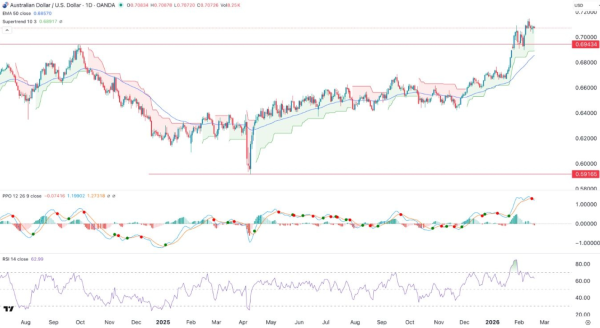
AUD/USD Technical Analysis: Bearish Divergence Forms
From a technical perspective, the AUD/USD pair has been consolidating in the daily timeframe, trading around 0.7042, slightly below its year-to-date high of 0.7150. The pair continues to hold above the Supertrend indicator, signaling a longer-term bullish bias, while also remaining above the key support level at 0.6945, which was last tested in September of the previous year.
However, a closer examination of momentum indicators suggests caution for long positions. Both the Relative Strength Index (RSI) and the Percentage Price Oscillator (PPO) have formed a bearish divergence, indicating potential downside pressure. The PPO lines have experienced a bearish crossover, while the RSI has slipped below the overbought threshold, signaling a weakening bullish trend.
The emergence of bearish divergence suggests that sellers could dominate in the near term, with a target support level around 0.6945. Conversely, a decisive move above the resistance level of 0.7150 would invalidate the bearish outlook, potentially resuming the prior uptrend.
Trading Implications
Given the combination of fundamental and technical factors, traders should remain alert for volatility surrounding the Australia jobs report and US economic releases. Key strategies include:
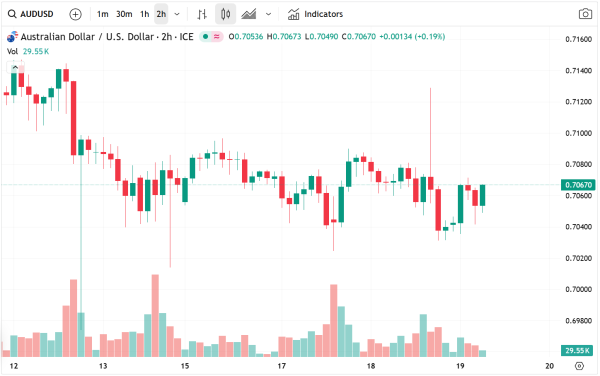
Monitoring key levels: Watch the support at 0.6945 and resistance at 0.7150 for breakout or reversal signals.
Watching momentum indicators: The RSI and PPO bearish divergence could indicate early signs of trend reversal.
Incorporating fundamental data: Strong wage growth and resilient labor market numbers may temporarily strengthen the AUD, while weaker employment data could fuel a decline.
Managing risk: Due to potential spikes in volatility, employing stop-loss orders and position sizing is critical for mitigating losses.
Forex market participants should also consider the broader macroeconomic environment, including RBA policy expectations and global risk sentiment, which can amplify movements in the AUD/USD pair.
Conclusion
The AUD/USD forex signal currently signals caution as a bearish divergence forms ahead of the Australia jobs report. While wage growth remains solid and supports the Australian dollar, momentum indicators highlight potential downside risks in the near term. The key support level at 0.6945 will likely determine the next major move, while a break above 0.7150 could negate bearish technical signals.
Traders should closely monitor both domestic economic indicators from Australia and macro developments in the United States, including the Fed minutes and trade data, to gauge the AUD/USD trajectory. Combining technical analysis with fundamental insights will be essential for navigating the market in the current environment.