The AUD/USD currency pair surged to its highest level since November 17, climbing toward 0.6512, a notable jump from this month’s low of 0.6420. The move came after the Australian Bureau of Statistics (ABS) released a stronger-than-expected inflation update, reducing expectations of an imminent RBA interest rate cut.
Combined with mixed US economic data, the market saw renewed bullish momentum for the Australian dollar. The team at Axstera presents a structured and insightful explanation of the matter in this article.
RBA Interest Rate Cut Odds Fall as Inflation Stays Hot
The latest data from the ABS revealed that Australia’s inflation pressures remain persistent. While headline CPI was flat on a month-over-month basis, the annual inflation rate rose from 3.6% in September to 3.8% in October, surpassing the expected 3.6%. This hotter-than-forecast reading suggests price pressures are still elevated, potentially keeping the Reserve Bank of Australia (RBA) in a more cautious position.
Two core inflation measures also pointed to underlying strength, with trimmed mean inflation rising slightly from 3.2% to 3.3% and weighted mean inflation increasing from 3.3% to 3.4%, indicating persistent underlying price pressures in the economy.
These metrics exclude volatile components such as food and energy, and both remain well above the RBA’s official 2% inflation target. Persistent underlying inflation lowers the likelihood that the central bank will move ahead with the additional rate cuts many traders had been speculating about earlier this year.
The bank previously held the cash rate at 3.6% during its last meeting after implementing three rate cuts earlier in 2024. With inflation stubbornly high, policymakers now have little incentive to ease further, and this shift in expectations supported the Australian dollar in FX markets.
US Economic Data Adds Momentum to AUD/USD
The AUD/USD also found support from the US side of the equation. Key US economic data released on Wednesday indicated softening activity in parts of the American economy. Notably, durable goods orders fell to 0.5% in September, down sharply from 3.0% previously. Such a decline typically signals weakening demand for long-lasting manufactured items, a bearish sign for the broader economic outlook.
However, the labor market produced a mild positive surprise. Initial jobless claims came in at 216,000, improving from 223,000 the previous week. While this indicates continued labor-market resilience, it was not enough to offset the downward momentum in durable goods.
Overall, the mixed data helped push the US dollar slightly lower, fueling additional upside for AUD/USD.
AUD/USD Technical Analysis: Rebound Faces Major Resistance
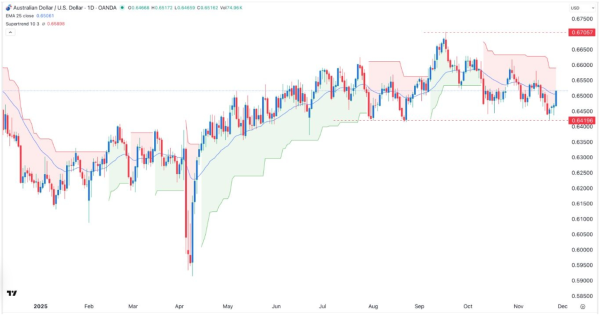
On the daily chart, the AUD/USD pair shows a strong rebound from its earlier lows, climbing as high as 0.6515. This recovery is significant because the 0.6420 region represented an important multi-month support level. It marked the pair’s lowest point in July and August and aligns with the lower boundary of a broad head-and-shoulders pattern, a widely recognized bearish reversal structure.
Despite the recent bullish correction, the pair still trades below the Supertrend indicator, which typically signals continued downward momentum in the broader trend. As long as the price remains beneath this dynamic resistance, the technical bias leans toward a resumption of the downtrend.
Key Technical Levels to Watch
The key technical levels to watch include support at 0.6420, which serves as a critical multi-month floor and the neckline of the head-and-shoulders pattern; a break below this zone could unleash deeper selling pressure.
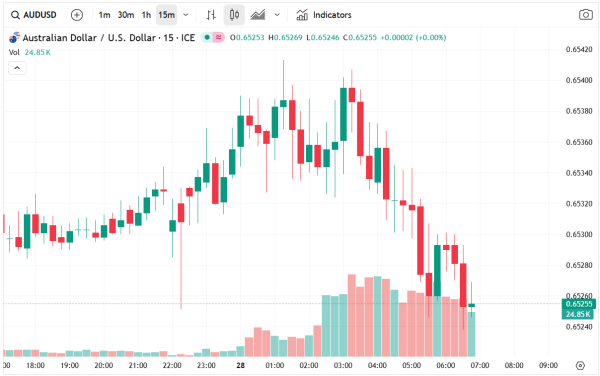
On the upside, resistance sits at 0.6515, created by Wednesday’s sharp spike, while the 0.6600 level stands as both a psychological barrier and a major threshold, one that could invalidate the current bearish outlook if price successfully breaks above it.
Should bullish momentum push the pair above 0.6600, it would likely signal a shift in market sentiment and potentially open the door for a sustained rally. However, failure to clear nearby resistance zones could result in renewed selling pressure dragging the pair back toward 0.6420.
Outlook: Cautious RBA, Soft US Data, and Technical Headwinds
The current environment surrounding the AUD/USD pair reflects the interplay between shifting rate cut expectations, evolving inflation trends, and softer US macro data. Australia’s hotter CPI print has effectively reduced the likelihood of near-term policy easing, supporting the Aussie dollar. Meanwhile, inconsistent US indicators have taken some shine off the US dollar index, aiding the pair’s upside.
From a technical standpoint, the rebound is impressive but still vulnerable. Traders will be watching whether the pair can sustain gains above 0.6515 or if bearish pressure returns to test 0.6420 again. In the absence of major catalysts during the holiday-thinned sessions, price action could remain choppy but range-bound.